Quick Facts & Repertoire Highlights
1. Introduction: The 2/4 Meter of Traditional Polkas
In traditional Irish music, polkas represent a distinct dance form characterized by a 2/4 meter and a buoyant rhythmic pulse.
While 19th-century European dance music influenced the style, polkas became integrated into Irish regional playing, particularly in Sliabh Luachra — the musical region centred on the borderlands of east Kerry and north-west Cork, with connections into west Limerick. Fiddlers such as Pádraig O'Keeffe, Denis Murphy, and Julia Clifford, alongside accordion players like Jackie Daly, are widely associated with this regional repertoire, which features finger cuts, open-string drones, and concise melodic articulation.
This guide ranks the 25 most represented Irish polkas based on tune-set and recording data from The Session.
2. Interactive Practice Checklist & Comparison Table
Track your progress as you learn each tune. Check off tunes to save your progress locally in your browser.
My Polka Repertoire Progress
| Learned | Rank | Tune Name | Key | Difficulty | Session Sets | Recordings |
|---|---|---|---|---|---|---|
| #1 | Dmajor |
Beginner | 483 | 64 | ||
| #2 | Dmajor |
Beginner | 448 | 48 | ||
| #3 | Adorian |
Beginner / Intermediate | 385 | 57 | ||
| #4 | Adorian |
Beginner / Intermediate | 283 | 54 | ||
| #5 | Dmajor |
Beginner / Intermediate | 273 | 42 | ||
| #6 | Gmajor |
Beginner | 248 | 70 | ||
| #7 | Dmajor |
Beginner | 219 | 44 | ||
| #8 | Amajor |
Beginner / Intermediate | 194 | 52 | ||
| #9 | Amixolydian |
Intermediate | 184 | 52 | ||
| #10 | Gmajor |
Beginner | 159 | 52 | ||
| #11 | Bminor |
Intermediate | 139 | 42 | ||
| #12 | Adorian |
Intermediate | 114 | 23 | ||
| #13 | Amajor |
Intermediate | 98 | 24 | ||
| #14 | Dmajor |
Beginner | 94 | 32 | ||
| #15 | Dmajor |
Beginner / Intermediate | 94 | 9 | ||
| #16 | Gmajor |
Intermediate | 83 | 37 | ||
| #17 | Adorian |
Intermediate | 82 | 34 | ||
| #18 | Dmajor |
Beginner | 76 | 41 | ||
| #19 | Dmajor |
Beginner | 75 | 52 | ||
| #20 | Adorian |
Intermediate / Advanced | 75 | 22 | ||
| #21 | Dmajor |
Beginner | 72 | 32 | ||
| #22 | Gmajor |
Intermediate | 71 | 29 | ||
| #23 | Dmajor |
Intermediate | 70 | 41 | ||
| #24 | Gmajor |
Intermediate | 69 | 21 | ||
| #25 | Gmajor |
Intermediate | 66 | 36 |
3. Detailed Breakdown of the Top 25 Session Polkas
Below is an overview of each tune, including playing advice, landmark album recordings, and common set transitions:
#1
 John Ryan's
Dmajor • Meter: 2/4 • Level: Beginner
Included in the soundtrack to the film Titanic (“An Irish Party in Third Class”), John Ryan's Polka is a D major tune associated with the Sliabh Luachra repertoire. Its scalar movement in 2/4 meter is straightforward to follow.
Focus on clear rhythmic articulation and steady tempo. Keep finger movement light through the scalar passages in the second strain.
Landmark Recordings:Denis Murphy & Julia Clifford – The Star Above the Garter (1969); Planxty – Cold Blow and the Rainy Night (1974)
Common Session Pairings:- Played after: Denis Murphy's (104 sets), Forty-Two Pound Cheque, The (75 sets), Britches Full Of Stitches, The (72 sets)
- Played before: Denis Murphy's (48 sets), Bill Sullivan's (27 sets), Egan's (26 sets)
#2
Egan's
Dmajor • Meter: 2/4 • Level: Beginner
Set in D major, Egan's Polka (sometimes titled The Kerry Polka) features 448 set appearances in the database. Its melody moves across the upper register with straightforward 2/4 phrasing.
Maintain a steady lift on the primary beats. Use light finger cuts on repeated notes to define the phrasing.
Landmark Recordings:Traditional session repertoire
Common Session Pairings:- Played after: Britches Full Of Stitches, The (63 sets), John Ryan's (26 sets), Maggie In The Woods (22 sets)
- Played before: Britches Full Of Stitches, The (69 sets), John Ryan's (60 sets), Maggie In The Woods (30 sets)
#3
Ballydesmond, The
Adorian • Meter: 2/4 • Level: Beginner / Intermediate
One of the tunes commonly grouped as the Ballydesmond Polkas, this A dorian melody is part of the Sliabh Luachra repertoire. Denis Murphy and Julia Clifford recorded a three-polka set on The Star Above the Garter (1969) that features tunes from this group.
Pay attention to the G natural in the A dorian scale. Keep finger cuts clean without disrupting the underlying 2/4 pulse.
Landmark Recordings:Denis Murphy & Julia Clifford – The Star Above the Garter (1969); Sliabh Notes – Sliabh Notes (1995)
Common Session Pairings:- Played after: Ballydesmond, The (98 sets), Ballydesmond, The (50 sets), Egan's (19 sets)
- Played before: Ballydesmond, The (245 sets), Ballydesmond, The (30 sets), Ballydesmond, The (22 sets)
#4
Ballydesmond, The
Adorian • Meter: 2/4 • Level: Beginner / Intermediate
Another tune included among the Ballydesmond Polkas, this A dorian melody frequently follows or precedes other polkas in the group during session play.
Highlight the rhythmic phrasing in the second strain. Fiddlers often employ open-string drones to reinforce the modal center.
Landmark Recordings:Denis Murphy & Julia Clifford – The Star Above the Garter (1969); Patrick Street – Cornerboys (1993)
Common Session Pairings:- Played after: Ballydesmond, The (245 sets), Ballydesmond, The (19 sets), Murroe, The (11 sets)
- Played before: Ballydesmond, The (50 sets), Ballydesmond, The (43 sets), John Ryan's (27 sets)
#5
Denis Murphy's
Dmajor • Meter: 2/4 • Level: Beginner / Intermediate
Associated with the Sliabh Luachra fiddler Denis Murphy (1910–1974), this D major polka is paired in the database with other D major or G major polkas.
Focus on clear note separation on repeated D notes. Keep the tempo steady and avoid accelerating through the second strain.
Landmark Recordings:Denis Murphy & Julia Clifford – The Star Above the Garter (1969); The Bothy Band – Out of the Wind Into the Sun (1977)
Common Session Pairings:- Played after: John Ryan's (48 sets), Egan's (19 sets), Maggie In The Woods (11 sets)
- Played before: John Ryan's (104 sets), Forty-Two Pound Cheque, The (77 sets), Bill Sullivan's (17 sets)
#6
Maggie In The Woods
Gmajor • Meter: 2/4 • Level: Beginner
A G major polka featuring 248 set appearances and 70 commercial album recordings in the database. Its two-part melody moves predictably across the G scale.
Use light articulation on whistle or short bow strokes on fiddle to outline the 2/4 dance pulse.
Landmark Recordings:The Chieftains – The Chieftains 9: Boil the Breakfast Early (1979); Sharon Shannon – Sharon Shannon (1991)
Common Session Pairings:- Played after: Egan's (30 sets), John Ryan's (18 sets), Denis Murphy's (14 sets)
- Played before: John Ryan's (32 sets), Britches Full Of Stitches, The (30 sets), Egan's (22 sets)
#7
Britches Full Of Stitches, The
Dmajor • Meter: 2/4 • Level: Beginner
A D major polka featuring a two-part structure with repeated melodic figures. Its clear phrasing provides a useful exercise in 2/4 rhythm.
Keep ornaments concise to preserve the clarity of the melodic line.
Landmark Recordings:Paddy Cronin – The House on the Hill (1975); Jackie Daly & Kevin Burke – Eavesdrop (1981)
Common Session Pairings:- Played after: Egan's (69 sets), Bill Sullivan's (45 sets), Maggie In The Woods (30 sets)
- Played before: John Ryan's (72 sets), Egan's (63 sets), Bill Sullivan's (61 sets)
#8
Bill Sullivan's
Amajor • Meter: 2/4 • Level: Beginner / Intermediate
Also listed under alternative titles including Mickey Chewing Bubble Gum, this A major polka is associated in some collections with Sliabh Luachra musician Terry “Cuz” Teahan. It features high register leaps in the second strain.
Maintain accurate intonation on C# and G# in the upper octave. Keep bass accents steady on accordion or concertina.
Landmark Recordings:Kevin Burke – In Concert (1999); Sliabh Notes – Along the Blackwater (2002)
Common Session Pairings:- Played after: Britches Full Of Stitches, The (61 sets), John Ryan's (27 sets), Egan's (18 sets)
- Played before: Britches Full Of Stitches, The (45 sets), John Ryan's (14 sets), Maggie In The Woods (10 sets)
#9
Maids Of Ardagh, The
Amixolydian • Meter: 2/4 • Level: Intermediate
An A mixolydian polka associated with Munster tradition. The contrast between C sharp and G natural produces a distinct mixolydian modal character.
Focus on smooth finger transitions between C# and G natural to maintain intonation and modal clarity.
Landmark Recordings:Jackie Daly – Many a Happy Hour (1995); De Dannan – Star-Spangled Molly (1981)
Common Session Pairings:- Played after: Murroe, The (47 sets), Toormore, The (43 sets), Egan's (12 sets)
- Played before: Bill Sullivan's (13 sets), Denis Murphy's (7 sets), Britches Full Of Stitches, The (6 sets)
#10
Rakes Of Mallow, The
Gmajor • Meter: 2/4 • Level: Beginner
A G major tune adopted into the polka repertoire, The Rakes of Mallow features a scalar two-part melody in 2/4 meter.
Maintain even scalar fingerings and clear rhythmic separation on the opening G-B passages.
Landmark Recordings:The Chieftains – The Chieftains 3 (1971)
Common Session Pairings:- Played after: Egan's (26 sets), Maggie In The Woods (19 sets), Rose Tree, The (8 sets)
- Played before: John Ryan's (12 sets), Rose Tree, The (10 sets), Dark Island, The (7 sets)
#11
Ievan Polkka
Bminor • Meter: 2/4 • Level: Intermediate
A Finnish polka melody that has been adopted into some Irish traditional session repertoires. Set in B minor, it provides a minor-mode contrast to D and G major polkas.
Maintain strict tempo control in B minor. Use concise articulation on lower register notes.
Landmark Recordings:Kevin Crawford – Carrying the Tune (2012)
Common Session Pairings:- Played after: Charlie Harris's (36 sets), Bill Sullivan's (8 sets), Britches Full Of Stitches, The (8 sets)
- Played before: Jessica's (45 sets), Egan's (10 sets), Britches Full Of Stitches, The (8 sets)
#12
Ballydesmond, The
Adorian • Meter: 2/4 • Level: Intermediate
An A dorian tune associated with the Ballydesmond Polka group, played alongside other polkas from the same family.
Maintain smooth transitions between the first and second strains, keeping the rhythmic emphasis grounded.
Landmark Recordings:Denis Murphy & Julia Clifford – The Star Above the Garter (1969); Patrick Street – Cornerboys (1993)
Common Session Pairings:- Played after: Ballydesmond, The (22 sets), Ballydesmond, The (10 sets)
- Played before: Ballydesmond, The (98 sets), Ballydesmond, The (19 sets)
#13
Jessica's
Amajor • Meter: 2/4 • Level: Intermediate
Composed by West Limerick accordion player Mick Mulcahy for his daughter, Jessica's Polka is an A major tune in modern session repertoire.
Practice register shifts carefully to maintain fluid fingerwork through the high-register passages.
Landmark Recordings:Mick, Louise & Michelle Mulcahy – Notes From the Heart (2005); Sharon Shannon – Out the Gap (1994)
Common Session Pairings:- Played after: Ievan Polkka (45 sets), I'll Buy Boots For Maggie (12 sets)
- Played before: None recorded in top transitions
#14
Dashing White Sergeant, The
Dmajor • Meter: 2/4 • Level: Beginner
A D major dance melody common to Scottish and Irish traditional repertoire, played for set and ceilidh dancing.
Keep the dotted rhythms springy without rushing beat transitions.
Landmark Recordings:Jimmy Shand – The Legendary Jimmy Shand (1960)
Common Session Pairings:- Played after: None recorded in top transitions
- Played before: Spootiskerry (19 sets), Tripping On The Mountain (8 sets), Davy-Davy Knick-Knack (6 sets)
#15
Forty-Two Pound Cheque, The
Dmajor • Meter: 2/4 • Level: Beginner / Intermediate
A D major Sliabh Luachra polka that is paired in the database with Denis Murphy's Polka and John Ryan's Polka.
Emphasize the primary downbeats with subtle bow pulse or bellows articulation to establish the dance rhythm.
Landmark Recordings:Julia Clifford – The Humours of Ballydaly (1977); Matt Molloy & Sean Keane – Contentment Is Wealth (1985)
Common Session Pairings:- Played after: Denis Murphy's (77 sets)
- Played before: John Ryan's (75 sets)
#16
Knocknaboul, The
Gmajor • Meter: 2/4 • Level: Intermediate
A G major polka associated with Sliabh Luachra, titled after the townland of Knocknaboul in County Kerry.
Ensure clean ornament execution in the second strain while maintaining a steady 2/4 pace.
Landmark Recordings:Paddy Cronin – Kerry's Own Paddy Cronin (1977); Jackie Daly – Sliabh Luachra Accordion (1977)
Common Session Pairings:- Played after: Scartaglen, The (31 sets), Forde's (7 sets)
- Played before: None recorded in top transitions
#17
Tralee Gaol
Adorian • Meter: 2/4 • Level: Intermediate
An A dorian polka titled after Tralee Gaol in County Kerry. Its minor modal structure provides contrast when grouped with major-key polkas.
Use subtle ornamentation and controlled finger rolls to highlight the modal cadences.
Landmark Recordings:Boys of the Lough – In the Golden Vanity (1976); Jackie Daly & Kevin Burke – Eavesdrop (1981)
Common Session Pairings:- Played after: O'Neill's (30 sets), Maggie In The Woods (7 sets), Britches Full Of Stitches, The (7 sets)
- Played before: After The Battle Of Aughrim (10 sets), Maggie In The Woods (8 sets), Rose Tree, The (7 sets)
#18
Rose Tree, The
Dmajor • Meter: 2/4 • Level: Beginner
A D major tune known in Irish and British traditional music, played as a polka in session settings.
Maintain an even, relaxed pace to let the melodic arch of the phrase speak clearly.
Landmark Recordings:The Chieftains – The Chieftains 2 (1969)
Common Session Pairings:- Played after: Rakes Of Mallow, The (10 sets), Tralee Gaol (7 sets)
- Played before: Rakes Of Mallow, The (8 sets), Rattlin' Bog, The (7 sets), Dark Girl Dressed In Blue (7 sets)
#19
I'll Tell Me Ma
Dmajor • Meter: 2/4 • Level: Beginner
A D major melody shared between traditional song and instrumental polka repertoires across Ireland and Britain.
Focus on clear 2/4 rhythm to support ensemble playing and sing-along settings.
Landmark Recordings:The Clancy Brothers & Tommy Makem – In Person at Carnegie Hall (1963)
Common Session Pairings:- Played after: Mairi's Wedding (13 sets), Star Of The County Down, The (6 sets), Egan's (6 sets)
- Played before: None recorded in top transitions
#20
Tolka, The
Adorian • Meter: 2/4 • Level: Intermediate / Advanced
Composed by Dónal Lunny and named after the Tolka River in Dublin, this A dorian polka was recorded by Planxty on The Woman I Loved So Well (1980).
Pay close attention to rhythmic precision and clean articulation through the chromatic turns in the second strain.
Landmark Recordings:Planxty – The Woman I Loved So Well (1980); Patrick Street – Patrick Street (1986)
Common Session Pairings:- Played after: Denis Doody's (28 sets), Glen Cottage, The (8 sets), Little Diamond, The (7 sets)
- Played before: None recorded in top transitions
#21
Rattlin' Bog, The
Dmajor • Meter: 2/4 • Level: Beginner
A D major melody associated with the traditional cumulative song of the same name, played instrumentally as a polka.
Maintain a driving, steady tempo so accompaniment instruments can maintain a solid 2/4 backing pulse.
Landmark Recordings:The Dubliners – At Home with The Dubliners (1969)
Common Session Pairings:- Played after: Britches Full Of Stitches, The (13 sets), Maggie In The Woods (13 sets), Egan's (9 sets)
- Played before: Egan's (12 sets), Maggie In The Woods (7 sets), John Ryan's (6 sets)
#22
Memories Of Ballymote
Gmajor • Meter: 2/4 • Level: Intermediate
A G major polka associated with the South Sligo tradition, titled after the town of Ballymote.
Focus on smooth phrasing and concise fingered cuts rather than aggressive bowing accents.
Landmark Recordings:Fred Finn & Peter Horan – Music from Coleman Country (1972); Dervish – Harmony Hill (1993)
Common Session Pairings:- Played after: Rooskey, The (11 sets), Gurteen Cross, The (11 sets)
- Played before: Gurteen Cross, The (35 sets), Happy, The (9 sets)
#23
Little Diamond, The
Dmajor • Meter: 2/4 • Level: Intermediate
A D major polka featuring note runs and triplet turns, played on accordion and fiddle in Munster sessions.
Practice triplet passages slowly to ensure finger independence before bringing up to full session speed.
Landmark Recordings:Jackie Daly – Many a Happy Hour (1995)
Common Session Pairings:- Played after: Ballydesmond, The (6 sets)
- Played before: Murroe, The (43 sets), Tolka, The (7 sets), Ray's Classic (6 sets)
#24
Scartaglen, The
Gmajor • Meter: 2/4 • Level: Intermediate
A G major polka associated with the village of Scartaglen in Sliabh Luachra, included in regional Kerry fiddle and accordion repertoires.
Highlight the 2/4 lift of the Scartaglen style with short, well-articulated bow strokes.
Landmark Recordings:Denis Murphy, Julia Clifford & Padraig O'Keeffe – Kerry Fiddles (1977); Sliabh Notes – Gleanntán (1999)
Common Session Pairings:- Played after: Top Of The Maol, The (11 sets)
- Played before: Knocknaboul, The (31 sets)
#25
Ballydesmond, The
Gmajor • Meter: 2/4 • Level: Intermediate
A G major polka associated with the Ballydesmond group, played in combination with the A dorian tunes from the same family.
Shift smoothly into G major when transitioning from A dorian tunes, maintaining consistent tempo.
Landmark Recordings:Denis Murphy & Julia Clifford – The Star Above the Garter (1969); Kevin Burke – Up Close (1984)
Common Session Pairings:- Played after: Ballydesmond, The (43 sets), Ballydesmond, The (30 sets), John Ryan's (17 sets)
- Played before: Ballydesmond, The (10 sets), Glenside, The (8 sets), Ievan Polkka (6 sets)
4. Playing Tips, Articulation & Performance Style for Polkas
Polka Rhythm & Style
- Rhythmic Lift & Phrasing: In Sliabh Luachra polka style, emphasis and lift are created through subtle finger cuts, note separation, and rhythmic weight within the 2/4 bar rather than uniform mechanical accents.
- Articulation: Fiddlers often use short, distinct bow strokes, while accordion and whistle players use clean cuts and taps to outline the meter without blurring the tune.
- Set Structure: Polkas are commonly played in sets of two or three tunes, often maintaining tempo while shifting key (for instance, from A dorian into D major or G major).
- Tempo Management: Polkas benefit from a steady, grounded beat that supports dancers and accompaniment without rushing beat transitions.
5. Frequently Asked Questions (FAQ)
What distinguishes a polka from a reel or jig in Irish music?
Reels are in 4/4 or 2/2 time and jigs are in 6/8 time, whereas polkas are in 2/4 meter. Polkas typically feature shorter two-phrase structures with clear 2/4 cadences.
Which instruments are strongly associated with Irish polka traditions?
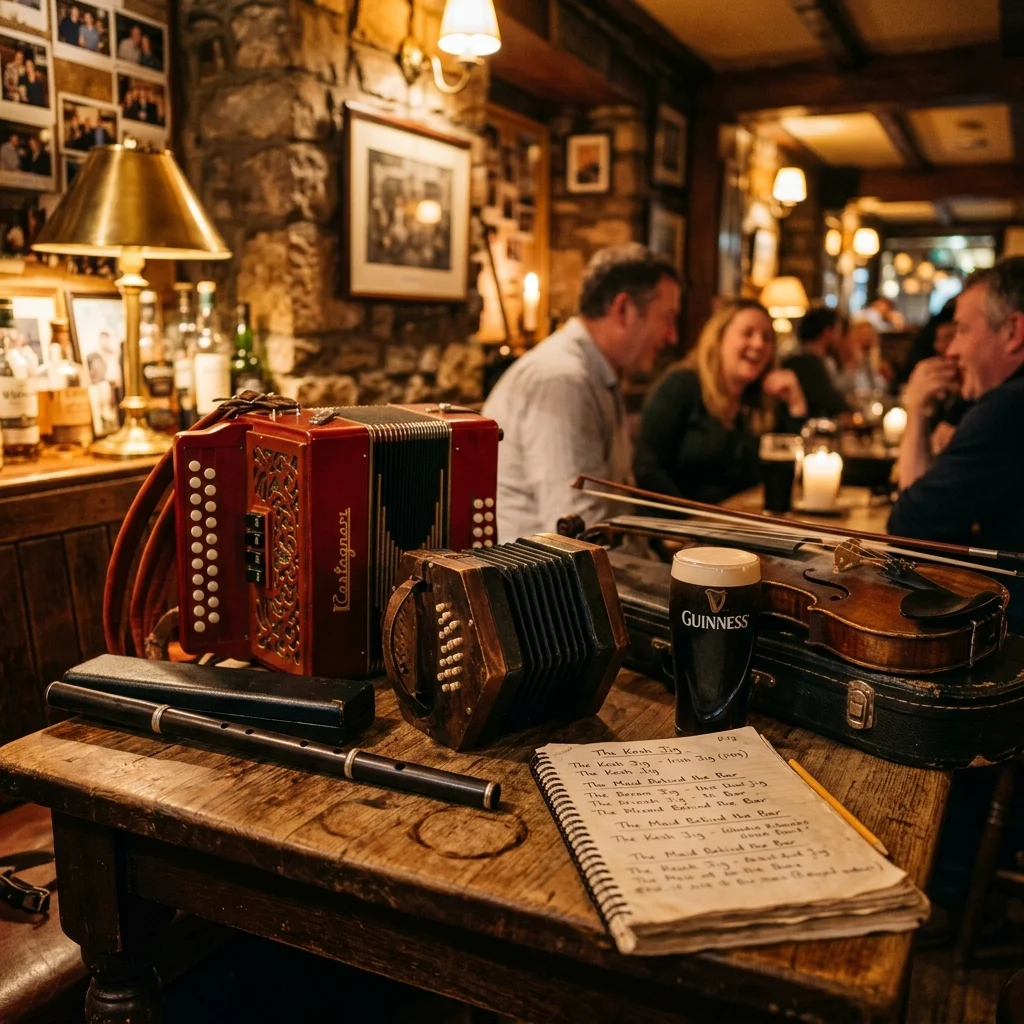
The button accordion, melodeon, concertina, and fiddle are central to Sliabh Luachra polka tradition. Tin whistle, wooden flute, banjo, and uilleann pipes are also widely used.
How are polka sets commonly structured in sessions?
Polkas are commonly played in sets of two or three tunes, repeating each tune two or three times. Sets often pair tunes of related regional association or complementary modal centers.
Are polkas suitable for beginner musicians?
Many polkas feature clear scalar motion and concise two-part structures, making them accessible entry points for learning 2/4 timing and ornamentation.
6. Conclusion & Next Steps
Polkas form a distinct branch of Irish traditional music. Learning these 25 tunes provides a solid foundation for playing polka sets in sessions.