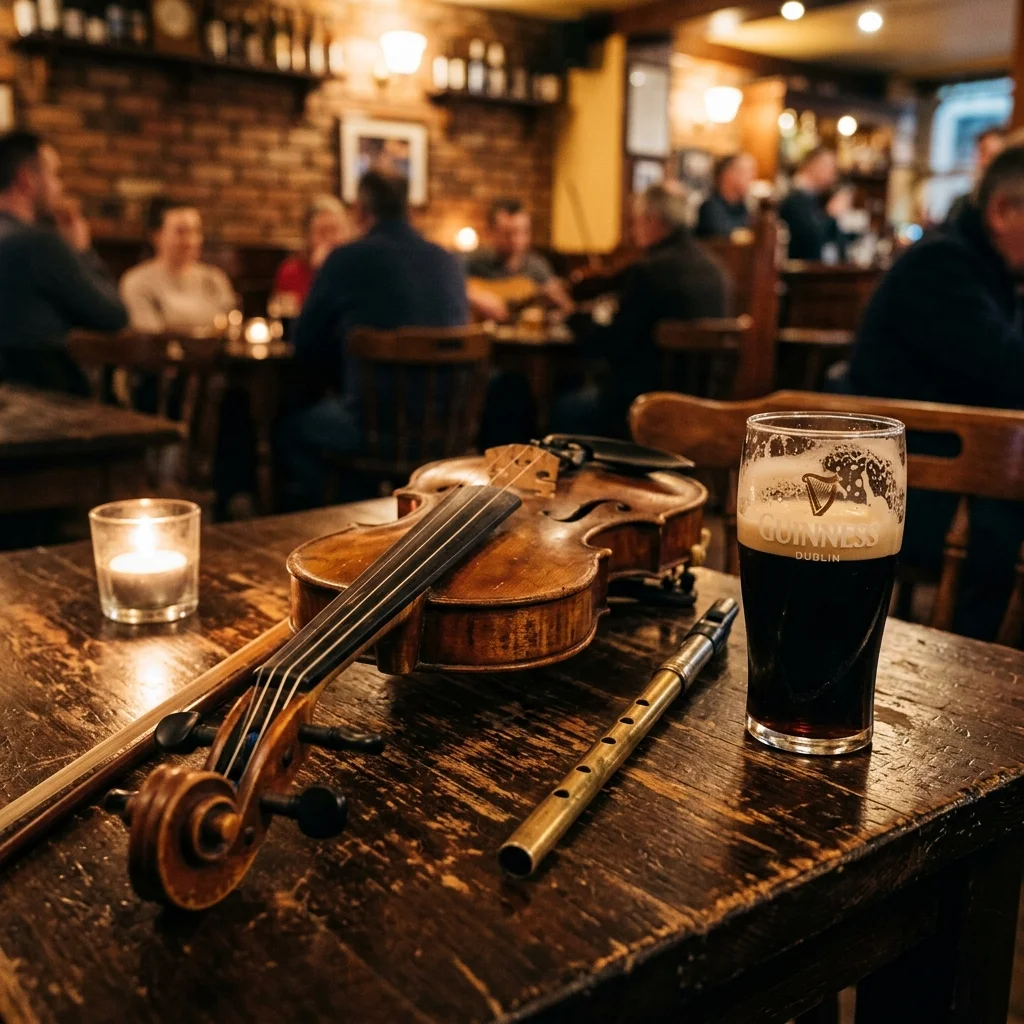
At a Glance: The Morrison's Footprint
Table of Contents
- Introduction: A Staple of the Repertoire
- What Is Morrison's Jig? (Key, Rhythm, & Meter)
- Historical Roots: James Morrison and Sligo Heritage
- The Aliases of Morrison's
- ABC Notation & Interactive Sheet Music
- Recordings & Artists: The Landmark Albums
- Morrison's in Sessions: Playback Statistics
- What Tunes Usually Follow Morrison's?
- What Tunes Usually Precede Morrison's?
- Three Curated Sets featuring Morrison's
- Interesting Facts & Data Curiosities
- Why Musicians Recommend the Tune
- Frequently Asked Questions
Introduction: A Staple of the Repertoire
In traditional Irish sessions, certain tunes function as common reference points. Morrison's Jig (often cataloged simply as Morrison's) is one of the most widely recognized double jigs in the tradition. With its driving E Dorian melody, it is played by both beginners and experienced players.
Database records indicate that the tune has a documented footprint of 1,761 session sets and 170 commercial recordings, registering 196 outgoing and 229 incoming transition paths. Drawing on database analytics from Trad Tune Explorer, this guide examines the tune's historical development, its musical structure, and transition patterns to explain its function in modern sets.
What Is Morrison's Jig? (Key, Rhythm, & Meter)
Morrison's is a double jig in 6/8 time. It is performed with a rolling, triplet-feel pulse (two groups of three eighth notes per measure).
- Tune Type: Double Jig (6/8 time)
- Key Signature: 1 sharp (F#)
- Musical Mode: E Dorian
- Common Session Tempo: 115–125 BPM
- Overall Character: Structured and scalar. The A-part features clear octave intervals and arpeggios, while the B-part utilizes descending scalar runs ending with a characteristic modal resolution.
- Difficulty Level: Beginner to Intermediate. The A-part utilizes simple octave patterns that are easy to play, while the B-part requires finger agility for fast scale runs.
Historical Roots: James Morrison and Sligo Heritage
The tune is associated with Sligo fiddler James Morrison (1893–1947), who emigrated to the United States and became one of the leading figures in Sligo-style recording in New York during the 1920s and 1930s. Morrison recorded the tune under the title “The Stick Across the Hob”, which refers to a fireplace fixture. While the tune is associated with Morrison's Sligo style, some archival notes suggest that the melody may have existed in earlier collections under titles like "The Stick Across the Hob", though Morrison's 1920s recordings solidified its modern form.
The tune was popularized in the modern era by The Bothy Band on their 1976 album Old Hag You Have Killed Me. Their recording established the tune's status in modern sessions, demonstrating how E Dorian modal tunes can be backed by sophisticated chord progressions. In continental Europe, French harpist Alan Stivell recorded the tune under the Bretonized title "Port Ui Mhuirgheasa", introducing the melody to the wider Celtic revival movement.
The Aliases of Morrison's
Because of oral transmission and various regional recordings, the tune is documented under several aliases:
- Morrison's (or Morrison's Jig) — The standard modern titles.
- Jim Morrison's — A common reference to James Morrison.
- Port Uí Mhuirgheasa — The Irish-language translation of the name.
- The Stick Across the Hob (or Stick On The Hob, The) — The older title used on early 78rpm recordings.
- The Rookery — A rare alias associated with Western Irish settings.
ABC Notation & Interactive Sheet Music
The standard setting of Morrison's Jig in the database was contributed by user Jeremy in 2001. Below, you can toggle between the Standard Setting (E Dorian) and a chorded arrangement contributed by user Sergei Ejov.
Recordings & Artists: The Landmark Albums
Morrison's Jig has been recorded 170 times across commercial albums. Notable recordings include:
- James Morrison (1920s): Recorded under the name The Stick Across The Hob, releasing the melody on 78rpm discs.
- The Bothy Band (1976): Featured on Old Hag You Have Killed Me. An influential recording that popularized the jig in sessions.
- Alan Stivell (1972): Featured on Renaissance of the Celtic Harp, performing the tune on the Celtic harp.
- Kevin Burke (2019): Recorded on Sligo Made, showcasing Sligo-style fiddle phrasing.
- Gaelic Storm (1998): Featured on their self-titled debut album Gaelic Storm.
- The Tulla Céilí Band (2016): Recorded on 70th Anniversary Celebration under the title "Morrison's Jig".
Search Recordings Database
Search and sort through commercial recordings of Morrison's Jig using real-world catalog data:
| Artist / Band ? | Album ? | Track ? | Recorded Name ? |
|---|---|---|---|
| James Morrison | The Professor | 1 | Stick Across The Hob, The |
| The Bothy Band | Old Hag You Have Killed Me | 8 | Morrison's |
| Alan Stivell | Renaissance of the Celtic Harp | 5 | Port Ui Mhuirgheasa |
| Kevin Burke | Sligo Made | 1 | Morrison's |
| Gaelic Storm | Gaelic Storm | 4 | Morrison's |
| Gaelic Storm | Special Reserve | 10 | Morrison's |
| Sean McGuire & Joe Burke | Two Champions | 10 | Morrison's |
| Peter O'Loughlin, Paddy Canny... | Friends of Note | 13 | Morrison's |
| Gilles Poutoux | Comme Par Enchantement | 12 | Morrison's |
| Danny Meehan | Drimalost And Beyond - CD 2 of 2 | 34 | Morrison's |
| The Tulla Céilí Band | 70th Anniversary Celebration | 9 | Stick Across The Hob, The |
| Sean McGuire | Sean McGuire - At His Best | 5 | Morrison's |
| Wolfstone | Pick Of The Litter | 6 | Morrison's |
| Paul McNevin | Learning Irish Fiddle | 12 | Morrison's |
| Aidan Crossey | We'll Seek No More Engagements | 1 | Morrison's |
Morrison's in Sessions: Playback Statistics
In community session databases, Morrison's ranks as the #3 most played jig of all time. It has an active popularity score, with 1,761 recorded sets.
Analyzing its position in sets reveals a distinct role: it is played as the set starter 522 times, representing 29.7% of its session appearances. In 70.3% of sets, it is played in the middle or closing position. This suggests that players typically use the tune in the middle or closing position of a set, where its tempo and key modulation build momentum.
What Tunes Usually Follow Morrison's?
When transitioning out of Morrison's, database statistics indicate that players show a strong preference for staying within the Dorian mode or modulating to the relative major:
This is the most common transition, occurring 159 times and accounting for 16.19% of all outgoing transitions from Morrison's. View Morrison's Set Follow-On Tree →
The second most common transition occurs 90 times, accounting for 9.16% of outgoing transitions, transitioning from 6/8 jig rhythm to 4/4 reel rhythm. View Morrison's Set Follow-On Tree →
These transitions display distinct musical logic:
- Morrison's → The Kesh (Relative Key Shift): E Dorian and G Major share the same key signature of 1 sharp (F#). Moving from Morrison's to The Kesh shifts the tonal center from E to its relative major G, shifting the character of the set from a dark, modal feel to a bright, open major sound without requiring any changes to accidental fingerings.
- Morrison's → Drowsy Maggie (Metric Modulation): Moving from a 6/8 jig to a 4/4 reel requires a change in rhythmic pulse. This transition is common in sessions because the E Dorian key center remains close (moving to D Dorian), and the rhythmic change from a rolling triple pulse to a driving duple pulse increases the set's momentum.
What Tunes Usually Precede Morrison's?
In sets where Morrison's is played in the second or third position, it is preceded by:
- The Kesh (21.42% of incoming sets): Out of 1,232 incoming transitions, 283 sets transition from The Kesh (G Major) into Morrison's. This represents the reciprocal loop of the G Major / E Dorian relative key relationship.
- The Swallowtail (9.38% of incoming sets): 68 sets transition from the A Dorian jig The Swallowtail into Morrison's, representing a shift between related Dorian scales.
- The Monaghan (15.51% of incoming sets): 47 sets transition from the E minor jig The Monaghan into Morrison's, keeping the key signature identical while shifting modes.
Three Curated Sets featuring Morrison's
Here are three typical session sets incorporating Morrison's Jig:
Set 1: The Essential Jig Trio
Standard StapleSet 2: The Sligo Fiddle Duet
Historical PairingSet 3: The Jig-to-Reel Modulating Set
Rhythmic ModulationInteresting Facts & Data Curiosities
- Versatility score 99.9%: Morrison's is one of the most harmonic connector tunes in the database. It connects with 196 outgoing and 229 incoming transition paths.
- Morrison's Fiddle Style: James Morrison was known for a Sligo style characterized by rolls, cuts, and triplets. He was recorded using a distinct bowing technique on the A-part octaves that became standard.
- Breton Translation: Alan Stivell's Breton title "Port Ui Mhuirgheasa" literally translates to "Morrison's Jig," demonstrating the tune's adaptation into Brittany's harp repertoire.
Why Musicians Recommend the Tune
String players (fiddle, banjo, mandolin) find the A-part ergonomic because the melody pivots around open strings, allowing for clean octaves. For wind players (flute, whistle, pipes), the phrasing leaves natural breathing points, and the E Dorian mode aligns well with uilleann pipe regulators and flute fingerings.
Frequently Asked Questions
What key is Morrison's Jig played in?
Morrison's Jig is traditionally played in E Dorian. The sheet music has a key signature of 1 sharp (F#), but the music resolves around E, giving it a characteristic Dorian modal tonality.
Who was James Morrison?
James Morrison (1893-1947) was a renowned Irish fiddler and teacher from County Sligo. He recorded extensively in New York during the 1920s and 1930s, helping popularize Sligo-style fiddle ornamentation.
Is Morrison's Jig suitable for beginners?
Yes, Morrison's Jig is popular among beginners. The A-part features straightforward arpeggiated finger patterns on fiddle and flute, while the B-part introduces scale climbs that help players practice ornamentation.
What is the relation between Morrison's Jig and The Kesh?
The Kesh (G Major) is the most common tune paired with Morrison's Jig. They are relative keys, meaning they share the same key signature of 1 sharp (F#), allowing for a natural transition that shifts the drone center from G to E.