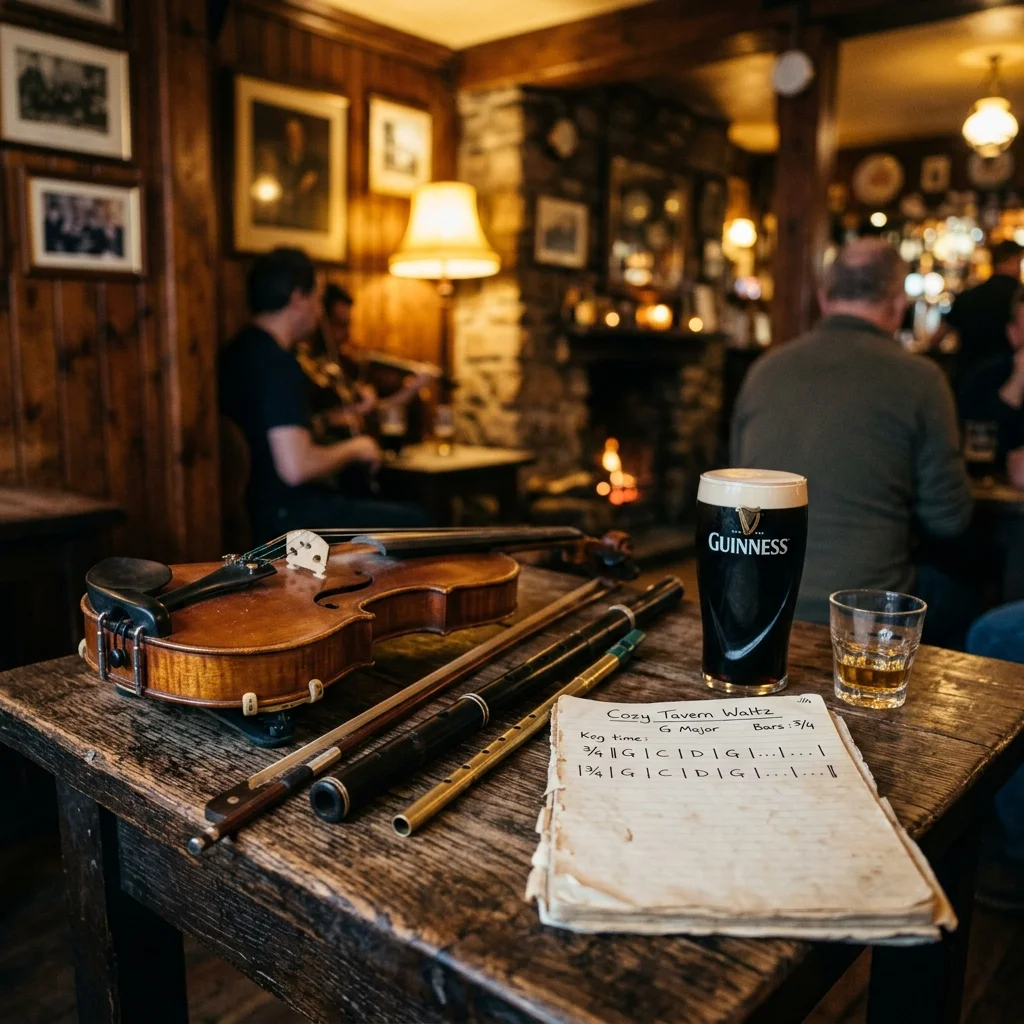
Quick Facts: Waltz Network Metrics
| Metric | Value | Description |
|---|---|---|
| Total Waltzes Mapped | 3,951 | Total waltz entries recorded in the Trad Tune Explorer archive. |
| Waltzes with Transitions | 951 | Waltzes containing at least one recorded preceding or following session transition. |
| Mapped Transitions | 6,383 | Total transition links logged for 3/4 waltz melodies. |
| Key Bridge Centers | G Major, D Major, E Minor, A Major | The core harmonic keys serving as transition hubs for waltzes. |
| Versatility Leader | Si Bheag Si Mhor (ID 449) | The absolute leader in network connectivity (197 distinct tune connections). |
Table of Contents
Introduction: The Flow of the Waltz
While fast reels and bouncing jigs represent the high-energy peaks of a traditional Irish music session, waltzes, airs, and planxties provide essential moments of contrast, reflection, and lyrical beauty. Written in 3/4 time, the waltz features a rolling triple meter that requires a relaxed, flowing rhythm. In sessions, waltzes are often introduced to let both musicians and listeners breathe, establishing a spacious atmosphere where melody and expression take precedence.
Transitions between waltzes require careful handling. Because they are played at a slower tempo, harmonic shifts and chordal backings are highly visible. Musicians rely on "glue tunes"—versatile waltzes that act as pivots, transitioning sets smoothly between key centers, resolving fingering tension, and linking different modal families.
Using data from the **Trad Tune Explorer**, we analyzed thousands of tune sets and session recordings to map the waltz transition network. By calculating **Degree Centrality** (the number of unique preceding and succeeding tunes associated with each melody), we have identified the top 25 most versatile waltzes. Whether you are looking for high-value repertoire or trying to craft sets that flow logically, these are the tunes that connect everything.
What Makes a Waltz Versatile?
To database engineers, versatility is a function of graph network centrality. But to traditional musicians, versatility is about physical and musical ergonomics:
- Outgoing Transitions (Exit Versatility): How easily a tune lets the session transition into something new. A waltz with high exit versatility has a neutral ending note or scale position that resolves cleanly, allowing players to transition into G major, D major, or relative minors.
- Incoming Transitions (Entry Versatility): How easily other tunes can lead into it. Waltzes with high entry versatility act as open doors, resolving harmonic tension built up by preceding melodies.
- Key and Modal Adaptability: Waltzes that occupy key family pivots (such as G major, D major, and E minor) are highly versatile. They can easily modulate up or down a step or pivot between relative majors and minors.
- Fingering Ergonomics: A session waltz must sit comfortably under the fingers. Circular, flowing fingering patterns on the fiddle, tin whistle, concertina, and uilleann pipes allow musicians to maintain a steady tempo without finger trips.
The Studio vs. Session Paradox: The Locked Waltzes
A common trap when building repertoire is confusing **popularity** (how often a tune is played) with **versatility** (how many contexts it can fit into).
Some waltzes are incredibly popular due to a single famous recording. For example, *The Tombigbee River* is played frequently (97 transitions) but has a total connected count of only 21 unique tunes in the database. Why? Because it is often locked into rigid, fixed set structures. It behaves as a specialist rather than a generalist.
In contrast, Si Bheag Si Mhor leads the waltz database in unique connections (197 connections) and overall transitions (572), acting as the central hub of the 3/4 repertoire. The statistics suggest that while many waltzes are highly set-locked, Si Bheag Si Mhor functions as a universal bridge connecting different modal centers.
Visualizing the Waltz Transition Network
Transition Network: Si Bheag Si Mhor Hub
Showing the spiderweb of unique transitions branching out from the central standard to key spoke tunes.
Modal Bridge Progression
How versatile waltzes facilitate smooth modal modulations across session sets.
Linear Set Progression Flow
Illustrating starter ? bridge ? closer set flow using actual database statistics.
The 25 Most Versatile Irish Waltzes
Here is the complete ranking of the 25 most versatile waltzes in the traditional archive, compiled from transition network centrality on the Trad Tune Explorer.
1. Si Bheag Si Mhor
D MajorTransition Analysis: Composed by the legendary blind harper Turlough O'Carolan in the late 17th or early 18th century, *Si Bheag Si Mhor* is widely regarded as one of his first compositions. Historically written in tribute to the mythological fairy mounds of Leitrim (Síodhe Beag and Síodhe Mór), it remains a cornerstone of the traditional repertoire. Today, its statistical centrality is unmatched among waltzes: it connects with 197 unique neighbouring tunes in the database. With a starter rate of 50.4%, it is equally popular as a set opener or a mid-set transition, bridging major and minor modes with grace. Common session transitions include: Leads to: Give Me Your Hand (15.4%), Leads to: Sonny's (15.4%), Leads to: Fanny Power (11.5%).
2. Inisheer
G MajorTransition Analysis: Composed by accordionist Thomas Walsh in the 1970s while staying on the Aran island of Inis Oírr, *Inisheer* is a hauntingly beautiful modern waltz that has achieved near-universal adoption. Its simple, scalar melody sits comfortably under the fingers on almost any instrument, and its G major key center provides a natural harmonic pivot. Its transition profile shows a balanced starter rate of 51.5% and 192 unique connections. It is frequently followed by popular session standards like *The Kesh* jig, demonstrating its versatility as a cross-rhythm connector. Common session transitions include: Leads to: Kesh, The (11.1%), Leads to: Glass Of Beer, The (11.1%), Leads to: Tuttle's (11.1%).
3. Fanny Power
G MajorTransition Analysis: Another masterpiece by Turlough O'Carolan, composed in honor of Frances Power, the daughter of a patron. *Fanny Power* is a bright, lively waltz in G major. In sets, it frequently behaves as a bridge or closer tune, having a lower starter rate (35.7%) and an average set position of 5.47. Musicians regularly use it to lift sets into bright G major or D major keys. It is most commonly paired with *Planxty Irwin*, forming a classic Carolan duet. Common session transitions include: Leads to: Wise Maid, The (8.3%), Leads to: Si Bheag Si Mhor (8.3%), Leads to: Garrett Barry's (8.3%).
4. Ashokan Farewell
D MajorTransition Analysis: Written by American fiddler Jay Ungar in 1982, *Ashokan Farewell* served as the emotional theme for Ken Burns' PBS series *The Civil War*. Though composed in New York, it has been deeply embraced by the Irish and Scottish traditional music communities. Its D major tonality and sweeping, expressive intervals make it an ideal set starter (51.1% starter rate) or a dramatic closer. It has a high exit versatility, connecting with 133 unique tunes across 227 transitions. Common session transitions include: Leads to: Green Mountain, The (25.0%), Leads to: Contradiction, The (25.0%), Leads to: Reel Beatrice (25.0%).
5. South Wind, The
G MajorTransition Analysis: An anonymous traditional waltz, *The South Wind* (An Ghaoth Aneas) is believed to have originated in County Mayo in the 18th century. Its lyrics express a longing for home. With a high Degree Centrality of 125 connections, it is a highly reliable session glue tune. It has a median set position of 2, indicating that it is often played in the middle of set sequences to bridge keys smoothly. Common session transitions include: Leads to: Give Me Your Hand (16.7%), Leads to: Kerfunten, The (8.3%), Leads to: Galway Rambler, The (8.3%).
6. Crested Hens
E DorianTransition Analysis: Known in French as *Les Poules Huppées*, *Crested Hens* is a traditional French waltz from the Bourbonnais region that has become a staple of modern Irish sessions, largely popularized by the band Solas in the 1990s. Unusually for waltzes, it is in E Dorian (a modal center that makes it extremely popular with pipers and whistle players). It behaves primarily as a set opener (59.6% starter rate) with a median set position of 1, frequently leading into jigs or reels. Common session transitions include: Leads to: Ships Are Sailing, The (11.1%), Leads to: Beare Island (11.1%), Leads to: Wizard's Walk (11.1%).
7. Planxty Irwin
G MajorTransition Analysis: Composed by Carolan for Colonel John Irwin of Sligo, *Planxty Irwin* is a joyful, bouncy melody in G major. Statistically, it is highly interconnected with other Carolan compositions, especially *Fanny Power*, which represents its most common transition (26.7% of all exit transitions). It features an average set position of 2.5, indicating a strong preference for placing it early in sets. Common session transitions include: Leads to: Si Bheag Si Mhor (21.4%), Leads to: South Wind, The (14.3%), Leads to: Fanny Power (14.3%).
8. Hector The Hero
A MajorTransition Analysis: Composed by Scottish fiddler James Skinner in 1881 as a lament for his friend, the painter Hector MacInnes. *Hector The Hero* is a deeply moving A major waltz that has crossed over into Irish sessions. Skinner's sweeping melody works beautifully on fiddle, flute, and pipes. It is a highly effective set starter (53.1% starter rate) that frequently transitions into G major standards like *Inisheer*. Common session transitions include: Leads to: Clumsy Lover, The (8.3%), Leads to: Jig Of Slurs, The (8.3%), Leads to: Mason's Apron, The (8.3%).
9. Give Me Your Hand
G MajorTransition Analysis: Attributed to the 16th-century harper Ruairí Dall Ó Catháin, *Give Me Your Hand* (Tabhair dom do Lámh) was composed in tribute to a reconciliation between prominent families. In sessions, it is typically played at a grand, flowing pace. It functions largely as a set bridge or closer (average set position 3.61), connecting G major with other keys. It has a high entry versatility, resolving the tension of preceding tunes. Common session transitions include: Leads to: Independence, The (40.0%), Leads to: Planxty Irwin (20.0%), Leads to: Lord Inchiquin (20.0%).
10. Far Away
B MinorTransition Analysis: Written by American waltz composer Sherry Maye in the B minor key, *Far Away* is a modern classic. Its minor modality gives it a melancholic, circular flow that has made it extremely popular in contemporary Celtic sets. It connects with 71 unique tunes and is most commonly paired with *Crested Hens* (20.9%), providing a dark, modal transition. Common session transitions include: Leads to: Musical Priest, The (9.1%), Leads to: Cock And The Hen, The (9.1%), Leads to: Tenpenny Bit, The (9.1%).
11. Josefin's
D MajorTransition Analysis: Composed by Swedish fiddler Roger Tallroth (of the folk group Väsen) in honor of his wife, *Josefin's Waltz* (Josefins Dopvals) has become an international folk standard. Its sweet, uplifting D major melody works beautifully on acoustic guitar, mandolin, and fiddle. In sets, it is commonly used as a starter (56.2% starter rate) before modulating into G major tunes like *Inisheer*. Common session transitions include: Leads to: Drag Her Round The Road (25.0%), Leads to: Hare's Paw, The (25.0%), Leads to: Breton Gavotte (25.0%).
12. Margaret's
G MajorTransition Analysis: A beautiful, modern composition by Scottish accordionist Pat Shaw, *Margaret's Waltz* has become a beloved standard across both Scottish and Irish traditions. Written in G major, it features a warm, lyrical melody that is highly versatile. It has a median set position of 2, and is most commonly followed by *Maggie West's* waltz. Common session transitions include: Leads to: Boys Of Malin, The (10.5%), Leads to: Laird Of Drumblair, The (5.3%), Leads to: Mrs Kenny's (5.3%).
13. Carolan's Welcome
B MinorTransition Analysis: Another harp composition by Turlough O'Carolan, *Carolan's Welcome* (also known as *O'Carolan's Welcome* or *Carolan's Receipt*) is a modal waltz in B minor. Its minor key provides a beautiful contrast in sets. Statistically, it is a very strong opener (59.1% starter rate) with an average set position of 2, commonly leading into reels or other waltzes. Common session transitions include: Leads to: Rolling In The Barrel (10.5%), Leads to: Calliope House (5.3%), Leads to: Coleraine, The (5.3%).
14. Skye Boat Song
D MajorTransition Analysis: A traditional Scottish folk melody dating back to the late 18th century, *Skye Boat Song* tells the story of Prince Charlie's escape to Skye. Its grand, simple melody has made it a universal waltz standard. In sessions, it is often used as a mid-set connector, transitioning sets between D major and G major. Common session transitions include: Leads to: Musical Priest, The (20.0%), Leads to: Austin Tierney's (20.0%), Leads to: Rowan Tree, The (20.0%).
15. Flatwater Fran
G MajorTransition Analysis: Composed by Phil Cunningham, *Flatwater Fran* is a modern G major waltz that has become popular in Irish and Scottish sessions. Its statistics show a strong connection profile with 97 connected tunes, serving as an effective bridge tune. It has a starter rate of 53.4% and is commonly followed by *Margaret's Waltz*. Common session transitions include: Leads to: Kevin Keegan's (40.0%), Leads to: Tennessee, The (20.0%), Leads to: Bluemont, The (20.0%).
16. Dark Island, The
D MajorTransition Analysis: A Scottish Gaelic waltz composed by accordionist Alan MacLachlan, *The Dark Island* has a melancholic, flowing melody. It is typically used as a set starter or closer in sessions, transitioning into *The South Wind* (17.8% of the time). It has a high exit versatility. Common session transitions include: Leads to: South Wind, The (20.0%), Leads to: Jig Of Slurs, The (10.0%), Leads to: Atholl Highlanders, The (10.0%).
17. Farewell To Uist
E MinorTransition Analysis: A traditional Scottish Gaelic waltz (also known as *Mhairead nan Oran*), *Farewell To Uist* is a beautiful E minor melody. In sessions, it is almost exclusively used as a set opener (81.8% starter rate) with an average set position of 2.02. It is heavily paired with *The Lochaber Badger* (79.5% of exit transitions). Common session transitions include: Leads to: Lochaber Badger (62.5%), Leads to: Inion Ni Scannlain (12.5%), Leads to: Glenuig Bay (12.5%).
18. Midnight On The Water
G MajorTransition Analysis: A famous Texas waltz written by Luke Thomasson in the early 20th century, *Midnight On The Water* has become a staple of the international old-time and Celtic fiddle repertoires. Its G major melody features beautiful, flowing double-stops. In sessions, it typically transitions into *Margaret's Waltz* (24.6%). Common session transitions include: Leads to: Bonaparte's Retreat (44.4%), Leads to: Margaret's (22.2%), Leads to: Whiskey Before Breakfast (11.1%).
19. Hewlett
D MajorTransition Analysis: Composed by Turlough O'Carolan for one of his patrons, *Hewlett* is a bright, cheerful D major waltz. It has a balanced starter rate of 45% and connects with 68 unique tunes. It is most commonly followed by *Planxty Irwin* (12.3%). Common session transitions include: Leads to: Sonny's (33.3%), Leads to: Si Bheag Si Mhor (16.7%), Leads to: Tommy Bhetty's (16.7%).
20. Arran Boat Song
E MinorTransition Analysis: A traditional Scottish waltz, *Arran Boat Song* (Bàta Eilean Arainn) is a haunting E minor melody. It is typically used as an opener (60% starter rate) and transitions sets into D major waltzes like *Skye Boat Song*. It connects with 68 unique tunes in the database. Common session transitions include: Leads to: Boys Of Malin, The (16.7%), Leads to: Man Of The House, The (16.7%), Leads to: King Of The Fairies (16.7%).
21. Eleanor Plunkett
G MajorTransition Analysis: A beautiful harp composition by Turlough O'Carolan in honor of Eleanor Plunkett of County Meath. Written in G major, its elegant melody flows naturally. In sets, it is used as an opener or bridge, commonly transitioning into *Fanny Power* (10.0%). Common session transitions include: Leads to: Kesh, The (6.7%), Leads to: Mason's Apron, The (6.7%), Leads to: Out On The Ocean (6.7%).
22. Lord Inchiquin
D MajorTransition Analysis: Composed by O'Carolan for Lord Inchiquin, this D major waltz is highly melodic and features classic classical-baroque influences. It functions primarily as a mid-set bridge, commonly transitioning into *Carolan's Welcome* (14.0%). Common session transitions include: Leads to: Donnybrook Fair (12.5%), Leads to: Contradiction, The (12.5%), Leads to: Give Me Your Hand (12.5%).
23. Jewels Of The Ocean
A MajorTransition Analysis: Written by fiddler Sharon Shannon, *Jewels Of The Ocean* is a modern A major waltz. It behaves primarily as an opener (62.3% starter rate) and is commonly followed by *If There Weren't Any Women In The World* (13.5%). Common session transitions include: Leads to: Humours Of Tulla, The (10.0%), Leads to: Jenny Dang The Weaver (10.0%), Leads to: Lad O'Beirne's (10.0%).
24. Wounded Hussar, The
G DorianTransition Analysis: A traditional Irish air in G Dorian, *The Wounded Hussar* is a melancholic waltz with a high recording count (93). It has a Degree Centrality of 50 connections, and functions as a bridge or opener, commonly followed by *Far Away* (11.8%). Common session transitions include: Leads to: Jug Of Punch, The (10.5%), Leads to: Sliabh Russell (5.3%), Leads to: Lord Mayo (5.3%).
25. Ash Grove, The
D MajorTransition Analysis: A traditional Welsh folk song (Llwyn Onn) that has been widely adopted in Irish and Scottish sessions. In D major, *The Ash Grove* is typically played in a bright, flowing style. It is often used as a closer or bridge, commonly transitioning into *Ar Eirinn Ni Neosfainn Ce Hi* (20.0%). Common session transitions include: Leads to: Cader Idris (28.6%), Leads to: Jean's (14.3%), Leads to: Sonny Brogan's (14.3%).
Deep-Dive Feature Callouts
*Si Bheag Si Mhor* sits in D major, but its melodic shape uses simple, open scalar steps that avoid sudden, awkward intervals. Because it does not force strong, rigid modal shifts, it remains highly neutral. Fiddlers and whistle players can easily transition out of it into relative keys like G major (via *Give Me Your Hand*) or E minor, and backing guitarists can play simple open-string drones beneath the melody. Its universal status as one of the first tunes many players learn also ensures it is regularly played, expanding its transition network.
In many sessions, Carolan compositions are played back-to-back. Our database shows that when *Si Bheag Si Mhor* is played, it leads directly into *Fanny Power* **13.31% of the time**. This transition is musically elegant, shifting from the stately D major of *Si Bheag Si Mhor* into the bright, dancing G major of *Fanny Power*. It provides a natural lift in energy without disrupting the waltz flow.
The most surprising entries in the top 25 are modern, non-Irish compositions like **Ashokan Farewell** (#4) and Swedish tunes like **Boda Waltz** (which ranks just outside the top 25 in the wider database, but stands as a notable standard). Their high centrality scores demonstrate how traditional sessions adopt external melodies. These tunes act as cross-cultural connectors, bringing fresh modalities and structures to traditional Celtic sets.
A great session waltz needs three features:
- Harmonic Neutrality: Supporting simple, open chords without forcing backing guitarists into frantic shifts.
- Ergonomic Fingering: Sitting comfortably on whistle, flute, and fiddle, avoiding complex cross-fingerings.
- Modal Anchoring: Starting and ending on common root notes (D, G, A, E) so players can easily slide in from other keys.
Frequently Asked Questions
What is a versatile waltz?
A waltz in 3/4 time that demonstrates transition diversity. Rather than being played in a single static set, it connects with multiple preceding and following tunes across different keys, modes, and sets.
How are these rankings calculated?
Using degree centrality network graph analysis on recorded transitions from TheSession.org. Score is based on the number of distinct preceding and following tunes associated with them in sets, not absolute popularity count.
Are these the most popular waltzes?
Not necessarily. Popularity counts absolute frequency. Versatility measures context diversity. Some popular tunes are set-locked, whereas versatile tunes act as bridge templates in multiple combinations.
Why do some waltzes rank lower?
High absolute popularity but low transition versatility due to set-locking (exclusive pairing in a single combination, such as the Tombigbee River).
How can versatile waltzes be used in set building?
As bridge or closer tunes. They provide transition paths between distant keys (e.g., E Minor to D Major) that are recognizable and ergonomic.
Conclusion & Repertoire Recommendations
Whether you are just starting out on your traditional music journey or are an experienced session player looking to refresh your repertoire, learning versatile waltzes is the single most efficient way to expand your musical horizons. By mastering tunes like *Si Bheag Si Mhor*, *Inisheer*, *Fanny Power*, and *The South Wind*, you gain entry tickets to thousands of sessions worldwide.
We invite you to use the interactive tools of the **Trad Tune Explorer** to dig deeper into these tune networks. Search for your favorite waltzes, explore their transition trees, and discover hidden connections that can help you compose your own perfect session sets.