25 Irish Jigs Every Session Musician Should Learn
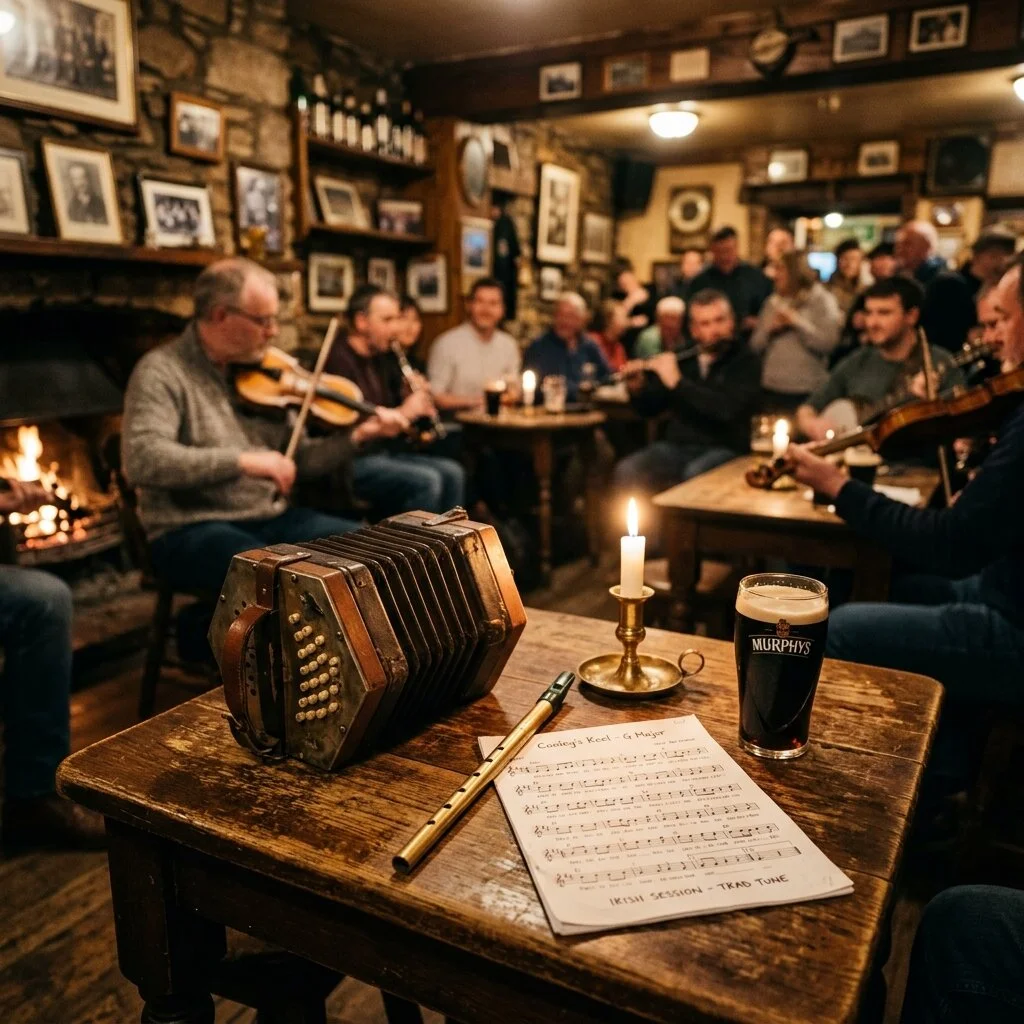
For absolute beginners, The Kesh Jig (G major, ID: 55) is the most universal and popular starter jig, appearing in 1,485 unique session sets. It has simple scalar movements and minimal finger jumps. Other highly recommended starter jigs are Out On The Ocean (G major, ID: 108) and Lilting Banshee, The (A dorian, ID: 60).
Data-Backed Repertoire: We analyzed session lists, user bookmarks, and album recordings to find the 25 jigs actually played at real pub sessions, saving you from learning obscure tunes.
1. Sourcing and Methodology
Entering the world of traditional Irish music can be overwhelming. There are tens of thousands of cataloged tunes, and local sessions can move at breakneck speeds. The common advice is to “learn the session standards,” but how do you know which tunes are actually played, and which ones are appropriate for a learner?
To solve this, we queried the Trad Tune Explorer database. We filtered the database by two main criteria:
- Session Frequency (Popularity): Ranked by how many custom user sets contain the tune, reflecting real-world session usage.
- Melodic Simplicity: Evaluated for playability (avoiding complex shifts, awkward leaps, or highly chromatic scales). We classified each tune as Easy or Intermediate.
The result is this curated list of 25 jigs. By learning these, you build a repertoire that is 99% guaranteed to be recognized and welcomed at any traditional Irish session worldwide.
2. Interactive Practice Checklist & Side-by-Side Comparison
| Learned | Rank | Tune Name | Key | Difficulty | Session Sets | Recordings |
|---|---|---|---|---|---|---|
| 1 | Gmajor | Easy | 1,485 | 136 | ||
| 2 | Gmajor | Easy | 1,321 | 173 | ||
| 3 | Dmixolydian | Intermediate | 1,214 | 148 | ||
| 4 | Edorian | Intermediate | 1,186 | 167 | ||
| 5 | Dmixolydian | Intermediate | 951 | 94 | ||
| 6 | Dmajor | Intermediate | 948 | 221 | ||
| 7 | Adorian | Intermediate | 784 | 139 | ||
| 8 | Adorian | Intermediate | 743 | 113 | ||
| 9 | Dmajor | Easy | 721 | 68 | ||
| 10 | Dmajor | Intermediate | 657 | 86 | ||
| 11 | Adorian | Intermediate | 594 | 153 | ||
| 12 | Gmajor | Easy | 585 | 110 | ||
| 13 | Dmajor | Intermediate | 582 | 140 | ||
| 14 | Edorian | Easy | 567 | 87 | ||
| 15 | Gmajor | Easy | 487 | 88 | ||
| 16 | Adorian | Intermediate | 453 | 74 | ||
| 17 | Dmajor | Intermediate | 451 | 87 | ||
| 18 | Gmajor | Intermediate | 448 | 132 | ||
| 19 | Amajor | Intermediate | 394 | 24 | ||
| 20 | Gmajor | Intermediate | 394 | 120 | ||
| 21 | Dmajor | Intermediate | 388 | 97 | ||
| 22 | Dmajor | Intermediate | 383 | 51 | ||
| 23 | Dmajor | Intermediate | 378 | 115 | ||
| 24 | Amixolydian | Intermediate | 357 | 124 | ||
| 25 | Dmajor | Intermediate | 356 | 66 |
3. The 25 Irish Jigs to Learn
Here is the detailed breakdown of the 25 essential jigs, ranked by their session occurrence. Each tune includes statistics from the database, landmark recordings to listen to, and specific tips for learning it.
1.
 Kesh, The
JIG | KEY: Gmajor | ID: 55
History: Popularized globally by The Bothy Band on their seminal 1975 debut album. This G major double jig is named after the town of Kesh in County Fermanagh.
Why Learn It: It has an incredibly simple and repetitive structure that sits comfortably under the fingers on almost any instrument. It is the universal session-starter jig.
Musical Traits & Tips: Features rolling triplets and an easy jump between G and D. The B-part features a lovely lift up to the high B.
Time For A Tune by Charlie Lennon (Track 9), Lucky In Love by Charlie Lennon And Mick O'Connor (Track 9), Two Champions by Sean McGuire And Joe Burke (Track 10)
Common Session Pairings:
Played after: Morrison's (x147), Out On The Ocean (x97), Blarney Pilgrim, The (x90)
Played before: Morrison's (x271), Out On The Ocean (x87), Swallowtail, The (x63)
2.
Out On The Ocean
JIG | KEY: Gmajor | ID: 108
History: A classic G major jig associated with East Galway and County Clare playing styles. Also known as 'The Over the Water' jig.
Why Learn It: It features long, spacious quarter notes (crotchets) that give beginner players time to breathe and plan their next notes or fingerings.
Musical Traits & Tips: Requires clean finger articulation on the G scale. The spacious layout makes it a perfect vehicle for practicing cuts and single rolls.
By Heck by Frankie Gavin's Roaring Twenties Irish Orchestra (Track 11), Irlande (Live) by Frankie Gavin, Arty McGlynn & Aidan Coffey (Track 10), Happy To Meet And Sorry To Part by Joe Burke, Michael Cooney And Terry Corcoran (Track 9)
Common Session Pairings:
Played after: Rolling Waves, The (x100), Kesh, The (x87), Connaughtman's Rambles, The (x85)
Played before: Kesh, The (x97), Lilting Banshee, The (x58), Connaughtman's Rambles, The (x54)
3.
Banish Misfortune
JIG | KEY: Dmixolydian | ID: 9
History: A three-part jig in D Mixolydian. Widely recorded, it is famous for its association with Willie Clancy and Joe Burke.
Why Learn It: It introduces players to modal playing — the D Mixolydian scale requires C natural instead of C#, giving it a traditional, ancient flavor.
Musical Traits & Tips: Features long, sweeping runs on the A and E strings. Getting the C natural in tune on fiddle and using the F-natural/C-natural keys on concertina are great skills.
Casey In The Cowhouse by Bobby Casey (Track 13), The Spirit Of West Clare by Bobby Casey (Track 3), The Irish Concertina 3: Live in New York by Noel Hill (Track 2)
Common Session Pairings:
Played after: Blarney Pilgrim, The (x80), Morrison's (x40), Garrett Barry's (x33)
Played before: Blarney Pilgrim, The
(x157), Cliffs Of Moher, The (x59), Out On The Ocean (x44)
4.
Morrison's
JIG | KEY: Edorian | ID: 71
History: Named after the legendary Sligo fiddle master James Morrison, who recorded it in New York in the 1920s.
Why Learn It: It is an absolute standard. It has a dramatic contrast between the rhythmic low-E drone in the A-part and the flying, scalar B-part.
Musical Traits & Tips: Uses the E Dorian mode. The A-part features repeating octave jumps (low E to high E), which is a fantastic exercise for bow control.
Sligo Made by Kevin Burke (Track 1), Two Champions by Sean McGuire And Joe Burke (Track 10), Old Hag You Have Killed Me by The Bothy Band (Track 8)
Common Session Pairings:
Played after: Kesh, The (x271), Swallowtail, The (x65), Butterfly, The (x49)
Played before: Kesh, The (x147), Drowsy Maggie (x88), Swallowtail, The (x61)
5.
Blarney Pilgrim, The
JIG | KEY: Dmixolydian | ID: 5
History: A traditional three-part jig in D Mixolydian, popular throughout Munster and frequently paired with The Merrily Kissed the Quaker.
Why Learn It: With three distinct parts, it challenges players to remember the structure, but each part is built from simple, intuitive motifs.
Musical Traits & Tips: A lyrical, bouncy melody. The third part has a wonderful rising and falling shape that feels very satisfying to play.
The Leg Of The Duck by Joe Burke, Michael Cooney And Noreen Donoghue (Track 13), The Long Grazing Acre by Paddy Keenan & Tommy O'Sullivan (Track 8), Recorded at Fiddler's Hearth by Tommy Peoples (Track 16)
Common Session Pairings:
Played after: Banish Misfortune (x157), Sliabh Russell (x24), Morrison's (x20)
Played before: Kesh, The (x90), Banish Misfortune (x80), John Ryan's (x48)
6.
Connaughtman's Rambles, The
JIG | KEY: Dmajor | ID: 19
History: A classic double jig in D major. Recorded on cylinder in 1907 by melodeon player John J. Kimmel, making it one of the earliest recorded Irish tunes.
Why Learn It: Its driving melody sits perfectly on the natural scale of the D tin whistle, flute, and fiddle.
Musical Traits & Tips: Characterized by rapid arpeggiated jumps up and down the D major triad. Keeping the tempo steady during the fast jumps is key.
Irlande (Live) by Frankie Gavin, Arty McGlynn & Aidan Coffey (Track 10), The Bucks Of Oranmore by Joe Burke (Track 2), Traditional Music Of Ireland And The Bucks Of Oranmore by Joe Burke & Charlie Lennon (Track 18)
Common Session Pairings:
Played after: Geese In The Bog, The (x92),
Out On The Ocean (x54), Lilting Banshee, The (x41)
Played before: Out On The Ocean (x85), Kesh, The (x51), Calliope House (x39)
7.
Cliffs Of Moher, The
JIG | KEY: Adorian | ID: 12
History: An Adorian jig named after the famous cliffs in County Clare. A favorite of Clare concertina players.
Why Learn It: It is an excellent introduction to A Dorian, utilizing the G natural. Its dark, moody tone makes a great contrast in sets.
Musical Traits & Tips: Features a repeating, hypnotic rhythm in the A-part and a lovely melodic rise in the B-part.
The Corner House Set by Aidan Coffey with Frankie Gavin, Alec Finn & Colm Murphy (Track 11), BBC Archive Recordings by Bobby Casey (Track 5), If The Cap Fits by Kevin Burke (Track 4)
Common Session Pairings:
Played after: Dusty Windowsills (x75), Banish Misfortune (x59), Lilting Banshee, The (x34)
Played before: Connaughtman's Rambles, The
(x41), Rose In The Heather, The (x37), Banish Misfortune (x22)
8.
Lilting Banshee, The
JIG | KEY: Adorian | ID: 60
History: Also known as 'The Killour Jig,' this A Dorian standard is widely played at introductory sessions.
Why Learn It: It has very few notes and uses a simple, repetitive structure, making it one of the easiest minor-key jigs to memorize.
Musical Traits & Tips: Features a rhythmic, marching feel. Perfect for practicing double-stops on the fiddle or drone keys on the concertina.
The Corner House Set by Aidan Coffey with Frankie Gavin, Alec Finn & Colm Murphy (Track 11), The Leg Of The Duck by Joe Burke, Michael Cooney And Noreen Donoghue (Track 15), Boil The Breakfast Early by The Chieftains (Track 10)
Common Session Pairings:
Played after: Out On The Ocean (x58), Swallowtail, The (x39), Kesh, The (x35)
Played before: Kesh, The (x43), Connaughtman's Rambles, The (x41), Out On The Ocean (x40)
9.
Tripping Up The Stairs
JIG | KEY: Dmajor | ID: 111
History: A bright, bouncy D major jig that is highly popular for both dancing and sessions.
Why Learn It: It is extremely easy to learn, featuring straightforward rising and falling scales that lay naturally under the fingers.
Musical Traits & Tips: The A-part rises from low D up to the A string, while the B-part features simple descending arpeggios.
De Danann by De Dannan (Track 1), Live in New York 1977 by De Dannan (Track 2), The Bucks Of Oranmore by Joe Burke (Track 7)
Common Session Pairings:
Played after: Out On The Ocean (x49), Lilting Banshee, The (x40), Swallowtail, The (x33)
Played before: Out On The Ocean (x34), Connaughtman's Rambles, The (x27), Kesh, The (x25)
10.
Calliope House
JIG | KEY: Dmajor | ID: 15
History: Composed by the legendary Glasgow fiddler Alan MacDonald, this D major jig has become a modern session classic.
Why Learn It: It has a joyful, modern lift and is popular among pipers, fiddlers, and whistle players alike.
Musical Traits & Tips: Features a syncopated A-part and a rolling B-part. Watch out for the high F# and G jumps in the second part.
My Own Style by Adrian McCarron (Track 8), Fire And Grace by Alasdair Fraser & Natalie Haas (Track 1), Just As It Was 3 by Alasdair Fraser and Muriel Johnstone (Track 10)
Common Session Pairings:
Played after: Connaughtman's Rambles, The
(x39), Out On The Ocean (x37), Kesh, The (x23)
Played before: Cowboy, The (x94), MacArthur Road (x35), Connaughtman's Rambles, The (x22)
11.
Mist Covered Mountain, The
JIG | KEY: Adorian | ID: 256
History: Composed by the Clare fiddler Junior Crehan, who named it after a local mountain in West Clare.
Why Learn It: A hauntingly beautiful A Dorian jig that teaches players to express the 'lonesome' (nyah) sound of Clare music.
Musical Traits & Tips: Features long, expressive notes. Great for learning how to use slides and vibrato.
Live in New York 1977 by De Dannan (Track 10), The Mist Covered Mountain by De Dannan (Track 1), In Good Company - The Very Best Of by Kevin Burke (Track 18)
Common Session Pairings:
Played after: Mac's Fancy (x29), Luachrachán's, The (x16), Orphan, The (x16)
Played before: Mug Of Brown Ale, The
(x14), Cliffs Of Moher, The (x12), Cat's Meow, The (x11)
12.
Blackthorn Stick, The
JIG | KEY: Gmajor | ID: 702
History: Also known as 'The Humours of Whiskey' or 'The Coach Road to Sligo,' this G major classic is found in O'Neill's Music of Ireland.
Why Learn It: An excellent starter jig in G major that has a very strong, rhythmic bounce.
Musical Traits & Tips: Features arpeggios that leap across the G major scale. Emphasize the first beat of each bar to keep the lift.
By Heck by Frankie Gavin's Roaring Twenties Irish Orchestra (Track 9), The Master's Return by Frankie Gavin, Malachy Bourke and Brian Bourke (Track 2), Sligo Made by Kevin Burke (Track 11)
Common Session Pairings:
Played after: Kesh, The (x37), Rakes Of Kildare, The (x27), Swallowtail, The (x26)
Played before: Rakes Of Kildare, The
(x52), Kesh, The (x24), Out On The Ocean (x17)
13.
Lark In The Morning, The
JIG | KEY: Dmajor | ID: 62
History: A massive four-part double jig in D major, dating back to the 19th century and popularized by Planxty.
Why Learn It: While it has four parts, the parts are highly thematic and repetitive, making it an excellent step up for intermediate players.
Musical Traits & Tips: Features rhythmic variations and drone sections. The third part has a wonderful rolling melody on the low strings.
Stack of Barley and Wheat by Michael Coleman (Track 11), Waiting For A Call by Tommy Peoples (Track 8), Aggie Whyte by Aggie Whyte (Track 40)
Common Session Pairings:
Played after: Banish Misfortune (x28), Kesh, The (x25), Lilting Banshee, The (x17)
Played before: Donegal Lass, The (x20), Banish Misfortune (x19), Lilting Banshee, The (x18)
14.
Swallowtail, The
JIG | KEY: Edorian | ID: 106
History: An E Dorian jig that is particularly popular in America and Ireland as a starter tune.
Why Learn It: It has a very simple, scalar A-part and a B-part that duplicates the rhythm, making it highly intuitive.
Musical Traits & Tips: Requires clean crossing between the D and A strings. The B-part contains repeating runs up to the high E.
Sons Of Liberty by Amadan (Track 3), Celtic Music From Maui by An Ríl (Track 7), Celtic Harp Vol II: A Following Sea by Andrea Freeman (Track 9)
Common Session Pairings:
Played after: Road
To Lisdoonvarna, The (x71), Kesh, The (x63), Morrison's (x61)
Played before: Kesh, The (x69), Morrison's (x65), Lilting Banshee, The (x39)
15.
Saddle The Pony
JIG | KEY: Gmajor | ID: 307
History: A G major session classic that has been recorded by almost every major traditional band.
Why Learn It: It is short, sweet, and has a very infectious rhythm that gets everyone tapping their feet.
Musical Traits & Tips: Features a rolling A-part and a high-energy B-part that leaps up to the high G.
Learn To Play Irish Fiddle: Polkas, Jigs And Slides ~ DVD 1 by Kevin Burke (Track 3), Back in Time by Angelina Carberry & Dan Brouder (Track 7), Fiddlers Rock by Archie McAllister (Track 4)
Common Session Pairings:
Played after: Humours Of Glendart, The
(x109), Haste To The Wedding (x24), Out On The Ocean (x22)
Played before: Tobin's Favourite (x50), Tripping Up The Stairs (x24), Blackthorn Stick, The (x20)
16.
Dusty Windowsills
JIG | KEY: Adorian | ID: 29
History: Composed by the legendary Dublin tin whistle player Sean Potts, a founding member of The Chieftains.
Why Learn It: An intermediate A Dorian jig that is a favorite of flute and whistle players due to its breath patterns.
Musical Traits & Tips: Features a syncopated rhythm and beautiful modal transitions. The third part adds a lovely melodic resolution.
Way of the Gull by a'Nish (Track 9), From Galway to Dublin by Alban Fuam (Track 9), A Glass and a Mile by Alistair Russell & Chris Parkinson (Track 12)
Common Session Pairings:
Played after: Banish Misfortune (x15), Cook In The Kitchen, The (x14), Tripping Up The Stairs (x14)
Played before: Cliffs Of Moher, The
(x75), Banish Misfortune (x18), Calliope House (x13)
17.
Rolling Waves, The
JIG | KEY: Dmajor | ID: 88
History: A traditional D major double jig. Also known as 'The Shaskeen Jig' in some older collections.
Why Learn It: A spacious, rolling jig with plenty of room for ornamentation and variation.
Musical Traits & Tips: Features long G and A notes in the A-part, and a B-part that steps gracefully down the D major scale.
The Poet And The Piper by Seamus Heaney And Liam O'Flynn (Track 7), Film Cuts by The Chieftains (Track 16), The Best Of The Chieftains by The Chieftains (Track 6)
Common Session Pairings:
Played after: Out On The Ocean (x37), Rolling Waves, The (x26), Rambling Pitchfork, The (x15)
Played before: Out On The Ocean (x100), Rolling Waves, The (x32), I Buried My Wife And
Danced On Her Grave (x13)
18.
Garrett Barry's
JIG | KEY: Gmajor | ID: 544
History: Named after the famous blind piper Garrett Barry from Inistymon, County Clare.
Why Learn It: A beautiful G major/mixolydian jig that captures the sweet, slow, Clare style of piping and concertina playing.
Musical Traits & Tips: Uses the F natural in the B-part, shifting the mood from G major to G Mixolydian. Great for ornament cuts.
A Chapter in History: 30 Years of Joe 'Banjo' Burke, Live. Volume II: Live from Eagle Tavern. by Joe Burke (Track 13), Eavesdropper by Kevin Burke And Jackie Daly (Track 5), The Celtic Fiddle Festival by Kevin Burke, Johnny Cunningham, Christian Lemaitre (Track 3)
Common Session Pairings:
Played after: Banish Misfortune (x35), Blarney Pilgrim, The (x12), Battering Ram, The (x12)
Played before: Banish Misfortune
(x33), Tatter Jack Walsh (x26), Hag's Purse, The (x16)
19.
Mouse In The Kitchen
JIG | KEY: Amajor | ID: 6655
History: Composed by the modern Scottish accordionist and composer Phil Cunningham.
Why Learn It: A lively A major jig that is popular in Scottish and Cape Breton sessions, as well as modern Irish sessions.
Musical Traits & Tips: Requires a sharp, crisp articulation. It sits nicely on the keys of the accordion and the strings of the fiddle.
Upside Down by Sharon Shannon, Mike McGoldrick, Jim Murray, Dezi Donnelly (Track 8), Frenzy by 3 On The Bund (Track 4), Murray & Magill by Alan Murray & Andrew Finn Magill (Track 9)
Common Session Pairings:
Played after: Seanamhac Tube Station (x40),
Jig For John (x19), Donegal Lass, The (x15)
Played before: Lisnagun, The (x43), Road To Errogie, The (x14), Calliope House (x11)
20.
Willie Coleman's
JIG | KEY: Gmajor | ID: 476
History: Named after the Galway accordion player Willie Coleman, who popularized it in the mid-20th century.
Why Learn It: A G major jig that is highly popular in Irish sessions for its sweet, rolling melody.
Musical Traits & Tips: Features repeating G-major arpeggios. Focus on keeping the tempo relaxed and bouncy.
Traditional Music Of Ireland And The Bucks Of Oranmore by Joe Burke & Charlie Lennon (Track 33), In Good Company - The Very Best Of by Kevin Burke (Track 7), Portland by Kevin Burke And Mícheál Ó Domhnaill (Track 6)
Common Session Pairings:
Played after: Kitty Lie Over (x41), McGoldrick's (x20), Banks Of Lough Gowna, The (x12)
Played before: Up In The Air (x31), Pull The Knife And Stick It Again (x26), Funky Spider, The (x18)
21.
Haste To The Wedding
JIG | KEY: Dmajor | ID: 582
History: A D major jig that dates back to the 18th century. It is popular in Irish, Scottish, and English folk traditions.
Why Learn It: A universal starter tune that is played at almost every wedding, ceili, and introductory session.
Musical Traits & Tips: Features a strong, march-like rhythm in D major. Highly scalar and easy to play at speed.
The Master's Return by Frankie Gavin, Malachy Bourke and Brian Bourke (Track 12), Happy To Meet And Sorry To Part by Joe Burke, Michael Cooney And Terry Corcoran (Track 7), Sing and Play the Music of the Adderbury Tradition by Adderbury Morris Men (Track 14)
Common Session Pairings:
Played after: Lilting Banshee, The
(x20), Irish Washerwoman, The (x17), Father O'Flynn (x14)
Played before: Saddle The Pony (x24), Maid On The Green, The (x19), Tripping Up The Stairs (x18)
22.
Kerfunten, The
JIG | KEY: Dmajor | ID: 139
History: Composed by the modern whistle player and accordionist Hammy Hamilton from Belfast.
Why Learn It: A beautiful, lyrical D major jig that has become a staple of modern session repertoire.
Musical Traits & Tips: Features smooth, flowing phrases with a lovely lifting B-part. Very comfortable on the whistle and flute.
Lúnasa by Lúnasa (Track 11), The Lonesome Touch by Martin Hayes And Dennis Cahill (Track 2), Irish Grace Notes by Ailbe Grace (Track 2)
Common Session Pairings:
Played after: Woodcock, The (x53), Seamus Cooley's (x41), Out On The Ocean (x15)
Played before: Out On The Ocean (x41), Eddie Kelly's (x10), Jimmy Ward's (x10)
23.
Humours Of Glendart, The
JIG | KEY: Dmajor | ID: 45
History: A classic D major jig found in O'Neill's, also known as 'The East at Glendart'.
Why Learn It: It has a very simple, scalar structure that makes it easy for beginners to pick up by ear.
Musical Traits & Tips: Features repeating rising phrases in D major. Excellent for practicing clean bowing patterns.
After The Break by Planxty (Track 2), Between the Jigs and Reels: A Retrospective by Planxty (Track 35), One Night In Bremen by Planxty (Track 4)
Common Session Pairings:
Played after: Joe Derrane's (x17), Lilting Banshee, The (x14), Saddle The Pony (x10)
Played before: Saddle The Pony (x109), Brian O'Lynn (x35), Leitrim Fancy, The (x24)
24.
Black Rogue, The
JIG | KEY: Amixolydian | ID: 1076
History: A D Mixolydian/A mixolydian jig that has a very strong, driving rhythm, popularized by Planxty.
Why Learn It: A great introduction to the Mixolydian mode, featuring a wonderful driving lift.
Musical Traits & Tips: Features a repeating, pipe-like drone quality. Excellent for piping and fiddling double-stops.
Fourmilehouse by Alan And John Kelly (Track 2), Port Eireann by Frankie Gavin and Catherine McHugh (Track 10), Happy To Meet And Sorry To Part by Joe Burke, Michael Cooney And Terry Corcoran (Track 9)
Common Session Pairings:
Played after: Joe Derrane's (x48), Rambling Pitchfork, The (x27), I Buried My Wife And
Danced On Her Grave (x13)
Played before: Whelan's (x22), Rambling Pitchfork, The (x17), Na Ceannabháin Bhána (x15)
25.
Tar Road To Sligo, The
JIG | KEY: Dmajor | ID: 151
History: Named after the road connecting Sligo to Mayo, this D major jig is associated with Michael Coleman.
Why Learn It: A high-energy session classic that is popular for ending sets due to its driving B-part.
Musical Traits & Tips: Requires fast finger agility. The B-part features rapid runs up to the high A on the E string.
Time For A Tune by Charlie Lennon (Track 16), Frankie Gavin 2003-2004: Speed of Sound - 1st CD of 4 by Frankie Gavin, Máirtín O'Connor and Carl Hession (Track 12), The 3rd Irish Folk Festival by Jackie Daly, Seamus Creagh, De Dannan, Andy Irvine, Treasa ni Mhiollain, Clannad (Track 18)
Common Session Pairings:
Played after: Tobin's Favourite (x29), Walls Of Liscarrol, The (x12), Legacy, The (x12)
Played before: Paddy Clancy's (x42), Cliffs Of Moher, The (x22), Tobin's Favourite (x14)
4. Summary & Next Steps
Learning traditional Irish music is a social, communal journey. The tunes listed here are more than just notes on a page; they are the shared vocabulary of session musicians across the globe. Learning these tunes will not only build your finger strength and rhythmic drive, but it will also open the doors to pubs and sessions wherever your travels take you.
Frequently Asked Questions (FAQ)
What is the most popular Irish jig?
According to session set list analysis, The Kesh Jig is the most common session jig with 1,485 unique set combinations. The Connaughtman's Rambles follows closely and is the most commercially recorded jig in the database with 221 albums.
What key is most popular for Irish jigs?
The most popular keys for traditional Irish jigs are G major (like Out On The Ocean) and D major (like Connaughtman's Rambles) due to their perfect layouts on traditional woodwinds (whistles and flutes) and fiddle strings.
What is the difference between a double jig and a slip jig?
A double jig is written in 6/8 time (grouped in triplets: 1-2-3, 4-5-6), whereas a slip jig is in 9/8 time (three groups of three: 1-2-3, 4-5-6, 7-8-9), giving it a more flowing, syncopated lilt.
How should beginners practice learning jigs?
Beginners should start by learning the melodies slowly, emphasizing the first beat of each triplet group to master the jig 'lift' (DA-da-da, DA-da-da), and use practice checklists to track their progress.
Ready to start practicing? Check out these vital tools across the Trad Tune Explorer: