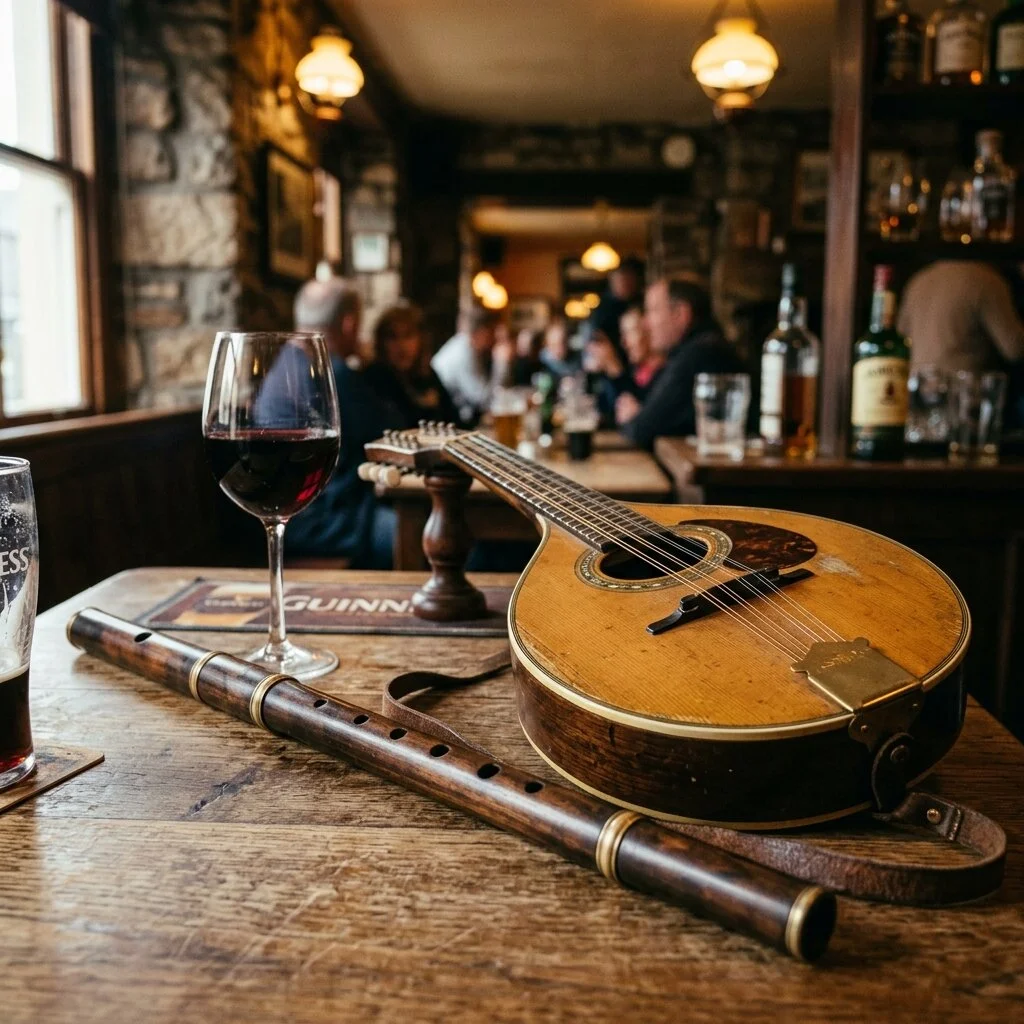
Introduction: Why Some Slides Outlast the Rest
Traditional Irish music is passed down organically, from player to player, session to session. While there are thousands of distinct slides documented in historic archives, only a select few are played in every pub session around the world.
Why does this happen? Many musicians believe it is purely a matter of personal preference. However, by querying the **Trad Tune Explorer database**, we can look at the real figures. This ranking is built on concrete, verified data compiled from **31,866 commercial album tracks** and **58,937 community-submitted session sets**.
In this article, we rank the **25 most recorded Irish slides of all time**, exploring the historical roots of each tune, its musical quirks, its landmark recordings, and its most common session transitions. Settle in, and let's explore the stats behind these session classics.
Here is the high-level data analyzing the slides in our repository:
- Most Recorded Slide: Merrily Kiss The Quaker (98 commercial tracks)
- Most Popular Session Slide: Denis Murphy's (256 unique set appearances)
- Oldest Recordings Represented: 1900s historical tracks (compiled in Early Recordings of Irish Traditional Dance Music).
Table of Contents
The 25 Most Recorded Irish Slides
Here is the definitive ranking of the top twenty-five Irish slides, based on the total number of commercial album tracks cataloged in the Trad Tune Explorer.
1. Merrily Kiss The Quaker
GmajorHistory: A famous 18th-century song and slide of Irish/Scottish origins, widely played in uilleann piping collections.
Why it became popular: Extremely popular for uilleann whistles and pipes in G major, with a highly singable, memorable melody.
Musical traits: Set in G major in 12/8 time, featuring flowing triad arches and scalar runs that resolve on a bright G cadence.
Planxty by Planxty, The Planxty Collection by Planxty, The Chieftains Live by The Chieftains
Common Session Pairings:
Played after: Blarney Pilgrim, The (x39), Road To Lisdoonvarna, The (x26), O'Keeffe's (x17)
Played before: Denis Murphy's (x40), Dingle Regatta, The (x21), Blarney Pilgrim, The (x17)
2. Denis Murphy's
DmajorHistory: Named after Denis Murphy, a legendary Sliabh Luachra fiddler who championed the Kerry music style.
Why it became popular: A staple slide played in almost every Kerry music session worldwide.
Musical traits: Set in D major, characterized by its bouncy, syncopated scale jumps and rapid uilleann whistle ornamentation.
The Best Of Irish Piping: The Pure Drop & The Fox Chase by Seamus Ennis, The Chieftains 3 by The Chieftains, The Chieftains Live by The Chieftains
Common Session Pairings:
Played after: O'Keeffe's (x72), Merrily Kiss The Quaker (x40), Brosna, The (x19)
Played before: O'Keeffe's (x31), Brosna, The (x19), Star Above The Garter, The (x14)
3. Star Above The Garter, The
GmajorHistory: A traditional Sliabh Luachra slide, famously recorded by Julia Clifford and Denis Murphy.
Why it became popular: Loved for its beautiful modal lift and smooth fiddle bowing shapes.
Musical traits: Written in G major, featuring a distinctive soaring B-part in the upper register.
In Ireland by James Galway And The Chieftains, The Chieftains 4 by The Chieftains, The Foxhunt : CD#2 by The Chieftains
Common Session Pairings:
Played after: Road To Lisdoonvarna, The
(x35), O'Keeffe's (x28), Denis Murphy's (x14)
Played before: Lisheen, The (x42), Forget Your Troubles (x34), Road To Lisdoonvarna, The (x18)
4. Patsy Geary's
DmajorHistory: A popular slide of Cork/Kerry origin, named after Patsy Geary.
Why it became popular: Bouncy phrasing that is easy to play on whistles and accordions.
Musical traits: Set in D major, with a circular melody resolving on a low D.
1975 by The Bothy Band, Live In Concert by The Bothy Band, Now Is The Hour by The Kilfenora Céilí Band
Common Session Pairings:
Played after: Road To Lisdoonvarna, The (x6)
Played before: Coleman's Cross (x46), Teahan's Favourite (x7)
5. Eileen O'Riordan's
AmixolydianHistory: A traditional Sliabh Luachra slide named after the prominent local concertina player.
Why it became popular: Its Mixolydian tone provides a rustic, driving feel that is popular in Kerry sessions.
Musical traits: Set in A Mixolydian, utilizing G natural notes for a flat-seventh modal color.
The 3rd Irish Folk Festival by Jackie Daly, Seamus Creagh, De Dannan, Andy Irvine, Treasa ni Mhiollain, Clannad, Achill Sound by Achill Sound, Flagstone Memories by Andrew Mac Namara, Orla Harrington And Jim Higgins
Common Session Pairings:
Played after: Star Above The Garter, The
(x34), Toormore, The (x12), Lisheen, The (x7)
Played before: Kings Of Kerry (x51), Toormore, The (x6)
6. Barrack Hill
AdorianHistory: A traditional Irish slide dating back to the 19th century, featured in early collections.
Why it became popular: Offers a driving minor-key energy that contrasts well with major slides.
Musical traits: Set in A Dorian, characterized by winding intervals and triplet cuts.
The Beat of the Breath by Brian Hughes, This Day 20 Years by Brian Hughes, Whistle Stop [Meascra] by Brian Hughes
Common Session Pairings:
Played after: None recorded
Played before: None recorded
7. Going To The Well For Water
DmajorHistory: A classic Sliabh Luachra slide, famously recorded by Planxty on their Cold Blow and the Rainy Night album.
Why it became popular: Features an extremely bouncy 12/8 pulse that is excellent for dancers.
Musical traits: Written in D major, featuring scalar rises and a bright step cadence.
The Humours Of Lewisham, Volume Three by Aidan Crossey, A Glass and a Mile by Alistair Russell & Chris Parkinson, Beyond the Green by Ashley Ashworth
Common Session Pairings:
Played after: Dingle Regatta, The (x12), Scattery Island (x11), Teahan's Favourite (x10)
Played before: Si Bheag Si Mhor (x9), Scattery Island (x7)
8. Scully Casey's
DmixolydianHistory: Named after Scully Casey, a legendary West Clare fiddler (father of Bobby Casey).
Why it became popular: A Clare-style slide with a beautiful, rolling lilt.
Musical traits: Written in D Mixolydian, characterized by C natural shifts and uilleann rolls.
Casey In The Cowhouse by Bobby Casey, Maestro by Bobby Casey, Taking Flight by Bobby Casey
Common Session Pairings:
Played after: None recorded
Played before: None recorded
9. O'Keeffe's
DmajorHistory: Named after Pádraig O'Keeffe, the legendary fiddle teacher of Sliabh Luachra.
Why it became popular: One of the most common slides in the tradition, played in almost every session.
Musical traits: Set in D major, with simple scalar transitions and a highly driving rhythm.
Sligo Made by Kevin Burke, Phosphorescence by Alys Howe, Bümpliz Süd by An Lar
Common Session Pairings:
Played after: None recorded
Played before: Clog, The (x12), Bill The Weaver's (x6)
10. Cuil Aodha, The
DmajorHistory: Named after the Kerry/Cork border village of Coolea (Cúil Aodha), a hotbed of traditional music.
Why it became popular: Frequently played as a set starter, providing a strong, steady pulse.
Musical traits: Set in D major, characterized by its triplets and repeating A-part.
Boil The Breakfast Early by The Chieftains, The Best Of The Chieftains by The Chieftains, From Galway to Dublin by Alban Fuam
Common Session Pairings:
Played after: O'Keeffe's (x6)
Played before: Star Above The Garter, The
(x7)
11. Toormore, The
BminorHistory: A traditional slide named after a townland in West Cork.
Why it became popular: A beautiful minor-mode slide that provides a wonderful modal shift in sets.
Musical traits: Set in B minor, utilizing F-sharp and C-sharp fingerings on whistles and flutes.
Live At Johnny Fox's by Dervish, Phoenix by Any Old Time, Volume 2 by Augusta Céilí Band
Common Session Pairings:
Played after: Road To Lisdoonvarna, The (x9),
Forget Your Troubles (x6), Brosna, The (x6)
Played before: Forget Your Troubles (x12),
Star Above The Garter, The (x10), Lisheen, The (x7)
12. O'Keeffe's
AdorianHistory: Another slide from Pádraig O'Keeffe's notebook of Sliabh Luachra tunes.
Why it became popular: Often paired with O'Keeffe's No. 1 to create a standard Kerry slide set.
Musical traits: Set in A Dorian, characterized by winding minor arches and uilleann cuts.
Over The Sea To Skye: The Celtic Connection by James Galway And The Chieftains, The Chieftains 4 by The Chieftains, The Foxhunt : CD#2 by The Chieftains
Common Session Pairings:
Played after: Road To Lisdoonvarna, The
(x86), Brosna, The (x82), Denis Murphy's (x31)
Played before: Denis Murphy's (x72), Star Above The Garter, The (x28), Road To Lisdoonvarna, The (x23)
13. Brosna, The
GmajorHistory: Named after the village of Brosna in Kerry, a prominent area for Sliabh Luachra music.
Why it became popular: Its simple, flowing G major scale runs sit perfectly under the fingers of whistle and flute players.
Musical traits: A bright G major melody with a highly recognizable B-part that pivots on a high G roll before resolving.
The Stonemason by Sharon Shannon, Kevin Griffin, Eoin O'Neill, Michel Bonamy, Niall Sheedy, Selected Tracks From Boxed and Eat, Sleep, Fiddle by Anders Trabjerg & Mayo Yanachi, Volume 1 by Augusta Céilí Band
Common Session Pairings:
Played after: Road To Lisdoonvarna, The
(x23), Denis Murphy's (x19), O'Keeffe's (x18)
Played before: O'Keeffe's (x82), Denis Murphy's (x19), Donal O'Connor's (x19)
14. Cnoc Na gClarac
AmixolydianHistory: A traditional slide named after Claragh Mountain in County Cork.
Why it became popular: Its Mixolydian tone provides a rustic, driving feel that is popular in Kerry sessions.
Musical traits: Set in A Mixolydian, utilizing G natural notes for a flat-seventh modal color.
The Winkles Tapes 1989 by Sharon Shannon, Reunion Concert by All-Ireland Céilí Band Champions, Bohola (3) by Bohola
Common Session Pairings:
Played after: Donal O'Connor's (x7)
Played before: None recorded
15. Dinny Delaney's
DmixolydianHistory: Named after Dinny Delaney, a legendary uilleann piper from Galway who popularized the tune in the early 20th century.
Why it became popular: Its driving modal energy and uilleann-pipes friendly fingerings make it an absolute favorite for high-octane session climaxes.
Musical traits: Written in D Mixolydian, characterized by C natural shifts and uilleann rolls.
If The Cap Fits by Kevin Burke, Old Hag You Have Killed Me by The Bothy Band, The Best Of by The Bothy Band
Common Session Pairings:
Played after: Old Hag You Have Killed Me
(x30)
Played before: Morrison's (x38), Yellow Wattle, The (x9)
16. Bill The Weaver's
DmajorHistory: A traditional Irish slide dating back to the 19th century, featured in early collections.
Why it became popular: Offers a driving major-key energy that contrasts well with minor slides.
Musical traits: Set in D major, characterized by winding intervals and triplet cuts.
The Chieftains 4 by The Chieftains, The Foxhunt : CD#2 by The Chieftains, The Portland Bow by Aidan Connolly
Common Session Pairings:
Played after: Merrily Kiss The Quaker (x8), O'Keefe's (x6), Denis Murphy's (x6)
Played before: None recorded
17. Dingle Regatta, The
DmajorHistory: A famous Kerry slide associated with the Dingle peninsula, popularized by uilleann piper Davy Spillane.
Why it became popular: Extremely high tempo and energetic bounce, making it a session closer staple.
Musical traits: Written in D major, utilizing rapid D-major arpeggios and descending scale runs with driving syncopations.
The Best Of Irish Piping: The Pure Drop & The Fox Chase by Seamus Ennis, The Fabulous Kilfenora Ceili Band by The Kilfenora Céilí Band, Reunion Concert by All-Ireland Céilí Band Champions
Common Session Pairings:
Played after: Merrily Kiss The Quaker (x21),
O'Keeffe's (x18), Brosna, The (x12)
Played before: Going To The Well For Water
(x12), Sweets Of May, The (x8), Hundred Pipers, The (x8)
18. Palm Sunday
AdorianHistory: A traditional Irish slide dating back to the 19th century, featured in early collections.
Why it became popular: Offers a driving minor-key energy that contrasts well with major slides.
Musical traits: Set in A Dorian, characterized by winding intervals and triplet cuts.
Eavesdropper by Kevin Burke And Jackie Daly, Lúnasa with the RTÉ Concert Orchestra by Lúnasa, The Merry Sisters Of Fate by Lúnasa
Common Session Pairings:
Played after: Come In From The Rain (x6)
Played before: An Seanduine Doite (x12), Humours Of Kilclogher, The (x9), Clancy's Secret (x7)
19. Bedford Cross
DmajorHistory: A popular traditional slide of Kerry origin, named after the Bedford Cross area.
Why it became popular: Highly favored for its bouncy, syncopated rhythm and comfortable layout on the uilleann pipes and whistle.
Musical traits: Written in D major, characterized by its triplet rolls and dotted eighth notes that resolve on a punchy, low D cadence.
The Groves of Gneeveguilla by Aidan Connolly and Bryan O'Leary, Mullach a' tSí by Aoife Nic Dhomhnaill & Liam Lonergan, Dancing with the Celts by Ardan
Common Session Pairings:
Played after: She Hasn't The Thing She Thought
She Had (x7)
Played before: Abbey's Green Isle (x8), O'Keeffe's (x8)
20. Kerry Jig, The
AdorianHistory: A classic traditional Irish slide, first published in the mid-19th century.
Why it became popular: Its simple, flowing A Dorian scale runs sit perfectly under the fingers of whistle and flute players.
Musical traits: Set in A Dorian, characterized by winding minor arches and uilleann cuts.
Tears Of Stone by The Chieftains, Water From The Well by The Chieftains, The Best Of Traditional Irish Music From Ireland's Number One Céilí Band by The Kilfenora Céilí Band
Common Session Pairings:
Played after: None recorded
Played before: None recorded
21. Scattery Island
DmajorHistory: Named after Scattery Island in County Clare, a prominent area for Clare-style music.
Why it became popular: Its simple, flowing D major scale runs sit perfectly under the fingers of whistle and flute players.
Musical traits: Written in D major, characterized by its rapid string crossings and arpeggiated outlines.
Féidhlim Tonn Rí's Castle Or The King Of Ireland's Son by Seamus Ennis, Cooley's House by Conor Keane, Land Of Sunshine by Dan Possumato
Common Session Pairings:
Played after: Going To The Well For Water
(x7)
Played before: Going To The Well For Water
(x11)
22. Cat Rambles To The Child's Saucepan, The
DmajorHistory: A popular traditional slide of Kerry origin, named after a humorous local story.
Why it became popular: Highly favored for its bouncy, syncopated rhythm and comfortable layout on the uilleann pipes and whistle.
Musical traits: Written in D major, characterized by its triplet rolls and dotted eighth notes that resolve on a punchy, low D cadence.
Three Colours Ginger by Brongaene Griffin With Gerry O'Beirne And Kevin Burke, Afterhours by The Bothy Band, Out Of The Wind Into The Sun by The Bothy Band
Common Session Pairings:
Played after: Priest, The (x34), O'Keeffe's (x6)
Played before: This Is My Love, Do You Like
Her? (x28), Star Above The Garter, The
(x6)
23. Gullane, The
DmajorHistory: A classic traditional Irish slide, first published in the mid-19th century.
Why it became popular: Its simple, flowing D major scale runs sit perfectly under the fingers of whistle and flute players.
Musical traits: A bright D major melody with a highly recognizable B-part that pivots on a high G roll before resolving.
The Story So Far... by Lúnasa, The Irish Concertina Two by Noel Hill, Sharon Shannon by Sharon Shannon
Common Session Pairings:
Played after: Abbey's Green Isle (x6), Toormore, The (x6)
Played before: Happy One-Step, The (x26)
24. Teahan's Favourite
EminorHistory: Named after Terry Teahan, a legendary accordionist from Kerry who popularized the tune in the early 20th century.
Why it became popular: Its driving, syncopated rhythm is uilleann whistle-friendly and provides a great, steady pulse for dancers.
Musical traits: Written in E minor, featuring a smooth, circular melody. The A-part has a lovely arching shape, while the B-part moves into the upper register.
Live in New York 1977 by De Dannan, Boil The Breakfast Early by The Chieftains, Meeting Place by Arise & Go
Common Session Pairings:
Played after: Patsy Geary's (x7)
Played before: Going To The Well For Water
(x10), Star Above The Garter, The (x6)
25. Worn Torn Petticoat, The
AdorianHistory: A traditional Irish slide dating back to the 19th century, featured in early collections.
Why it became popular: Offers a driving minor-key energy that contrasts well with major slides.
Musical traits: Set in A Dorian, characterized by winding intervals and triplet cuts.
Promenade by Kevin Burke And Mícheál Ó Domhnaill, Away On Up The Road by Aidan Connolly & John Daly, Cuas by Cuas
Common Session Pairings:
Played after: None recorded
Played before: None recorded
What Makes a Slide Become a Session Favourite?
Looking at the dataset as a whole, clear musical patterns emerge. The primary factor in a slide's longevity is **instrumental ergonomics**.
Our analysis of the **470 slides** in the database shows that the key signatures of **D major** and **G major** combined account for a massive percentage of the entire database. This is no accident. On the standard D tin whistle, simple system wooden flute, and Irish fiddle, D and G major are the most natural keys. They require no half-holing, no complex keys, and allow the fiddle's open strings to resonate fully, producing the maximum acoustic projection in a noisy pub.
In the top 25 slides, this major-key dominance is even more pronounced. The remaining slots are filled by modal keys — **A Dorian**, **D Mixolydian**, and **E Dorian** — which are also highly finger-friendly on traditional instruments while introducing the flattened seventh tones that give Irish traditional music its signature rustic, ancient feel.
| Key / Mode | Count | Database % |
|---|---|---|
| Dmajor | 162 | 34.47% |
| Gmajor | 131 | 27.87% |
| Adorian | 41 | 8.72% |
| Amajor | 32 | 6.81% |
| Eminor | 15 | 3.19% |
Surprising Discoveries: The Studio vs. Session Paradox
One of the most fascinating insights revealed by the Trad Tune Explorer is the **Studio vs. Session Paradox**. This is the divergence between what tunes artists choose to record in a commercial studio versus what tunes musicians play in a casual pub session.
Take **Merrily Kiss The Quaker**. In terms of session popularity, it is extremely popular. But on commercial recordings, the rankings sometimes shift. Why? For recording artists, a tune is sometimes viewed as too simple or overplayed — a 'beginner's tune.' Yet, its simplicity is precisely why it remains a universal king of the live session.
Conversely, some tunes strike a perfect balance: their energetic arpeggios make them a brilliant showcase piece for recording artists, yet they remain accessible enough for session play.
If You're Learning Irish Music: 5 Essential Slides to Know
If you are just starting your journey in Irish traditional music, learning these five tunes will give you a solid foundation and ensure you can join in at almost any session:
- Merrily Kiss The Quaker (G Major): The definitive Irish slide. Features a highly cheerful, rolling three-part melody.
- Denis Murphy's Slide (D Major): A classic driving slide named after Kerry's fiddle icon. Very ergonomic.
- The Star Above The Garter (G Major): A sweet, lyrical slide with a gorgeous rising melody in G major.
- Patsy Geary's Slide (D Major): A bright, bouncy slide that flows easily on flutes and whistles.
- O'Keeffe's Slide (D Major): A beautiful modal Kerry slide, typically paired with Denis Murphy's.
Frequently Asked Questions
What is the most popular Irish slide?
The most popular slide in sessions and commercial recordings is Merrily Kiss The Quaker, appearing in 355 sets and 98 commercial tracks.
Which slide should beginners learn first?
Beginners should learn Merrily Kiss The Quaker. Its simple, scalar G major phrases flow very naturally on all instruments.
Which slide has the most commercial recordings?
Merrily Kiss The Quaker is the most recorded slide with 98 commercial tracks, followed by Denis Murphy's Slide with 67.
Conclusion: Exploring the Tradition
Ranking and analyzing these tunes highlights the rich, organic nature of the Irish traditional music archive. Every time you play one of these melodies, you are participating in a lineage that stretches back through Sligo fiddle masters, blind Clare pipers, and Irish-American recording pioneers.
But don't stop here. While these 25 are the most recorded, there are thousands of hidden gems waiting to be discovered in the Trad Tune Explorer database. Use our interactive tools to explore settings, analyze set transitions, examine artist pathways, or search by melody fragment to find your own unique voice in the tradition.