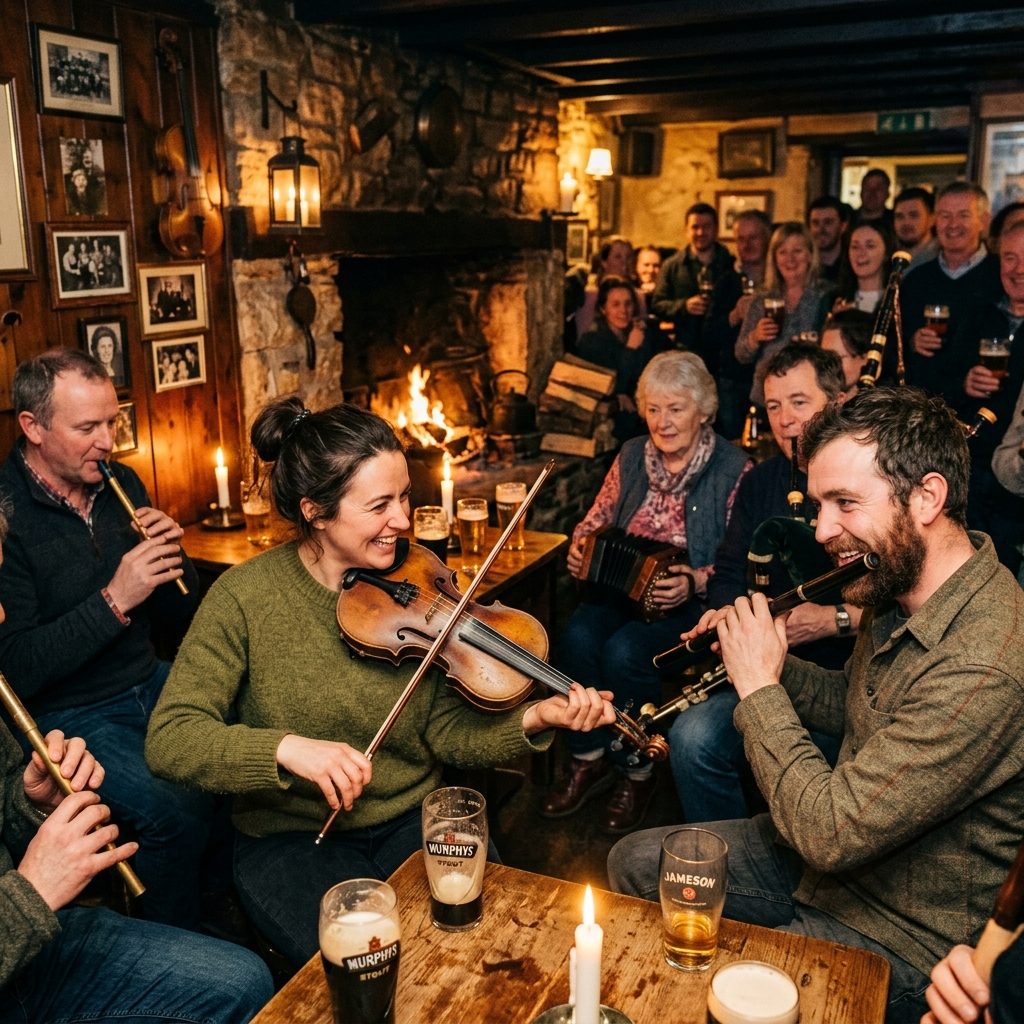
At a Glance: The Tarbolton Footprint
Table of Contents
- Introduction: A Repertoire Icon
- What Is The Tarbolton Reel? (Key & Character)
- Historical Roots: From Ayrshire to Sligo
- The Aliases of Tarbolton
- ABC Notation & Interactive Sheet Music
- Recordings & Artists: The Landmark Albums
- Tarbolton in Sessions: Playback Statistics
- What Tunes Usually Follow Tarbolton?
- What Tunes Usually Precede Tarbolton?
- Three Typical Tarbolton Session Sets
- Interesting Facts & Data Curiosities
- Why Musicians Love The Tarbolton
- Explore Tarbolton Yourself
- Frequently Asked Questions
Introduction: A Repertoire Icon
In traditional Irish sessions, a core vocabulary of tunes helps establish immediate musical coordination. The Tarbolton Reel is widely regarded as one of these standard repertoire pieces. Characterized by its driving, cyclical eighth-note patterns and key-change compatibility, it is played in sessions globally.
Database records indicate that the tune has a documented footprint of 636 session sets and 118 commercial recordings. Drawing on database analytics from Trad Tune Explorer, this guide traces the tune's historical development, examines its musical architecture, and analyzes transition patterns to explain its function within set structures.
What Is The Tarbolton Reel? (Key & Character)
The Tarbolton is a traditional 4/4 reel featuring a steady flow of eighth notes.
- Tune Type: Reel
- Key Signature: 1 sharp (F#)
- Musical Mode: E Dorian
- Common Session Tempo: 110–120 BPM
- Overall Character: Cyclical, driving, and steady. The A-part revolves around string-crossing arpeggios, while the B-part utilizes melodic leaps that resolve back to E.
- Difficulty Level: Intermediate. The repetitive E Dorian fingering shapes are relatively straightforward to memorize, while the B-part requires coordination for clean ornamentation at session speeds.
Historical Roots: From Ayrshire to Sligo
The tune takes its name from Tarbolton, a village in South Ayrshire, Scotland. In the late 18th century, Robert Burns lived nearby and co-founded the Tarbolton Bachelors' Club in 1780. Originally documented as a Scottish reel titled “Tarbolton Lodge”, the tune subsequently crossed into the Irish traditional repertoire and became associated with the Sligo style of playing.
A notable historical event in the tune's dissemination occurred in New York in 1922, when Sligo fiddler Michael Coleman recorded the tune for a 78rpm disc. Coleman paired it with two other reels: The Longford Collector and The Sailor's Bonnet. Coleman's recording influenced subsequent generations of players, and this medley — often referred to as the Tarbolton Set — became a standard sequence that traditional musicians continue to play today. Traditional accounts often connect the tune's title to the village of Tarbolton where Robert Burns co-founded the Bachelors' Club in 1780, though there is no verified historical record of Burns himself dancing to this specific melody.
The Aliases of The Tarbolton
Because traditional tunes were distributed orally, alternative names and spelling variations are common. Reconstructed database records indicate that The Tarbolton has been documented under several titles:
- The Tarbolton (or Tarbolton, The) — The modern standard title.
- Tarbolton Lodge — Reflecting its original Scottish title.
- Cooleen Bridge — A rare Irish regional title.
- Hatton Burn — An uncommon historical alias.
- Tarboltan / Tarbolten / Tarbolten Lodge — Spelling variations found in recording credits.
ABC Notation & Interactive Sheet Music
The standard setting of The Tarbolton Reel in the database was contributed by user b.maloney on February 21, 2002. Use the interactive player below to switch between the Standard Setting (E Dorian) and a setting with Chord Suggestions contributed by user BillScates.
Recordings & Artists: The Landmark Albums
The Tarbolton has a documented recording history, with 118 distinct tracks cataloged by 100 different artists. Notable recordings include:
- Michael Coleman (1922): Recorded in New York and released on the 78rpm disc Stack of Barley and Wheat. This recording established the standard Tarbolton medley.
- Johnny Doran (1947): The uilleann piper recorded it as a solo track, now compiled on The Bunch Of Keys: Complete Recordings.
- Matt Molloy & Donal Lunny (1976): Featured on Matt Molloy's solo album, performed on the wooden flute with high-velocity phrasing.
- The Chieftains (1977): Recorded on their studio album The Chieftains 7 and featured on live albums like The Chieftains Live.
- Buddy MacMaster (1989): Performed under the title "Tarbolton Lodge" on his self-titled album, showcasing a Cape Breton fiddle setting.
Search Recordings Database
Search and sort through commercial recordings of The Tarbolton Reel using real-world catalog data:
| Artist / Band ? | Album ? | Track ? | Recorded Name ? |
|---|---|---|---|
| Michael Coleman | Stack of Barley and Wheat | 10 | Tarbolton, The |
| The Chieftains | The Chieftains 7 | 1 | Tarbolton, The |
| Johnny Doran | The Bunch Of Keys: The Complete Recordings Of Johnny Doran | 4 | Tarbolton, The |
| Matt Molloy & Donal Lunny | Matt Molloy | 1 | Tarbolton, The |
| Alasdair Fraser & Natalie Haas | Abundance | 5 | Tarbolton Lodge |
| Danny Meehan | Navvy On The Shore | 21 | Tarbolton, The |
| Danny Meehan | Drimalost And Beyond - CD 1 of 2 | 16 | Tarbolton, The |
| Johnny Doran | The Master Pipers Volume 1 | 3 | Tarbolton, The |
| The Chieftains | Chronicles : 60 Years Of The Chieftains | 1 | Tarbolton, The |
| The Chieftains | The Chieftains Live | 8 | Tarbolton, The |
| Buddy MacMaster | Cape Breton Tradition | 5 | Tarbolton Lodge |
| Ashley MacIsaac & Dave MacIsaac | MacIsaac & MacIsaac: Fiddle Music 101 | 10 | Tarbolton Lodge |
| Battlefield Band | Music in Trust Vol. 2 | 3 | Tarbolton Lodge, The |
| Abby Newton | Crossing To Scotland | 6 | Tarbolton Lodge |
| Alex Francis MacKay | A Lifelong Home | 13 | Tarbolton Lodge |
Tarbolton in Sessions: Playback Statistics
In our global session database, The Tarbolton is widely played. It ranks #24 among all reels in session popularity, evidenced by 636 recorded set appearances.
Analyzing its position within sets reveals a distinct pattern: it is overwhelmingly used as a set opener. It has a starter count of 447 times, meaning that in 70.3% of its session appearances, it is played as the first tune. Its median set position is 1, and its average position is 3.08 (influenced by longer multi-tune sets). This suggests that players typically use the tune to launch a set, establishing a steady tempo and recognizable melody for other session participants.
What Tunes Usually Follow Tarbolton?
When transitioning out of The Tarbolton Reel, database statistics indicate that players show a strong preference for a single sequence:
Out of 521 recorded set transitions out of Tarbolton, 346 times (66.41%) transition directly into The Longford Collector. Among those transitions, 339 times (90.88%) continue into The Sailor's Bonnet. View The Tarbolton Set Follow-On Tree →
This sequence demonstrates a clear musical progression in tonality and register:
- E Dorian to G Major (Relative Shift): E Dorian and G Major share the exact same key signature (1 sharp, F#). Transitioning from E Dorian to G Major shifts the tonal center from E to its relative major G. The melody shifts to a brighter, more open register without requiring any changes to accidental fingerings.
- G Major to D Major (Fifth Shift): Shifting from G Major (1 sharp) to D Major (2 sharps, F# and C#) is a modulation up a perfect fifth. This introduces a second sharp (C#), raising the pitch register and increasing the melodic tension to resolve the set.
In commercial recordings, The Longford Collector is also the top follow-on choice, occurring 37 times and accounting for 46.84% of recorded follow-ons. Other recorded choices include The Fermoy Lasses (3.8%) and Lucy Campbell (2.53%).
What Tunes Usually Precede Tarbolton?
Because Tarbolton is played as the set opener in 70.3% of sets, incoming transitions are less common. However, when it is placed later in sets, database records show a few typical preceding tunes:
- Bog An Lochan (13.64% of preceding sets, 9.09% of recordings): A traditional Scottish strathspey in E Dorian. Transitioning from a strathspey to a reel is a common technique in Cape Breton and Donegal fiddle styles. The dotted, snappy rhythm of the strathspey resolves into the even, rolling flow of Tarbolton, while maintaining E Dorian modal consistency.
- The Sailor's Bonnet (7.35% of preceding sets): Occurring in sets where the standard Coleman medley is looped or repeated.
- The Longford Collector (1.88% of preceding sets): Occurring in reverse-order sets.
- Tam Lin / The Howling Wind (1.24% of preceding sets): Providing a minor-key entry (D minor) before resolving into E Dorian.
Three Typical Tarbolton Session Sets
Here are three data-backed ways to group The Tarbolton Reel in sets:
Set 1: The Definitive Coleman Set
Standard TrioSet 2: The Scottish Strathspey-to-Reel Transition
Donegal/Cape Breton StyleSet 3: The Minor Key Climb Set
Modern ContrastInteresting Facts & Data Curiosities
- Ranked #13 in Versatility: With a versatility score of 199 connected tunes, Tarbolton is in the upper tier of session reels, acting as a harmonic bridge between modal and major key sets.
- The Burns Connection: The town of Tarbolton, Burns's home, was the setting for several of his poems, and historical accounts indicate that he co-founded the Bachelors' Club where social dancing occurred.
- Coleman's Tempo: Michael Coleman's original 1922 recording was played at a fast tempo. Fiddle players suggest this was partially due to the 3-minute recording limit of early 78rpm shellac records.
Why Musicians Love The Tarbolton
The tune's popularity is supported by its ergonomic qualities on traditional instruments. On the fiddle, the A-part's arpeggios fit comfortably under the left-hand fingers and allow for open-string crossings on the D and A strings, producing a resonant tone. For wind players (flute, tin whistle, and pipes), the phrasing leaves natural breathing points, and the E Dorian mode aligns well with uilleann pipe regulators and flute fingerings.
Explore Tarbolton Yourself
Explore these related data-driven tools in our database:
Frequently Asked Questions
What key is The Tarbolton Reel played in?
The Tarbolton Reel is traditionally played in E Dorian. The sheet music carries a key signature of 1 sharp (F#), sharing the same accidental structure as G Major, but the music resolves and centers around E.
Why is The Tarbolton Reel played before The Longford Collector?
This transition was established by Michael Coleman in his landmark 1922 recording. Musically, it works due to a smooth 'relative' key shift from E Dorian to G Major. G Major shares the exact same notes as E Dorian, making the transition seamless.
Is The Tarbolton Reel of Scottish or Irish origin?
The tune originated as a Scottish reel named 'Tarbolton Lodge' (named after the town of Tarbolton in Ayrshire). However, Sligo musicians, particularly Michael Coleman, adopted the tune into the Irish traditional repertoire, renaming it 'The Tarbolton Reel'.
How can I learn The Tarbolton Reel easily?
Start by practicing the arpeggiated A-part slowly, focusing on getting a clean open-string sound. Once the fingerings are memorized, speed up the tempo and practice transitioning directly into The Longford Collector.