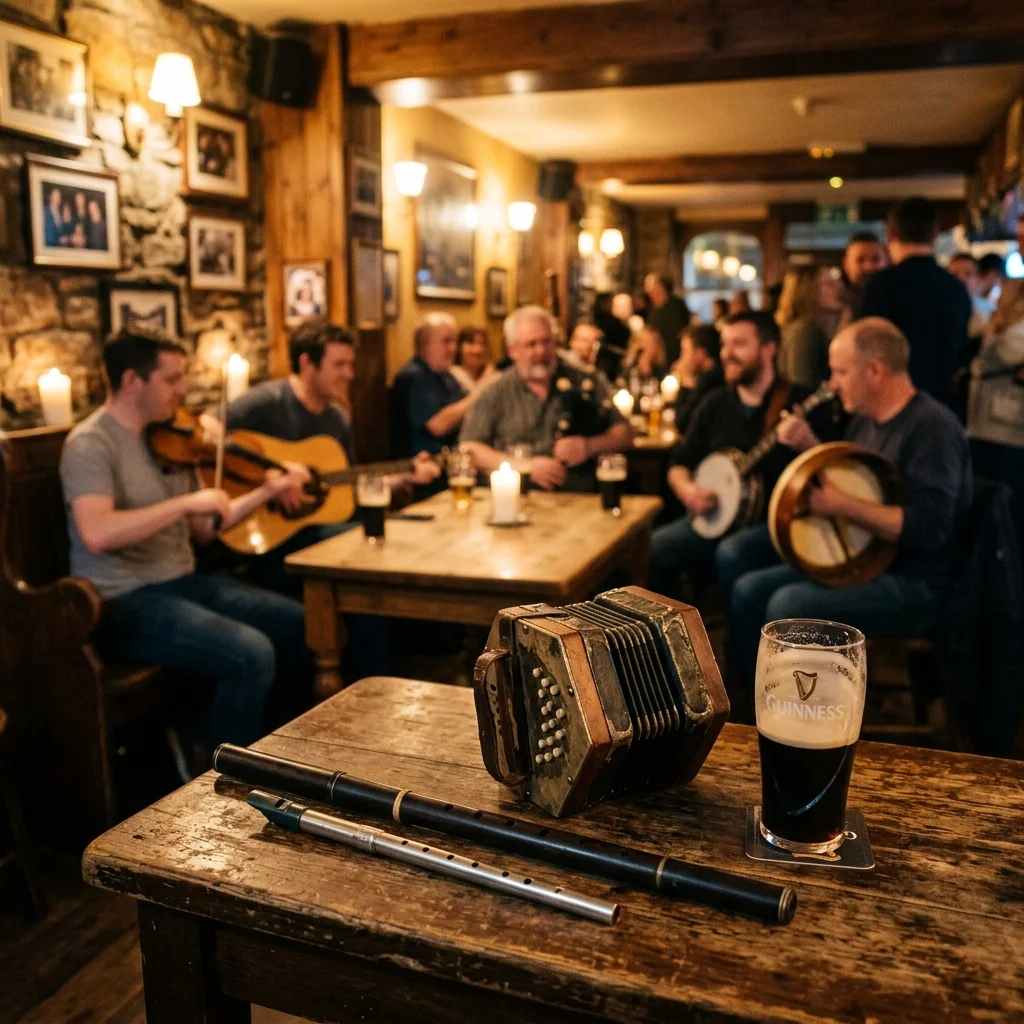
At a Glance: The Butterfly Footprint
Table of Contents
- Introduction: The Flight of the Slip Jig
- What Is The Butterfly? (Key, Rhythm, & Meter)
- Historical Roots: Tommy Potts and Dublin Innovation
- The Aliases of The Butterfly
- ABC Notation & Interactive Sheet Music
- Recordings & Artists: The Landmark Albums
- The Butterfly in Sessions: Playback Statistics
- What Tunes Usually Follow The Butterfly?
- What Tunes Usually Precede The Butterfly?
- Three Curated Sets featuring The Butterfly
- Interesting Facts & Data Curiosities
- Why Musicians Recommend the Tune
- Frequently Asked Questions
Introduction: The Flight of the Slip Jig
While standard 6/8 jigs and 4/4 reels dominate many traditional Irish music sessions, the 9/8 slip jig offers a distinct rhythmic feel. The Butterfly is widely recognized as the most frequently played slip jig in the modern repertoire. With its modal E minor phrasing and hopping structure, it serves as a common entry point for players learning the 9/8 rhythm.
According to database records, the tune has a footprint of 1,335 session sets and 137 commercial recordings, registering 182 outgoing and 165 incoming transition paths. Using database analytics from Trad Tune Explorer, this guide details the tune's history, sheet music settings, and transition patterns.
What Is The Butterfly? (Key, Rhythm, & Meter)
The Butterfly is played in 9/8 meter as a slip jig. Unlike a standard double jig, each measure contains three main beats, each divided into three eighth notes.
- Tune Type: Slip Jig (9/8 time)
- Key Signature: 1 sharp (F#)
- Musical Mode: E Minor (Aeolian, utilizing C natural)
- Common Session Tempo: 110–120 BPM
- Overall Character: Flowing, syncopated, and hopping. The A-part utilizes repeating figures, the B-part introduces an octave climb, and the C-part provides a descending scalar sequence.
- Difficulty Level: Easy. The melody utilizes repetitive shapes that make the fingerings accessible, although the 9/8 timing requires initial practice for steady phrasing.
Historical Roots: Tommy Potts and Dublin Innovation
The composition of the tune is associated with Dublin fiddle player Tommy Potts (1912–1988), who recorded a landmark solo setting on his 1972 album The Liffey Banks. Potts was known for an individual style that incorporated classical phrasing and rhythmic variations. While the tune is widely credited to Potts, some traditional sources suggest he adapted and re-phrased an older melody, potentially 'Skin the Peeler' or 'The Reel of Bogie', transforming it from a reel or simple slip jig into a three-part modal masterpiece.
The tune entered wider traditional repertoire through The Bothy Band, who recorded an instrumental arrangement on their 1975 self-titled debut album. This recording established the tune's place in modern session circles. Later recordings, such as Martin Hayes on The Butterfly (2021) and fiddle player Kevin Burke on Kevin Burke In Concert, have demonstrated the melody's suitability for different styles.
The Aliases of The Butterfly
Due to its connection to older tunes and spelling variations, the tune appears under several aliases:
- The Butterfly (or Butterfly, The) — The standard modern title.
- Fiona — An alias under which it was recorded by Cape Breton/Scottish ensembles.
- Red Admiral Butterfly, The — A descriptive title used by flute player James Galway.
- The Reel of Bogie (or Reel of Bogie, The) — The title of the older melody Potts adapted.
- Skin the Peelers (or Skin the Peeler) — A historical regional name.
ABC Notation & Interactive Sheet Music
The standard setting of The Butterfly in our database was contributed by user Jeremy in 2001. Below, you can toggle between the Standard Setting (E Minor) and a chorded setting contributed by user Bryce in 2013.
Recordings & Artists: The Landmark Albums
The Butterfly has been recorded 137 times across commercial albums. Notable recordings include:
- Tommy Potts (1972): Released on The Liffey Banks. The solo fiddle recording that established the modern setting.
- The Bothy Band (1975): Featured on their debut album 1975. A driving ensemble setting that brought the slip jig to sessions.
- Martin Hayes & Brooklyn Rider (2021): Featured on The Butterfly, demonstrating a slow, lyrical chamber-folk arrangement.
- Mairéad Nesbitt (2001): Featured on Raining Up, showing a modern, commercial fiddle interpretation.
- James Galway & The Chieftains (1987): Recorded on In Ireland under the title "Red Admiral Butterfly, The".
- Kevin Burke (1992): Featured on Kevin Burke In Concert, displaying a clean, Sligo-style fiddle phrasing.
Search Recordings Database
Search and sort through commercial recordings of The Butterfly slip jig using real-world catalog data:
| Artist / Band ? | Album ? | Track ? | Recorded Name ? |
|---|---|---|---|
| Tommy Potts | The Liffey Banks | 6 | Butterfly, The |
| The Bothy Band | 1975 | 13 | Butterfly, The |
| The Bothy Band | Afterhours | 2 | Butterfly, The |
| Martin Hayes and Brooklyn Rider | The Butterfly | 4 | Butterfly, The |
| Mairéad Nesbitt | Raining Up | 6 | Butterfly, The |
| Mairéad Nesbitt | Hibernia | 11 | Butterfly, The |
| James Galway And The Chieftains | In Ireland | 7 | Red Admiral Butterfly, The |
| The Chieftains | Chappell Recorded Music Library - National Ireland | 12 | Butterfly, The |
| Kevin Burke | Kevin Burke In Concert | 1 | Butterfly, The |
| Patrick Ball | Carolan's Dream | 1 | Butterfly, The |
| John Spiers, Jon Boden... | Olde Irish Jigs and Reels | 8 | Butterfly, The |
| Rory Campbell & Malcolm Stitt | Nusa | 4 | Fiona |
| Paddy Glackin, Jolyon Jackson | Hidden Ground | 9 | Butterfly, The |
| Paul McNevin | Learning Irish Fiddle | 15 | Butterfly, The |
The Butterfly in Sessions: Playback Statistics
In session databases, The Butterfly is ranked as the #1 most popular slip jig of all time.
Analyzing its position within sets reveals that it acts primarily as a set starter. It has an opener count of 892 times, meaning that in 66.8% of its session appearances, it is played in the first position. Its median set position is 1. This suggests that players typically use the tune to open a set, establishing a steady tempo and recognizable melody for other session participants.
What Tunes Usually Follow The Butterfly?
When transitioning out of The Butterfly, database statistics indicate a strong preference for staying within the slip jig rhythm and E minor key signature:
This is the most common follow-on transition, occurring 163 times and accounting for 18.27% of all outgoing transitions from The Butterfly. View The Butterfly Set Follow-On Tree →
The second most common transition occurs 136 times, accounting for 15.25% of outgoing transitions, shifting the mode from E minor to E Dorian. View The Butterfly Set Follow-On Tree →
These transitions demonstrate distinct musical logic:
- The Butterfly → The Kid on the Mountain (Key & Rhythm Stability): Both tunes are 9/8 slip jigs in E Minor. Transitioning between them maintains E minor drone stability. This transition is popular because *The Kid on the Mountain* climbs into a higher register, providing a natural lift in energy without key changes.
- The Butterfly → A Fig For A Kiss (Minor-to-Dorian Shift): Moving from E Minor (utilizing C natural) to E Dorian (utilizing C#) represents a modal shift. This raises the sixth scale degree, shifting the atmosphere of the set from a dark, minor sound to a brighter, modal color.
What Tunes Usually Precede The Butterfly?
In sets where The Butterfly is played in the second or third position, it is preceded by:
- A Fig For A Kiss (17.46% of incoming sets): Out of 590 incoming transitions, 103 sets transition from A Fig For A Kiss (E Dorian) into The Butterfly. This represents the reciprocal shift from E Dorian back to E Minor.
- The Kid On The Mountain (13.19% of incoming sets): 55 sets transition from the E minor slip jig The Kid On The Mountain into The Butterfly, maintaining key and meter consistency.
- The Snowy Path (17.21% of incoming sets): 37 sets transition from Alastair Fraser's 9/8 slip jig The Snowy Path (G Major) into The Butterfly, shifting from G Major to its relative minor E Minor.
Three Curated Sets featuring The Butterfly
Here are three typical session sets incorporating The Butterfly:
Set 1: The Standard Slip Jig Trilogy
Popular StapleSet 2: The Modern Revival Set
Modulating FinishSet 3: The Jig-to-Slip-Jig Rhythmic Shift
Rhythmic ModulationView Morrison's Jig Complete Guide →
Interesting Facts & Data Curiosities
- Tommy Potts' Adaptations: Potts did not consider himself the sole composer of the tune, but rather an arranger. Fiddle players suggest his B-part and C-part ornamentations were influenced by classical violin techniques.
- The Slip Jig Revival: In the early 20th century, slip jigs were less common in commercial recordings compared to reels and double jigs. Fiddle recordings by The Bothy Band and uilleann piping by Liam O'Flynn contributed to a revival of the rhythm.
- Galway's Flute Tone: Flute player James Galway recorded the tune under the title "Red Admiral Butterfly", showcasing the tune's suitability for classical silver flutes.
Why Musicians Recommend the Tune
Fiddle players find the A-part's string crossings comfortable to execute, utilizing the open D and A strings to support a steady rhythm. Flute and whistle players find the tune's E natural minor scale fits cleanly on keyless D flutes, allowing for natural breathing points at the end of each three-bar phrase.
Frequently Asked Questions
What meter is a slip jig?
A slip jig is played in 9/8 meter, featuring three beats per measure with three eighth notes per beat. This creates a distinctive, hopping rhythm compared to the standard 6/8 double jig.
Who composed The Butterfly?
The tune is credited to Dublin fiddle player Tommy Potts (1912-1988), who developed its three-part structure by adapting older traditional phrases.
What key is The Butterfly played in?
The Butterfly is played in E Minor (1 sharp in the key signature). Its melody highlights natural minor phrases, utilizing C natural, which distinguishes it from the Dorian-mode settings of other E minor tunes.
Why is The Butterfly often paired with The Kid on the Mountain?
They are both slip jigs in E minor, sharing the same key signature and structure. The transition is common in sessions because it maintains E minor drone stability while increasing melodic energy.