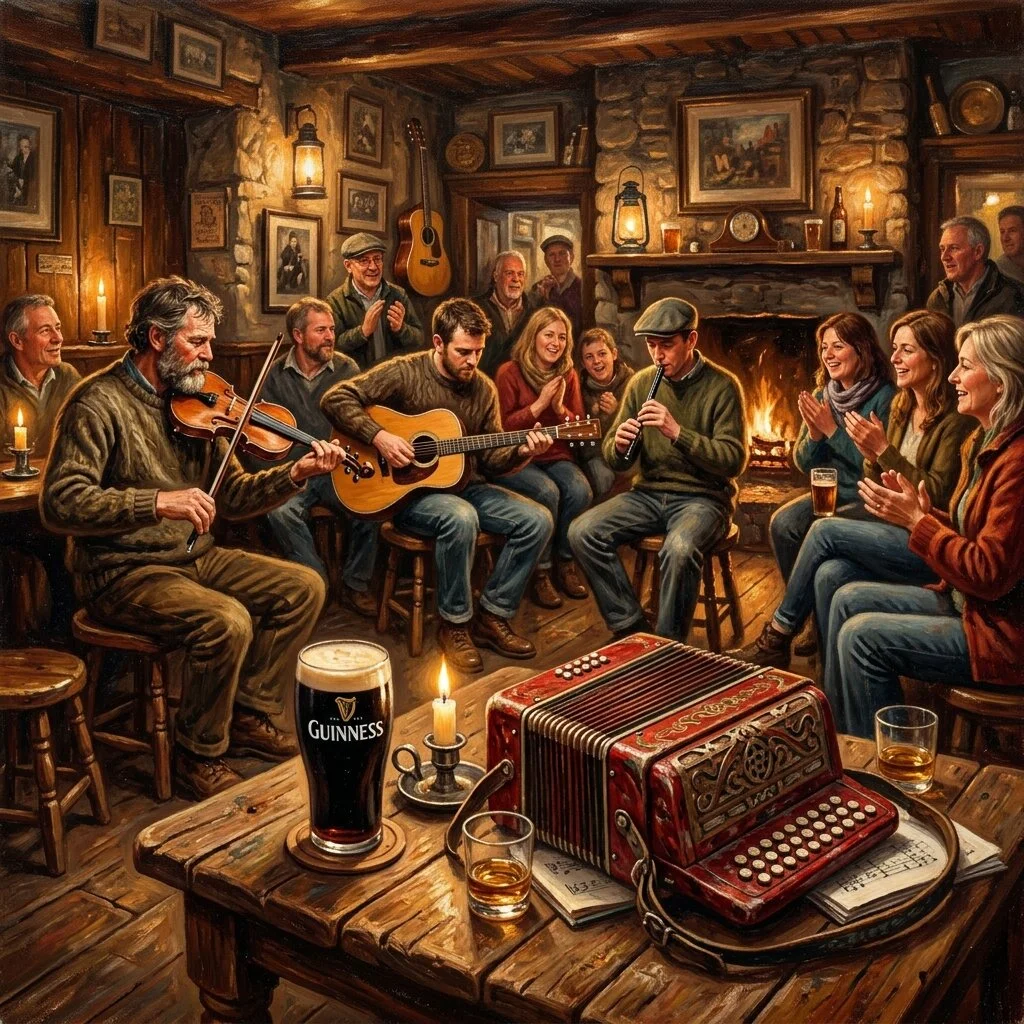
The most influential commercial recording of Cooley's Reel is by The Bothy Band on their 1978 album Live In Concert. It set the gold standard for speed and energy in modern Irish music. For button accordion, study Tony MacMahon's 1972 rendition; for concertina, listen to Noel Hill and Tony Linnane (1979). Sourced from our database of 197 commercial recordings, Cooley's is the #1 most played reel in traditional sessions worldwide, appearing in 1,670 unique sets.
Why this page is useful: This data-driven guide analyzes 197 albums and 1,670 user sets from the Trad Tune Explorer database. We break down Cooley's history, E Dorian musical structure (including ABC notation), chronological timeline, 25 landmark recordings, and popular tune transitions.
- 1. Introduction: The Reign of Cooley's Reel
- 2. How Cooley's Reel Compares with Other Reels
- 3. The Session Stats: Cooley's by the Numbers
- 4. Anatomy of a Session Classic (Musical Analysis)
- 5. Chronological Recording Timeline
- 6. The 25 Most Recorded & Notable Versions
- 7. Popular Sets and Tune Pairings
- 8. Frequently Asked Questions (FAQ)
- 9. Conclusion: Finding Your Voice on Cooley's
1. Introduction: The Reign of Cooley's Reel
If you walk into a traditional Irish music session anywhere in the world—from the flagstone-floored pubs of County Clare to the acoustic corners of Boston, Tokyo, or Munich—and the musicians strike up a reel set in a minor key, there is a very high probability you will hear Cooley's Reel. It is, by almost any metric, the undisputed king of Irish session reels. With its driving rhythm, memorable melody, and accessible fingering, it serves as a universal musical language connecting players across generations and continents.
The tune is named after Joe Cooley (1924–1973), a legendary button accordion player from Peterswell, County Galway. Cooley was a towering figure in the mid-20th-century traditional music revival, renowned for his robust, rhythmic, and deeply soulful playing style. He was an early member of the historic Tulla Céilí Band, and spent years in the United States, particularly in Chicago and San Francisco, leaving an indelible mark on American-Irish music communities.
Yet, Joe Cooley did not compose the tune. It was a traditional reel, previously known by titles like "Put the Cake in the Dresser" or "Luttrell's Pass". In the mid-20th century, Cooley played this reel with such vigor, frequency, and signature style that his name became permanently fused to the melody. Today, it stands as the absolute #1 most bookmarked and recorded reel on the community platform TheSession.org. For learners and seasoned veterans alike, tracing its commercial recording history is a masterclass in how a tune travels, adapts, and cements itself into the living tradition.
- The Standard Key: Over 98% of musicians play it in E Dorian. It is rarely played in E natural minor.
- Joe Cooley's Legacy: Joe Cooley did not compose the tune; it was a traditional tune (like "Put the Cake in the Dresser") that became named after him because of his driving, bouncy Galway button accordion style.
- Landmark Set: The most popular session set starts with Drowsy Maggie, transitions to Cooley's Reel, and resolves into The Wise Maid.
- Recording Insights: Sourced from 197 commercial recordings, study the 1978 Bothy Band version for Sligo-tempo drive and Noel Hill's 1979 duet for concertina ornamentation.
2. How Cooley's Reel Compares with Other Popular Session Reels
While Cooley's Reel is famously popular, how does it stack up against other giants of the tradition when we analyze hard numbers? To answer this, we queried the Trad Tune Explorer database, examining over 20,000 sets and thousands of commercial albums.
The table below compares Cooley's Reel with four other premier session reels based on three distinct metrics: live session set occurrences, commercial recording counts, and community bookmark popularity.
| Reel Title | Key / Mode | Session Sets Count (Rank) | Commercial Recordings (Rank) | User Bookmarks (Rank) |
|---|---|---|---|---|
| Cooley's (ID: 1) | E Dorian | 1,670 (#1) | 197 (#11) | 568 (#2) |
| Drowsy Maggie (ID: 27) | E Dorian / E minor | 1,358 (#2) | 203 (#10) | 636 (#1) |
| The Maid Behind the Bar (ID: 64) | D Major | 909 (#3) | 130 (#44) | 299 (#4) |
| The Banshee (ID: 8) | G Major | 899 (#4) | 153 (#26) | 288 (#6) |
| The Silver Spear (ID: 182) | D Major | 880 (#5) | 230 (#5) | 216 (#9) |
A fascinating pattern emerges from the data: Cooley's is the undisputed #1 reel in live session sets (1,670 occurrences) but drops to #11 in commercial recordings (197). Why?
Commercial studio albums often favor complex, rare, or Sligo-tempo showpieces (like The Pigeon on the Gate or The Mason's Apron) to demonstrate instrumental virtuosity. However, in live, participatory sessions, community musicians prioritize accessible fingering, strong pulse, and group cohesion—making the steady, E Dorian drive of Cooley's the ultimate choice for pub circles. You can explore these patterns using our Recording Transitions tool.
3. The Session Stats: Cooley's by the Numbers
Using data compiled by the Trad Tune Explorer database, we can see exactly how deeply Cooley's Reel has embedded itself into commercial recordings and session sets. The statistics below offer a quantitative look at this classic tune:
| Statistic Metric | Value / Detail | Context & Relevance |
|---|---|---|
| Total Commercial Recordings | 197 | Albums featuring Cooley's Reel on their tracklists. Browse all recordings → |
| Total Database Occurrences | 204 | Includes duplicate track listings and reissue appearances. |
| Unique Recording Artists | 166 | Soloists, céilí bands, and groups who have recorded the tune. Explore their Shared Pathways → |
| Number of Settings (Transcriptions) | 32 | Distinct variations of notation submitted by community players. View all settings → |
| Earliest Database Upload | May 14, 2001 | Transcribed and uploaded to the database by user Jeremy. |
| Standard Key / Mode | E Dorian (E dor) | Uses the G major scale (F#) starting on E, creating a bright-minor sound. |
3. Anatomy of a Session Classic (Musical Analysis)
Musically, Cooley's is classified as a two-part reel in 4/4 time. It is structured in the standard AABB form, with each part consisting of eight measures. What makes it so attractive to musicians is its balanced mix of driving syncopation and repetitive fingering patterns that build speed easily.
The A-part is built around E minor chord structures, contrasted against strong D major chord transitions. It opens with an emphatic leap up to the B note, immediately establishing the rhythmic pulse:
|:D2|EBBA B2 EB|B2 AB dBAG|FDAD BDAD|FDAD dAFD|
On the fiddle and button accordion, the roll on E (often played as ~E3 or EB~B2)
provides a robust rhythmic bounce. The transition to the D major chord (measures 3 and 4) requires active
string crossing or bellows work but resolves back to E Dorian cleanly.
The B-part takes the tune up an octave, beginning with a driving run of eighth notes:
|:gf|eB B2 efge|eB B2 gedB|A2 FA DAFA|A2 FA defg|Here, the high G and F# notes provide melodic lift. The second half of the B-part mirrors the resolution of the A-part, bringing the tune back down to its home base on E. For accompanists (guitar, bouzouki, piano), Cooley's allows for a variety of styles, from simple Em to D major chord shifts, to more modern driving bassline movements using C major, G major, and B minor chords to underscore the Dorian mode's bright sixth (C#).
Below is the primary transcription of Cooley's Reel (Setting #1), originally uploaded by Jeremy on May 14, 2001, which remains the gold standard for session players:
X:1
T:Cooley's
R:reel
M:4/4
L:1/8
K:Edorian
|:D2|EBBA B2 EB|B2 AB dBAG|FDAD BDAD|FDAD dAFD|
EBBA B2 EB|B2 AB defg|afec dBAF|DEFD E2:|
|:gf|eB B2 efge|eB B2 gedB|A2 FA DAFA|A2 FA defg|
eB B2 efge|eB B2 gedB|A2 FA dBAF|DEFD E2:|4. Chronological Recording Timeline
How did a local Galway reel grow into a global acoustic phenomenon? The answer lies in the timeline of its commercial recordings, showing how major milestones in Irish music history elevated the tune:
5. The 25 Most Recorded & Notable Versions
Musicians looking to study the nuances of Cooley's Reel should listen to a wide variety of instruments and styles. Below is a detailed analysis of the 25 most recorded, historical, and stylistically significant versions of Cooley's Reel from the Trad Tune Explorer database.
1. The Bothy Band — Live In Concert (1978)
ID: 5 | Track 5, Tune #4Perhaps the most famous live recording of the tune. Featuring Tommy Peoples (fiddle), Matt Molloy (flute), Paddy Keenan (uilleann pipes), and Micheál Ó Domhnaill (guitar), this version is celebrated for its incredible lift, drive, and speed. It serves as a masterclass in ensemble dynamic control.
- Tune #1: Michael Gorman's (Hop Jig, ID: 1714)
- Tune #2: The Frieze Britches (Jig, ID: 34)
- Tune #3: The Road To Lisdoonvarna (Reel, ID: 249)
- Tune #4: Cooley's (Reel, ID: 1)
2. Frankie Gavin and Paul Brock — Ómós Do Joe Cooley (1986)
ID: 208 | Track 1, Tune #1A deliberate tribute to Joe Cooley, featuring Frankie Gavin's Sligo-influenced fiddle playing and Paul Brock's masterfully clean button accordion technique. They open the album with Cooley's Reel, playing with a bouncy, traditional East Galway lift that captures Cooley's own spirit.
- Tune #1: Cooley's (Reel, ID: 1)
- Tune #2: The Wise Maid (Reel, ID: 118)
3. Noel Hill and Tony Linnane — Noel Hill And Tony Linnane (1979)
ID: 27 | Track 12, Tune #2A standard-setting recording for concertina and fiddle players. Noel Hill's rhythmic concertina ornamentation (cuts, rolls, and bellows bellows-bouncing) combined with Tony Linnane's sweet Clare fiddle style makes this a must-listen for learners looking to master micro-ornamentation.
- Tune #1: Lady Ann Montgomery (Reel, ID: 59)
- Tune #2: Cooley's (Reel, ID: 1)
4. Tony MacMahon — Traditional Irish Accordion (1972)
ID: 325 | Track 1, Tune #2Recorded by one of the absolute giants of the button accordion. Tony MacMahon plays the tune under the alternative title "Joe Cooley's Fancy." His style is marked by a deep, dark, and highly rhythmic bellows-driven bounce, capturing the pure soul of Clare accordion playing.
- Tune #1: Joe Cooley's Morning Dew (Reel, ID: 9828)
- Tune #2: Cooley's (Reel, ID: 1)
5. Gaelic Storm — Gaelic Storm (1998)
ID: 127 | Track 8, Tune #3Famous for their appearance in the movie Titanic, Gaelic Storm brought this reel to a massive global rock audience. Their version features a driving, highly energized modern folk band arrangement with guitar, djembe, and mandolin backing up a crisp fiddle lead.
- Tune #1: Julia Delaney (Reel, ID: 589)
- Tune #2: Mouth Of The Tobique (Reel, ID: 423)
- Tune #3: Cooley's (Reel, ID: 1)
6. The Dubliners — Celebration CD 1 (Reissue)
ID: 1255 | Track 4, Tune #1John Sheahan's driving fiddle and Barney McKenna's iconic tenor banjo style define this raw and lively Dubliners recording. This is a classic example of the pub session style that popularized the tune across Europe in the 1970s folk revival.
- Tune #1: Cooley's (Reel, ID: 1)
- Tune #2: Twilight In Portroe (Reel, ID: 4091)
- Tune #3: The Mullingar Races (Reel, ID: 225)
7. The Tulla Céilí Band — 40th Anniversary 1946 - 1986 (1986)
ID: 2147 | Track 9, Tune #1As a former band member, Joe Cooley's influence is clear in the Tulla's signature lift. This recording is a perfect reference for the classic, steady-tempo Clare céilí band style, designed specifically for set dancing with heavy piano and snare drum accents.
- Tune #1: Cooley's (Reel, ID: 1)
- Tune #2: Drag Her Round The Road (Reel, ID: 1148)
- Tune #3: Come West Along The Road (Reel, ID: 474)
8. The Tulla Céilí Band — A Celebration Of 50 Years (1996)
ID: 894 | Track 9, Tune #1Recorded ten years after their 40th anniversary, this recording features a larger, more polished ensemble sound but retains the exact Clare swing. The set transitions from Cooley's into a driving rendition of the Cup of Tea and resolves with the Wise Maid.
- Tune #1: Cooley's (Reel, ID: 1)
- Tune #2: Cup Of Tea, The (Reel, ID: 20)
- Tune #3: Wise Maid, The (Reel, ID: 118)
9. John McGreevy and Seamus Cooley — McGreevy And Cooley (1974)
ID: 2070 | Track 15, Tune #2Seamus Cooley (Joe's brother) playing wooden flute alongside Sligo-style fiddle legend John McGreevy in Chicago. The style is tight, rhythmic, and represents the historic immigrant-community sound that kept Irish traditional music alive in urban midwest America.
- Tune #1: Tim Moloney's (Reel, ID: 621)
- Tune #2: Cooley's (Reel, ID: 1)
10. Peter O'Loughlin — A Musical Life
ID: 7539 | Track 12, Tune #1Clare fiddle and concertina master Peter O'Loughlin presents Cooley's Reel as a solo track, playing it with a relaxed, deep, and unhurried tempo. He focuses heavily on the steady pulse and classic bowing patterns characteristic of East Clare.
- Tune #1: Cooley's (Reel, ID: 1)
11. John Carty — I Will If I Can (2000s)
ID: 1778 | Track 9, Tune #1John Carty, a master of multiple traditional instruments, records a highly influential version on banjo. His playing style features crisp triplets and incredible cross-string picking that highlights the syncopation of the E Dorian melody.
- Tune #1: Cooley's (Reel, ID: 1)
- Tune #2: The Maid Behind The Bar (Reel, ID: 64)
12. Johnny Connolly — Drioball na Fáinleoige (1990s)
ID: 1304 | Track 4, Tune #1A beautiful, bright button accordion performance by Connemara melodeon and accordion master Johnny Connolly. This version demonstrates a faster, punchier, Western style of accordion playing that stands in contrast to the Clare bellows-shaking style.
- Tune #1: Cooley's (Reel, ID: 1)
- Tune #2: Come West Along The Road (Reel, ID: 474)
13. Kevin Keegan — Irish Accordion
ID: 7718 | Track 10, Tune #2Kevin Keegan’s accordion style is fluid, bouncy, and deeply traditional. Keegan was another major exponent of the Galway style who brought his music to San Francisco. Playing Cooley's as a follow-on to Father Kelly's, he highlights the accordion's capacity for rapid treble ornamentation.
- Tune #1: Father Kelly's (Reel, ID: 791)
- Tune #2: Cooley's (Reel, ID: 1)
14. Bobby Casey et al. — Traditional Irish Music From Galway And Clare (1977)
ID: 3455 | Track 6, Tune #2Recorded in London during the peak of the Irish emigrant music scene. Fiddle player Bobby Casey joins Raymond Roland (accordion) and Liam Farrell (banjo) in a classic ensemble recording. They play at a medium session tempo, full of swing and Clare-style ornamentation.
- Tune #1: Across The Fence (Reel, ID: 1294)
- Tune #2: Cooley's (Reel, ID: 1)
15. Na Fili — An Ghaoth Anair (The West Wind) (1974)
ID: 639 | Track 5, Tune #1An acoustic trio consisting of Tomas Ó Canainn (uilleann pipes), Matt Cranitch (fiddle), and Raymond Roland (accordion). This recording is slower, clean, and highlights the counterpoint between Cranitch's precise Munster fiddle bowing and Ó Canainn's pipes.
- Tune #1: Cooley's (Reel, ID: 1)
- Tune #2: The Mountain Lark (Reel, ID: 884)
16. Matt Cunningham — Dance Music Of Ireland, Volume 3
ID: 2467 | Track 24, Tune #2Matt Cunningham's extensive recordings are the bible for set dancers. This version has a highly regular, rock-steady tempo, with pronounced melody leads. Excellent for beginners who want to listen to a clear, uncluttered statement of the tune to get it under their fingers.
- Tune #1: The Plains Of Boyle (Hornpipe, ID: 652)
- Tune #2: Cooley's (Reel, ID: 1)
17. Seán Ryan and Dan Coughlan — Ryan & Coughlan, Vol. 1
ID: 6904 | Track 11, Tune #2A classic duet featuring Seán Ryan on whistle and Dan Coughlan on guitar. For whistle players, this recording shows how to navigate the E Dorian rolls, cuts, and breath control at a moderate pace without losing the tune's driving groove.
- Tune #2: Cooley's (Reel, ID: 1)
18. Shaskeen — The Joys Of Life
ID: 2152 | Track 8, Tune #2The long-running band Shaskeen presents a classic Galway-style group setting. Cooley's is positioned as the middle tune, sandwiched between the driving Morning Dew and the lifted Earl's Chair, showing how to construct a standard three-reel set.
- Tune #1: The Morning Dew (Reel, ID: 69)
- Tune #2: Cooley's (Reel, ID: 1)
- Tune #3: The Earl's Chair (Reel, ID: 221)
19. Eddie Moloney — Master Musician, Disc 2 of 2
ID: 5051 | Track 12, Tune #1Galway flute player and fiddler Eddie Moloney represents the classic mid-century style. Playing Cooley's Reel on the flute, his version features strong puffing breath accents and rapid finger cuts that are highly characteristic of the North Clare/South Galway flute style.
- Tune #1: Cooley's (Reel, ID: 1)
- Tune #2: Scotch Mary (Reel, ID: 96)
20. Chris Droney — Down From Bell Harbour (1990s)
ID: 1888 | Track 4, Tune #1Chris Droney, the late legendary concertina player from Bell Harbour, County Clare, plays Cooley's Reel with a bouncy, single-note staccato Clare style. The tempo is steady and the focus is on a crisp rhythm that is perfect for step dancing.
- Tune #1: Cooley's (Reel, ID: 1)
- Tune #2: Cronin's (Hornpipe, ID: 10790)
21. Tom Doherty — Take The Bull By The Horns
ID: 1210 | Track 11, Tune #2Tom Doherty, playing a robust double-row button accordion, drives Cooley's Reel forward with thick chordal bass accompaniment on the left hand. His recording highlights the driving, energetic style common in the western counties of Mayo and Galway.
- Tune #1: The Sally Gardens (Reel, ID: 98)
- Tune #2: Cooley's (Reel, ID: 1)
22. Michael Gorman — The Sligo Champion (CD 1 of 2) (Historical)
ID: 1163 | Track 22, Tune #1An invaluable historical recording of Sligo fiddle legend Michael Gorman. He plays the tune solo under its older name, "Put the Cake in the Dresser." His style features the rapid Sligo bowing and sliding notes that represent a pre-revival era of traditional music.
- Tune #1: Cooley's (Reel, ID: 1)
23. Wendy MacIsaac — The 'Reel' Thing (2000s)
ID: 3505 | Track 6, Tune #3This recording showcases the Cape Breton stylistic adaptation of the tune. Fiddler Wendy MacIsaac plays with the sharp, driving, and heavily syncopated Cape Breton bowing style, combining Cooley's with classic Scottish and local Cape Breton reels.
- Tune #1: King Of The Fairies (Hornpipe, ID: 475)
- Tune #3: Cooley's (Reel, ID: 1)
- Tune #4: Drowsy Maggie (Reel, ID: 27)
- Tune #5: The Tarbolton (Reel, ID: 560)
24. Sharon Corr — Dream Of You (2010)
ID: 3801 | Track 8, Tune #1Fiddler Sharon Corr (of the famous Irish folk-pop band The Corrs) records Cooley's Reel as a solo instrumental on her debut solo album. This version is polished, lyrical, and showcases the crossover pop-folk production style of the early 2010s.
- Tune #1: Cooley's (Reel, ID: 1)
25. Ceoltóirí Cultúrlainne — Foinn Seisiún 1 (2000s)
ID: 1227 | Track 28, Tune #1The ultimate educational reference. Recorded by Comhaltas Ceoltóirí Éireann, this is a clean, medium-tempo group recording designed specifically for students and session learners to play along with. It couples Cooley's with the Wise Maid and the Bird in the Bush.
- Tune #1: Cooley's (Reel, ID: 1)
- Tune #2: The Wise Maid (Reel, ID: 118)
- Tune #3: The Bird In The Bush (Reel, ID: 629)
Traditional Irish tunes are rarely played in isolation; they are grouped into sets of two, three, or four tunes to create contrast and momentum. Our database transition statistics reveal which tunes are most frequently paired with Cooley's Reel in sessions and recordings:
The Lead-In: What to Play Before Cooley's
When building a set that leads into Cooley's Reel, community setlist data points to a clear winner:
- Drowsy Maggie (ID: 27): Sits at the #1 spot, accounting for 21.76% of all preceding transitions (227 occurrences). The shift from Drowsy Maggie's high E minor tension down to Cooley's robust opening leap is a classic.
- The Wise Maid (ID: 118): The #2 lead-in tune (16.04%), providing a bright G major transition before dropping into E Dorian.
- The Maid Behind the Bar (ID: 64): A driving D major reel that pairs exceptionally well (12.4%).
- The Banshee (ID: 8): A popular G major reel (8.38%) that offers a smooth melodic transition.
The Follow-On: What to Play After Cooley's
If you are starting your set with Cooley's Reel, where should you go next? The statistics indicate:
- The Wise Maid (ID: 118): By far the most common follow-on tune, appearing in 18.46% of sets (287 occurrences). The transition from E Dorian to D major is incredibly uplifting.
- Drowsy Maggie (ID: 27): The #2 follow-on (11.00%), reversing the classic pairing.
- The Maid Behind the Bar (ID: 64): Sits at #3 with 8.04% of sets.
- The Cup of Tea (ID: 20): A classic session transition (6.69%) that shifts the key to E minor / D major.
This set starts with high-octane fiddle tension in Drowsy Maggie, shifts to the deep accordion drive of Cooley's, and resolves into the sunny, lyrical resolution of The Wise Maid.
8. Frequently Asked Questions (FAQ)
Who wrote Cooley's Reel?
Cooley's Reel is an anonymous traditional Irish folk tune. Its composer is unknown, and the melody existed long before it was recorded under titles like "Put the Cake in the Dresser" or "Luttrell's Pass". It was renamed in honor of button accordionist Joe Cooley, who famously popularized it.
Is Cooley's Reel difficult to play?
No, Cooley's Reel is highly popular among beginners. Its A-part features repeating, comfortable fingering patterns that sit naturally on the fiddle, whistle, flute, and accordion. The B-part goes up an octave and requires clean finger work for the higher notes, but it remains one of the most accessible session reels.
What key is Cooley's Reel in?
Cooley's Reel is played in E Dorian (E dor). While it centers on the note E, it uses the G major scale signature (featuring one sharp, F#). The presence of the bright C sharp note (C#) distinguishes E Dorian from natural E minor (which contains a C natural), giving the tune its characteristic lifted, modal sound.
What instruments suit Cooley's Reel?
It is classically associated with the button accordion (following Joe Cooley's legacy) and the fiddle (which benefits from playing open string drones). However, it is an absolute standard on the tin whistle, wooden flute, concertina, tenor banjo, and uilleann pipes.
What tune usually follows Cooley's Reel?
In both live sessions and recordings, The Wise Maid (ID: 118) is the most common follow-on tune, appearing in 18.46% of all sets (287 database instances). Other popular follow-ons include Drowsy Maggie (ID: 27) (11.00%) and The Maid Behind the Bar (ID: 64) (8.04%).
Where can I find Cooley's Reel sheet music?
You can find multiple transcribed settings, community variations, and interactive sheet music for Cooley's Reel using the Trad Tune Explorer Tune Settings tool.
Is Cooley's Reel public domain?
Yes. As a traditional folk melody of anonymous origin, Cooley's Reel is completely in the public domain globally and free of copyright restrictions.
Why is it called Cooley's Reel?
The reel is named after the legendary Peterswell button accordionist Joe Cooley (1924–1973). Cooley played this traditional melody with such incredible lift, drive, and personal signature that the tune became permanently associated with his name in the folk community.
What is the difference between "Cooley's Reel" and "Joe Cooley's Morning Dew"?
They are entirely different tunes. "Cooley's Reel" (Tune ID: 1) is the famous E Dorian reel analyzed in this article. "Joe Cooley's Morning Dew" (Tune ID: 9828) is a variation of the classic reel "The Morning Dew" (Tune ID: 69) played in E Dorian, which was also associated with Joe Cooley's repertoire. They are occasionally played together in sets.
9. Conclusion: Finding Your Voice on Cooley's
Cooley's Reel is much more than a simple sequence of notes; it is a rite of passage for every traditional musician and a bridge that connects players across borders. Whether you study the fierce, driving energy of The Bothy Band, the rhythmic nuances of Noel Hill, or the steady dance pulse of the Tulla Céilí Band, each recording offers a unique perspective on this timeless melody.
We encourage you to explore our interactive tools to study the sheet music settings, analyze alternative chord progressions, search for related melody fragments, and discover new artist pathways to build your own unique session sets. Happy playing!