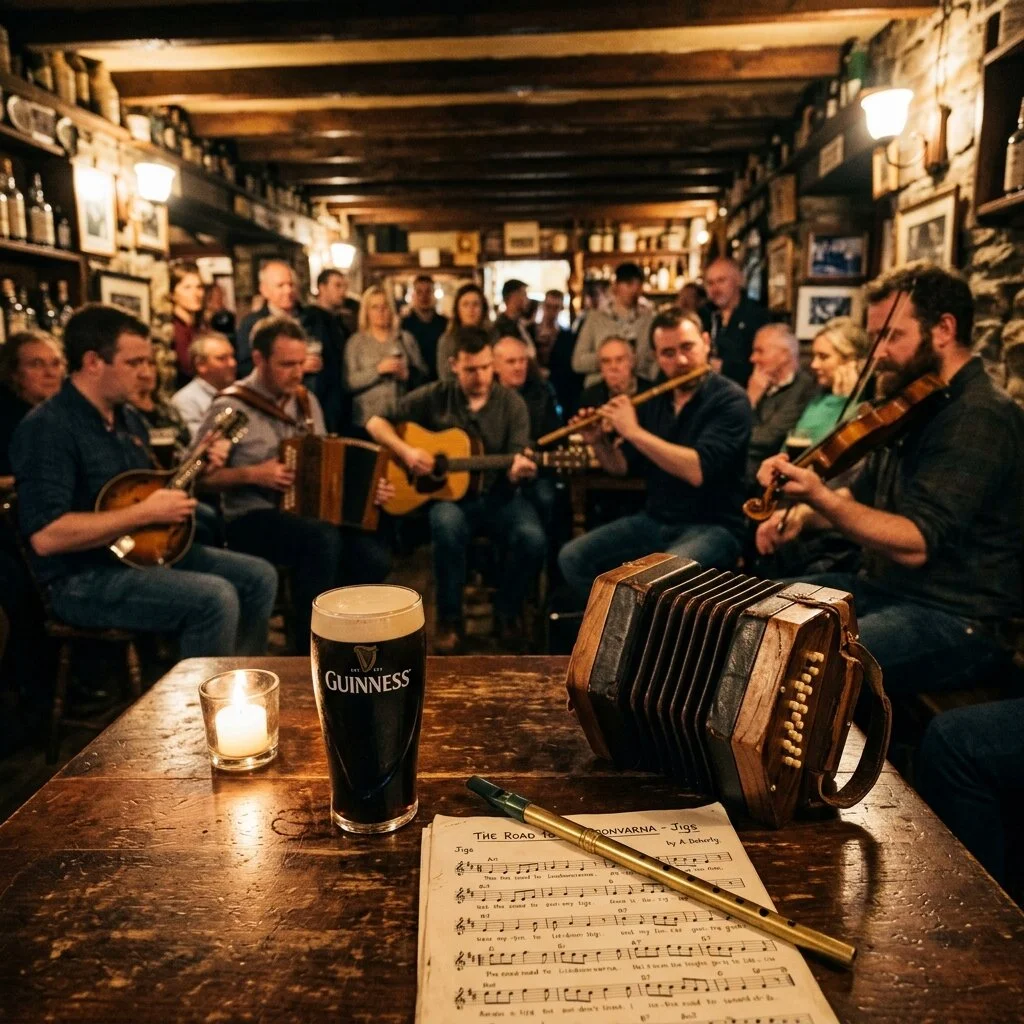
Introduction: The Narrow Circle of Session Jigs
Walk into any traditional Irish music session, and you are highly likely to hear the same sequence of classic jigs. Standards like The Kesh Jig, Morrison's, and The Connaughtman's Rambles form the absolute bedrock of the shared session repertoire. These melodies are beautiful and highly functional, providing a common vocabulary that allows musicians from different parts of the world to sit down and play together instantly.
However, this shared foundation comes with a trade-off. Out of the thousands of traditional jigs documented in historical archives, only a tiny fraction are played in live public sessions. This isn't because the unplayed tunes are inferior. Often, it is simply due to historical accident, the regional bias of a few influential recordings, or because a tune has a slightly unusual key signature or structure that makes it less suitable for casual group learning.
This article is a data-backed guide to the **"hidden gems"** of the traditional archive—tunes that have been heavily recorded by professional musicians on commercial albums but remain surprisingly rare in live session circles. By identifying these underrated jigs, we hope to provide traditional musicians with fresh, high-quality material to expand their setlists and bring forgotten melodies back into the session circle.
Our analytics engine calculates a **Hidden Gem Score** by comparing two opposing signals: professional studio adoption (recording count) against live session set frequency. A high score indicates a tune of proven aesthetic value that remains underplayed.
- Top Hidden Gem: Maurice O'Connor (13 commercial recordings, 0 session sets)
- Most Recorded Jig: Padraig O'Keeffe's (21 commercial recordings)
- Ancient Origins: Turlough O'Carolan composition crossover (Lady Dillon)
Table of Contents
What is a Hidden Gem?
In plain terms, a "Hidden Gem" is a tune that shows a significant imbalance between its professional recording history and its modern community adoption. These are not obscure, unplayable tunes scribbled in the margins of a dusty 19th-century manuscript. Rather, they are high-quality, fully realized melodies that have been chosen, arranged, and recorded by professional recording artists on commercial albums.
A tune becomes a hidden gem when it has been vetted and performed by elite musicians, yet fails to transition into the common repertoire of the casual session circle. It represents an untapped resource—a melody of proven aesthetic quality that is ripe for rediscovery and study by session musicians looking to expand their repertoire.
How We Measured This
Rather than relying on subjective opinions about which jigs are "underrated," this analysis uses the quantitative analytics engine of the **Trad Tune Explorer**. We calculated a composite score for each tune by comparing two opposing signals:
- The Quality Signal (Commercial Records): The number of times a tune has been recorded on commercial albums, along with the number of unique artists who have recorded it. This indicates a melody's durability and professional appeal.
- The Exposure Signal (Community Adoption): The frequency of the tune in live session set combinations, and user-submitted bookmarks. This represents the tune's presence in standard session circles.
A high score identifies a tune that has been heavily vetted in the studio (high recordings/artists) but is virtually absent from live settings (low bookmarks/session sets).
Visualizing the Hidden Gem Paradox
& Artists
User Bookmarks
Tunes with this profile score the highest on our index, highlighting them as major candidates for session revival.
Top 13 Hidden Gem Jigs
Below is the complete dataset of the 13 hidden gem jigs identified by the Trad Tune Explorer, ordered by their Hidden Gem Score.
1. Maurice O'Connor
DmajorStatistical Summary: Recorded 13 times by 13 artists, but appears in only 1 bookmarks and 0 session sets. Evidence Level: medium.
Analysis: Composed by the blind harper Turlough O'Carolan, Maurice O'Connor is a beautiful D major jig. Carolan's tunes are highly celebrated for their classical baroque influence mixed with traditional Irish structures. This jig features cascading arpeggios and a beautiful, flowing scale that lies naturally on harp, guitar, and fiddle.
Despite its high recording count by 13 independent artists, it has never been recorded in a live session set. Its baroque, classical structure makes it highly popular for solo instrumentalists but less common in standard set building, where dance-driven session jigs dominate.
2. Gartan Mother's Lullaby, The
DmajorStatistical Summary: Recorded 10 times by 9 artists, but appears in only 0 bookmarks and 0 session sets. Evidence Level: medium.
Analysis: Originating as a traditional Donegal lullaby, the haunting melody of The Gartan Mother's Lullaby has been recorded by numerous classical and folk artists. The melody was collected by Seosamh Mac Cathmhaoil (Joseph Campbell) in County Donegal.
Because it is highly associated with slow, vocal lullaby interpretations, session musicians rarely think to perform it. However, when played at a moderate jig tempo, the melody features a beautiful, flowing rise and fall that makes it a spectacular addition to set arrangements.
3. Homecoming, The
GmajorStatistical Summary: Recorded 10 times by 10 artists, but appears in only 0 bookmarks and 0 session sets. Evidence Level: medium.
Analysis: Written by the modern traditional flute master Joanie Madden of Cherish The Ladies, The Homecoming is a G major jig with a highly syncopated and lift-filled structure. Madden is celebrated for her brilliant, driving composition style.
It has been recorded 10 times by 10 different artists on various contemporary albums, including by Madden herself. While popular on albums, it remains almost entirely unplayed in standard pub sessions. Its bouncy, rhythmic lift lies beautifully on flute and tin whistle.
4. Padraig O'Keeffe's
DmajorStatistical Summary: Recorded 21 times by 17 artists, but appears in only 0 bookmarks and 1 session sets. Evidence Level: strong.
Analysis: Named after the legendary Kerry fiddle master Pádraig O'Keeffe, this D major jig has a highly driving, rhythmic structure associated with the Sliabh Luachra slide style. O'Keeffe composition and playing style remains highly influential among advanced fiddle and accordion players.
Despite its high pedigree and 21 commercial recordings, it has only a single recorded session set, suggesting a strong geographic division in the traditional scene—Sliabh Luachra standard tunes are frequently recorded but struggle to transition into the Irish session core.
5. Lady Dillon
GmajorStatistical Summary: Recorded 12 times by 12 artists, but appears in only 1 bookmarks and 0 session sets. Evidence Level: medium.
Analysis: Another traditional O'Carolan composition, Lady Dillon is written in G major. It features a bright, melodic structure with a highly syncopated and elegant baroque character.
It has been recorded 12 times by 12 independent artists, including classical and traditional harpers like Anne-Marie O'Farrell. Like other Carolan compositions, its classical, non-dance structure makes it less common in standard pub set building.
6. Month Of January, The
DmajorStatistical Summary: Recorded 10 times by 10 artists, but appears in only 2 bookmarks and 0 session sets. Evidence Level: medium.
Analysis: Originally a traditional Ulster ballad, The Month Of January is written in D major. Its gorgeous, flowing melody has been adapted by many musicians into a instrumental jig. Altan recorded a landmark version on their album The Gap of Dreams, and John Doyle covered it on Wayward Son.
Because it is highly associated with singing and ballad performance, instrumentalists in session circles rarely think to perform it. Yet, the melody features a beautiful, rolling D major structure that lies naturally on fiddle strings and wooden flute holes, making it an exceptional option for set building.
7. Blue
AminorStatistical Summary: Recorded 11 times by 10 artists, but appears in only 1 bookmarks and 0 session sets. Evidence Level: medium.
Analysis: Blue is a contemporary A minor jig written in a highly expressive modal style. It has been recorded 11 times by 10 different artists, showing a high degree of independent discovery.
Despite its high recording count, it has never been recorded in a live session set. Its modal structure is deeply expressive, blending the line between a lament and a driving dance rhythm, making it a stellar candidate for a group looking to build a unique set.
8. Egan's
AminorStatistical Summary: Recorded 13 times by 12 artists, but appears in only 1 bookmarks and 0 session sets. Evidence Level: medium.
Analysis: Written in A minor, Egan's features a driving, rhythmic structure that lies beautifully under the fingers. It has been recorded 13 times by 12 different artists.
Its modal structure is deeply expressive, providing a bright, syncopated, and highly driving rhythm. Despite its high pedigree among professional musicians, it remains almost completely absent from the broader session repertoire.
9. Holey Ha'penny
GmajorStatistical Summary: Recorded 12 times by 8 artists, but appears in only 0 bookmarks and 3 session sets. Evidence Level: medium.
Analysis: Holey Ha'penny is a traditional G major jig with a highly syncopated and driving rhythm. It has been recorded 12 times by 8 different artists, including Kathryn Tickell.
Its bouncy, rhythmic lift lies beautifully on fiddle and tin whistle, making it highly danceable and satisfying to play.
10. Capers
DmajorStatistical Summary: Recorded 10 times by 8 artists, but appears in only 2 bookmarks and 3 session sets. Evidence Level: medium.
Analysis: Composed by Cape Breton fiddle legend Jerry Holland, Capers is a D major jig with a highly syncopated and lift-filled structure. Holland recorded it multiple times, and it was also covered by various Cape Breton and Scottish fiddle players.
11. Teddy O'Neill
DmajorStatistical Summary: Recorded 13 times by 11 artists, but appears in only 0 bookmarks and 3 session sets. Evidence Level: medium.
Analysis: Originally a traditional song, Teddy O'Neill has been adapted as a D major jig. De Dannan recorded a famous version on their album Ballroom. Its gorgeous melody features a beautiful, flowing scale that lies naturally on fiddle and accordion.
12. Two Sisters
GmajorStatistical Summary: Recorded 14 times by 14 artists, but appears in only 0 bookmarks and 1 session sets. Evidence Level: medium.
Analysis: Two Sisters is a traditional G major jig recorded 14 times by 14 different artists. This high artist count shows a strong degree of independent discovery.
13. Dovecote Park
DmajorStatistical Summary: Recorded 13 times by 10 artists, but appears in only 0 bookmarks and 5 session sets. Evidence Level: medium.
Analysis: Composed by the Scottish pipe major James Braidwood, Dovecote Park is a Scottish pipe jig in D major. It has a driving rhythm and is recorded 13 times by 10 different artists, yet it remains rarely played in live Irish sessions.
Common Patterns in the Data
Analyzing the statistics of these 13 hidden gem jigs reveals several recurring patterns:
- Ballad and Song Crossovers: Jigs like The Gartan Mother's Lullaby and Teddy O'Neill are heavily recorded because of their vocal roots, but instrumentalists frequently overlook them in sessions.
- Baroque Classical Influences: Carolan compositions (Maurice O'Connor and Lady Dillon) have a very distinct classical influence, which makes them highly popular for solo arrangements but less common in standard set building.
- Geographic and Style Division: Scottish pipe jigs (Dovecote Park) and Cape Breton jigs (Capers) struggle to cross over into live Irish session circles despite high commercial success.
Why Hidden Gems Matter
Expanding your repertoire with underrated tunes is a fantastic way to prevent session fatigue. By playing these high-quality but underplayed jigs, you can bring fresh textures, modes (like G dorian or A minor), and syncopations to your local session.
Frequently Asked Questions
What is a hidden gem Irish jig?
It is a tune that has a strong commercial recording history (recorded multiple times by professional artists) but is rarely bookmarked by users or played in modern session sets, making it a perfect candidate for revival.
Why are some great jigs underrated?
Many great jigs remain obscure due to fingerings associated with specific regional styles, classical influences, or vocal-driven lullaby origins where instrumentalists don't naturally think to convert them to dance tempos.
Where can I find settings and sheet music?
You can click on the title of any jig card above to access the tune setting page on the Trad Tune Explorer.
Conclusion
The quiet corners of the traditional archive hold melodies that deserve a place in every session circle. We hope this data-backed guide encourages you to explore these 13 hidden gem jigs and introduce them to your fellow session musicians.