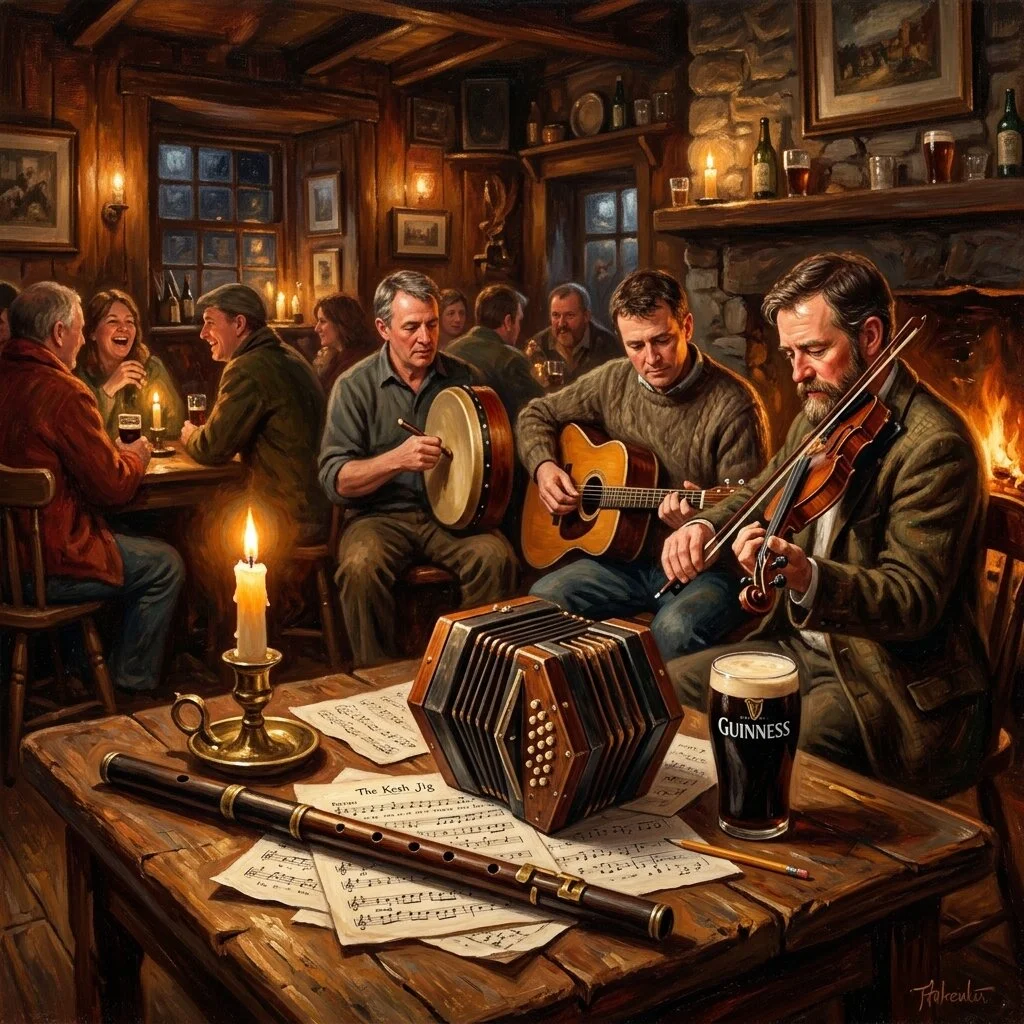
The absolute benchmark recording of the Kesh Jig is by The Bothy Band on their self-titled 1975 debut album. Sourced at Track 1, they play the Kesh Jig on uilleann pipes, fiddle, and wooden flute, transitioning into *The Swaggering*, *The Flower of the Flock*, and *The Famous Ballymote*.
Tune Profile: Jig (6/8) • G Major • 137 database occurrences • 135 commercial recordings.
1. Historical Overview & Notation
The Kesh Jig (often referred to simply as "The Kesh") is perhaps the most widely recognized jig in traditional Irish music. Sourced from the Sligo concertina master Paddy Killoran, who recorded it in the 1930s, the tune represents the quintessential rolling, cheerful character of double jigs. It is named after the village of Kesh in County Fermanagh.
Below is the primary setting of The Kesh Jig in G Major, which you can play and listen to using the interactive controls:
2. Comparative Statistics Table
With 135 commercial recordings in the database, the Kesh Jig has been recorded in a wide variety of instrument combinations:
| Rank & Artist | Album Title | Release Year | Track Location |
|---|---|---|---|
| 1. The Bothy Band | 1975 | 1975 | Track 1 |
| 2. The Bothy Band | Afterhours | 1979 | Track 1 |
| 3. The Bothy Band | Live In Concert | 1976 | Track 9 |
| 4. Sean McGuire & Joe Burke | Two Champions | 1971 | Track 10 |
| 5. Ashley MacIsaac | Hi, How Are You Today? | 1995 | Track 6 |
| 6. Al Goll, Tim May, & Charlie Chadwick | Goin' Across the Sea | 2015 | Track 11 |
| 7. Aidan Crossey | The Humours Of Lewisham, Volume Three | 2000 | Track 6 |
| 8. Augusta Céilí Band | Volume 2 | 2012 | Track 13 |
3. Detailed Review of Top 8 Recordings
1. The Bothy Band — 1975 (1975)
Track 1The Bothy Band's legendary self-titled debut album opens with this exact set. With Paddy Keenan's virtuosic uilleann piping and Tommy Peoples' explosive fiddle bowings, it remains the absolute benchmark for how to play the Kesh Jig in a driving, concert-hall style. It set the standard for traditional group performance.
2. The Bothy Band — Afterhours (1979)
Track 1Recorded live in Paris, this live version showcases the band's incredible onstage chemistry. Paddy Keenan and Matt Molloy (flute) lead the melody with tight, unison ornamentation while Dónal Lunny (bouzouki) and Micheál Ó Domhnaill (guitar) drive the rhythm with acoustic brilliance.
3. The Bothy Band — Live In Concert (1976)
Track 9Culled from BBC recordings, this version swaps in Sean Reid's Jig (also known as the Gilbert Clancy Jig) as the third tune. Kevin Burke's fiddle lends a sweet, flowing Galway tone to the melody, making it a favorite for dancers and players alike.
4. Sean McGuire & Joe Burke — Two Champions (1971)
Track 10Accordion legend Joe Burke and violin master Sean McGuire deliver a highly technical, fast-paced version of the Kesh. Sourced from their landmark duet album, this set popularized the Kesh-to-Morrison's transition that is now standard in sessions around the world.
5. Ashley MacIsaac — Hi, How Are You Today? (1995)
Track 6Cape Breton fiddle innovator Ashley MacIsaac places the Kesh at the end of a high-energy set of reels. Combining traditional style with rock rhythms, this track showcases the Kesh's versatility and global influence.
6. Al Goll, Tim May, & Charlie Chadwick — Goin' Across the Sea (2015)
Track 11A beautiful acoustic string band rendition featuring dobro and mandolin. It highlights the Kesh Jig's crossover appeal into American Old-Time and bluegrass music, showing the shared roots of folk styles.
7. Aidan Crossey — The Humours Of Lewisham, Volume Three (2000)
Track 6Pianist and multi-instrumentalist Aidan Crossey plays the Kesh after the complex, rolling notes of The Maid at the Spinning Wheel. It demonstrates how a simpler, lifting jig can serve as a perfect climax to a set.
8. Augusta Céilí Band — Volume 2 (2012)
Track 13A steady, bouncy céilí band performance that is specifically arranged for traditional dancers. The tempo is maintained perfectly to support long sets and social dancing.
4. Conclusion
The Kesh Jig remains a vital, living part of traditional music sessions. Practicing these landmark sets is a great way to improve your set-building skills and timing.
Build your own tune sets using Trad Tune Explorer.