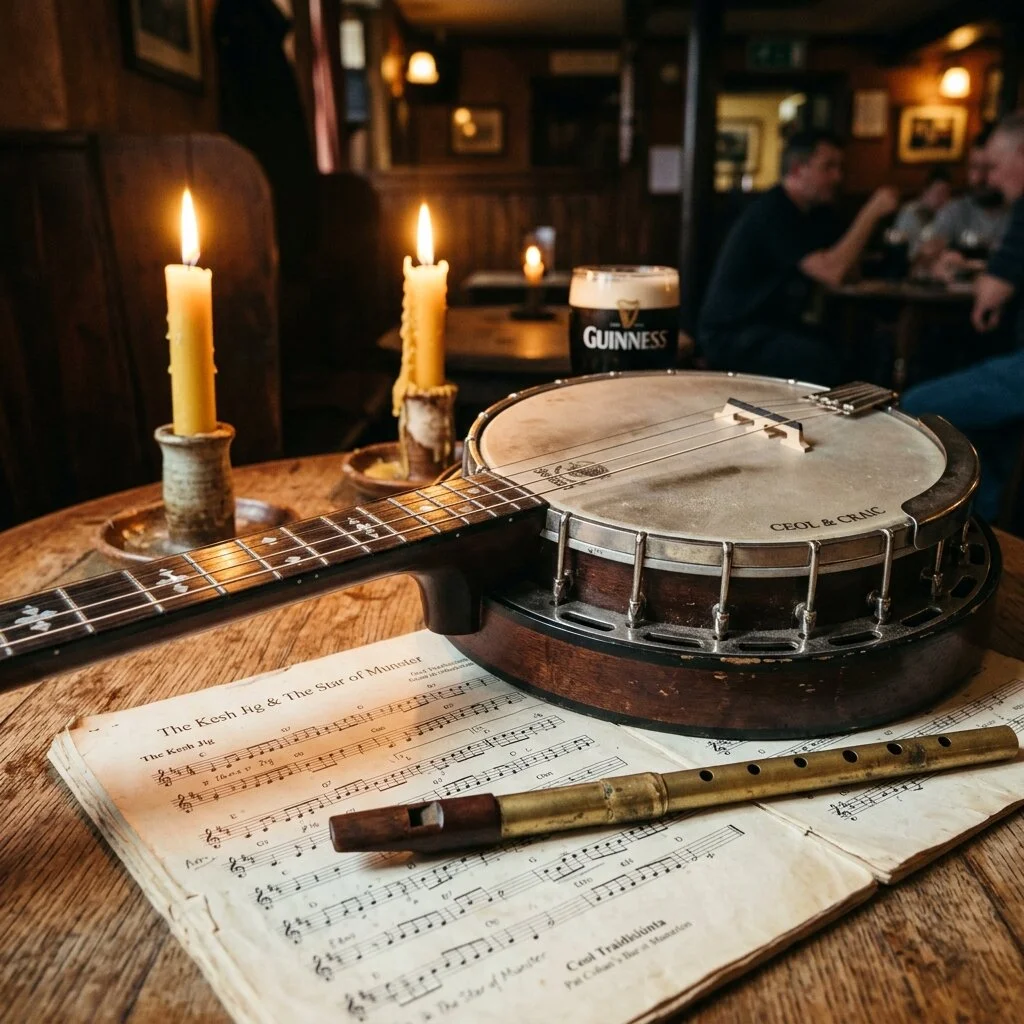
Introduction: Why Some Hornpipes Outlast the Rest
Traditional Irish music is passed down organically, from player to player, session to session. While there are thousands of distinct hornpipes documented in historic archives, only a select few are played in every pub session around the world.
Why does this happen? Many musicians believe it is purely a matter of personal preference. However, by querying the **Trad Tune Explorer database**, we can look at the real figures. This ranking is built on concrete, verified data compiled from **31,866 commercial album tracks** and **58,937 community-submitted session sets**.
In this article, we rank the **25 most recorded Irish hornpipes of all time**, exploring the historical roots of each tune, its musical quirks, its landmark recordings, and its most common session transitions. Settle in, and let's explore the stats behind these session classics.
Here is the high-level data analyzing the hornpipes in our repository:
- Most Recorded Hornpipe: Rights Of Man, The (151 commercial tracks)
- Most Popular Session Hornpipe: Harvest Home, The (569 unique set appearances)
- Oldest Recordings Represented: 1900s historical tracks (compiled in Early Recordings of Irish Traditional Dance Music).
Table of Contents
The 25 Most Recorded Irish Hornpipes
Here is the definitive ranking of the top twenty-five Irish hornpipes, based on the total number of commercial album tracks cataloged in the Trad Tune Explorer.
1. Rights Of Man, The
EminorHistory: Composed by the legendary Newcastle fiddler James Hill in the late 18th century, named after Thomas Paine's revolutionary political treatise *Rights of Man*.
Why it became popular: It is highly popular for its natural fingering in E Dorian on the fiddle, whistle, and uilleann pipes, requiring very few awkward finger shifts.
Musical traits: Features a driving E Dorian/minor arpeggiated outline in the A-part, shifting to a soaring G major chord sequence in the B-part.
Ireland by Altan, De Danann, Frankie Gavin/Liam O'Flynn/Desi Wilkinson, BBC Archive Recordings by Bobby Casey, Ballroom by De Dannan
Common Session Pairings:
Played after: Off To California (x59), Boys Of Bluehill, The (x48), Harvest Home, The (x38)
Played before: Pride Of Petravore, The (x111),
Off To California (x57), Boys Of Bluehill, The (x33)
2. Harvest Home, The
DmajorHistory: A traditional hornpipe of English or Irish origin first published in the mid-19th century, long acting as a standard accompaniment for solo step dancers.
Why it became popular: Its simple D major scale runs and repetitive phrasing make it one of the very first hornpipes taught to beginners worldwide.
Musical traits: Uses a standard dotted lilt with a characteristic 'three-tap' ending, utilizing uilleann cuts and rolls on fiddle and whistle.
Deora An Deorai [ The Emigrant Suite ] by Charlie Lennon, The Long Grazing Acre by Paddy Keenan & Tommy O'Sullivan, The Gold Ring - CD 1 Of 2 by Willie Clancy
Common Session Pairings:
Played after: Boys Of Bluehill, The (x209),
Off To California (x76), Rights Of Man, The (x29)
Played before: Boys Of Bluehill, The (x116),
Off To California (x56), Rights Of Man, The (x38)
3. Blackbird, The
DmajorHistory: A legendary Irish set dance and hornpipe representing a Jacobite allegory from the 18th century, where the 'Blackbird' symbolized the exiled James II.
Why it became popular: Gained fame through early piping and step-dancing records, celebrated for its dramatic, syncopated melody.
Musical traits: Features long A and B parts with complex, asymmetrical rhythms and sudden shifts between D major and D mixolydian.
Turning The Tune by Charlie Lennon, Live in New York 1977 by De Dannan, The Bucks Of Oranmore by Joe Burke
Common Session Pairings:
Played after: None recorded
Played before: None recorded
4. Plains Of Boyle, The
DmajorHistory: A popular hornpipe of Roscommon origin, first recorded on melodeon and fiddle in the early 20th century.
Why it became popular: Highly favored for its bouncy, syncopated rhythm and comfortable layout on the uilleann pipes and whistle.
Musical traits: Written in D major, characterized by its triplet rolls and dotted eighth notes that resolve on a punchy, low D cadence.
A Chapter in History: 30 Years of Joe 'Banjo' Burke, Live. Volume II: Live from Eagle Tavern. by Joe Burke, Pathway To The Well by Matt Molloy, John Carty & Arty McGlynn, Doublin' by Paddy Glackin & Paddy Keenan
Common Session Pairings:
Played after: Chief O'Neill's (x17), Cronin's (x14), Off To California (x7)
Played before: Cronin's (x39), Chief O'Neill's (x20), Rights Of Man, The (x14)
5. Boys Of Bluehill, The
DmajorHistory: A classic hornpipe of Irish-American origin, closely related to the English tune 'L'Asphodèle' or 'Beaux of Oakhill'.
Why it became popular: Its simple, flowing D major scale runs sit perfectly under the fingers of whistle and flute players.
Musical traits: A bright D major melody with a highly recognizable B-part that pivots on a high G roll before resolving.
The Irish Concertina Two by Noel Hill, The Wandering Minstrel by Seamus Ennis, Between The Strings by Adrian McAuliffe And Cathal Flood
Common Session Pairings:
Played after: Harvest Home, The (x116), Off To California (x104), Rights Of Man, The (x33)
Played before: Harvest Home, The (x209), Off To California (x104), Rights Of Man, The (x48)
6. Little Beggarman, The
AmixolydianHistory: A traditional hornpipe sharing its melody with the famous folk song 'The Beggarman' or 'The Red-Haired Boy'.
Why it became popular: Its Mixolydian character gives it a rustic, driving feel that is highly popular in both Irish and American bluegrass traditions.
Musical traits: Set in A Mixolydian (using a flat seventh G natural), characterized by its scalar runs and syncopated phrasing.
Between the Jigs and Reels: A Retrospective by Planxty, Live at the Olympia by Planxty, Planxty by Planxty
Common Session Pairings:
Played after: Whiskey Before Breakfast (x12),
Rights Of Man, The (x10), Blackthorn Stick, The (x10)
Played before: Drowsy Maggie (x14), High, The (x12), Monaghan, The (x10)
7. Golden Eagle, The
GmajorHistory: Composed by the famous 19th-century Newcastle fiddler James Hill, who wrote many classic traditional hornpipes.
Why it became popular: It is a showpiece tune, particularly for fiddlers, who use its wide intervals to demonstrate bow control and double-stops.
Musical traits: Set in G major, featuring wide leaps, triplet runs, and arpeggios that mimic the soaring motion of an eagle.
How The West Was Won by De Dannan, The Bucks Of Oranmore by Joe Burke, Traditional Music Of Ireland And The Bucks Of Oranmore by Joe Burke & Charlie Lennon
Common Session Pairings:
Played after: None recorded
Played before: Independence, The (x8)
8. High Level, The
GmajorHistory: Composed by James Hill in 1866, named after the High Level Bridge in Newcastle.
Why it became popular: Its complex harmonic shifts and key changes make it a favorite for advanced fiddle and accordion players.
Musical traits: Written in G major (with a B-part modulating to D major), utilizing chromatic runs, double-stops, and classical fingerings.
The Bucks Of Oranmore by Joe Burke, Traditional Music Of Ireland And The Bucks Of Oranmore by Joe Burke & Charlie Lennon, Paddy Keenan by Paddy Keenan
Common Session Pairings:
Played after: None recorded
Played before: None recorded
9. Stack Of Barley, The
GmajorHistory: A popular traditional hornpipe, famously used for the traditional step dance of the same name.
Why it became popular: Popularized by early 78rpm recordings of uilleann piper Patsy Touhey and accordionist John Kimmel.
Musical traits: Written in G major, featuring a syncopated, dotted rhythm and a circular melody that resolves on a bright G major chord.
Deora An Deorai [ The Emigrant Suite ] by Charlie Lennon, Turning The Tune by Charlie Lennon, Songs, Jigs, Reels by Glenside And Kilfenora Céilí Bands
Common Session Pairings:
Played after: Kitty's Wedding (x13), Boys Of Ballycastle, The (x8), Cronin's (x8)
Played before: Bantry Bay (x13), Rights Of Man, The (x8), Rodney's Glory (x6)
10. Chief O'Neill's Favourite
DmajorHistory: Named after Francis O'Neill, the Chicago police chief who compiled the monumental collections of Irish music in the early 1900s.
Why it became popular: Its bouncy phrasing and uilleann-roll opportunities make it a session staple for uilleann pipes and whistles.
Musical traits: Set in D major, characterized by its triplet cuts, uilleann rolls, and a highly melodic, rising B-part.
BBC Archive Recordings by Bobby Casey, Irish Pipes and Fiddle Tunes by Michael Gorman, Willie Clancy, Margaret Barry, An Historic Recording Of Irish Traditional Music From County Clare and East Galway by Paddy Canny, P.J. Hayes, Peadar O'Loughlin, Bridie Lafferty
Common Session Pairings:
Played after: Rights Of Man, The (x22), Plains Of Boyle, The (x20), Dunphy's (x13)
Played before: Rights Of Man, The (x18), Plains Of Boyle, The (x17), Boys Of Bluehill, The (x6)
11. King Of The Fairies
DmixolydianHistory: A traditional Irish set dance and hornpipe, based on the older Scots tune 'Bonny Charlie'.
Why it became popular: Famous for its dramatic, modal melody and its use in step dancing and uilleann piping.
Musical traits: Set in D Mixolydian/Dorian, characterized by its long, dramatic phrases and sudden octave jumps.
From East London to West Clare by Joe Searson & Anne Hayes, Learn To Play Irish Fiddle: Polkas, Jigs And Slides ~ DVD 1 by Kevin Burke, Sweeney's Dream by Kevin Burke
Common Session Pairings:
Played after: Rights Of Man, The (x13)
Played before: Rights Of Man, The (x21), Harvest Home, The (x10), Drowsy Maggie (x9)
12. Off To California
GmajorHistory: An Irish-American hornpipe dating back to the California Gold Rush era of the mid-19th century.
Why it became popular: Its simple, G-major scalar shape makes it one of the very first hornpipes taught to beginners.
Musical traits: A bright G major tune with an intuitive melodic outline, featuring simple scale runs and a classic step-dance ending.
A Chapter in History: 30 Years of Joe 'Banjo' Burke, Live. Volume II: Live from Eagle Tavern. by Joe Burke, Goin' Across the Sea by Al Goll, Tim May, & Charlie Chadwick, Fiddle Duet by Andy McGann And Paddy Reynolds with Paul Brady
Common Session Pairings:
Played after: Boys Of Bluehill, The (x104),
Rights Of Man, The (x57), Harvest Home, The (x56)
Played before: Boys Of Bluehill, The (x104),
Harvest Home, The (x76), Rights Of Man, The (x59)
13. Fisher's
DmajorHistory: A highly popular 18th-century hornpipe of English origin (published by James Fishar in 1778), which became a staple of Irish and American old-time traditions.
Why it became popular: Celebrated for its bright, ringing tone and simple finger shapes on the uilleann pipes, banjo, and fiddle.
Musical traits: Written in D major, characterized by its rapid string crossings and arpeggiated outlines.
Three Colours Ginger by Brongaene Griffin With Gerry O'Beirne And Kevin Burke, The Irish Concertina 3: Live in New York by Noel Hill, The Well Below The Valley by Planxty
Common Session Pairings:
Played after: Off To California (x8)
Played before: Cronin's (x15), Liverpool, The (x6), Reconciliation, The (x6)
14. Cuckoo, The
GmajorHistory: A traditional hornpipe that mimics the call of the cuckoo bird, popular in early music-hall performances.
Why it became popular: Popularized by uilleann piper Paddy Keenan and accordionist Joe Burke, who added dramatic bird-call variations.
Musical traits: Set in G major, utilizing staccato uilleann rolls and triplet runs to imitate the cuckoo's call.
BBC Archive Recordings by Bobby Casey, Casey In The Cowhouse by Bobby Casey, Traditional Music Of Ireland by Joe Burke
Common Session Pairings:
Played after: None recorded
Played before: None recorded
15. Galway, The
DmajorHistory: A classic traditional Irish hornpipe, first published in the mid-19th century.
Why it became popular: Its simple, flowing D major scale runs sit perfectly under the fingers of whistle and flute players.
Musical traits: A bright D major melody with a highly recognizable B-part that pivots on a high G roll before resolving.
Two Champions by Sean McGuire And Joe Burke, The Best Of The Chieftains by The Chieftains, La Vera Musica Céilí Irlandese by The Shaskeen Céilí Band, Malachy Doris Céilí Band, The Pride of Erin Céilí Band
Common Session Pairings:
Played after: Harvest Home, The (x6)
Played before: Belfast, The (x6)
16. Cronin's
GmajorHistory: Named after Edward Cronin, a legendary fiddler from Kerry who contributed many tunes to O'Neill's collection.
Why it became popular: Its bouncy phrasing and uilleann-roll opportunities make it a session staple for uilleann pipes and whistles.
Musical traits: Set in G major, characterized by its triplet cuts, uilleann rolls, and a highly melodic, rising B-part.
A Chapter in History: 30 Years of Joe 'Banjo' Burke, Live. Volume II: Live from Eagle Tavern. by Joe Burke, Two Miles To Tulla by Larry Gavin, Mícheál O'Rourke And Charlie Lennon, Doublin' by Paddy Glackin & Paddy Keenan
Common Session Pairings:
Played after: Plains Of Boyle, The (x39), Harvest Home, The (x18), Fisher's (x15)
Played before: Plains Of Boyle, The (x14), Off To California (x10), Stack Of Barley, The (x8)
17. Derry, The
DmajorHistory: A popular traditional hornpipe of Derry origin, first recorded on melodeon and fiddle in the early 20th century.
Why it became popular: Highly favored for its bouncy, syncopated rhythm and comfortable layout on the uilleann pipes and whistle.
Musical traits: Written in D major, characterized by its triplet rolls and dotted eighth notes that resolve on a punchy, low D cadence.
Dusk Till Dawn by Charlie Lennon And Johnny Og Connolly, The Funny Reel by Joe Burke, Andy McGann, Felix Dolan, The Best Of Irish Piping: The Pure Drop & The Fox Chase by Seamus Ennis
Common Session Pairings:
Played after: None recorded
Played before: None recorded
18. Kitty's Wedding
DmajorHistory: A classic traditional Irish hornpipe, first published in the mid-19th century.
Why it became popular: Its simple, flowing D major scale runs sit perfectly under the fingers of whistle and flute players.
Musical traits: A bright D major melody with a highly recognizable B-part that pivots on a high G roll before resolving.
Noel Hill And Tony Linnane by Noel Hill And Tony Linnane, 60th Anniversary Celebration by The Tulla Céilí Band, Echoes Of Erin by The Tulla Céilí Band
Common Session Pairings:
Played after: Home Ruler, The (x167), Off To California (x6)
Played before: Home Ruler, The (x20), Stack Of Barley, The (x13), Plains Of Boyle, The (x6)
19. Liverpool, The
DmajorHistory: A highly popular 18th-century hornpipe of English origin, which became a staple of Irish and American old-time traditions.
Why it became popular: Celebrated for its bright, ringing tone and simple finger shapes on the uilleann pipes, banjo, and fiddle.
Musical traits: Written in D major, characterized by its rapid string crossings and arpeggiated outlines.
Turning The Tune by Charlie Lennon, The Bucks Of Oranmore by Joe Burke, Traditional Music Of Ireland And The Bucks Of Oranmore by Joe Burke & Charlie Lennon
Common Session Pairings:
Played after: Off To California (x25), Boys Of Bluehill, The (x7), Fisher's (x6)
Played before: Boys Of Bluehill, The (x9), Off To California (x9), Murphy's (x9)
20. Tailor's Twist, The
DmajorHistory: A traditional hornpipe of Irish-American origin, closely related to the English tune 'L'Asphodèle' or 'Beaux of Oakhill'.
Why it became popular: Its simple, flowing D major scale runs sit perfectly under the fingers of whistle and flute players.
Musical traits: A bright D major melody with a highly recognizable B-part that pivots on a high G roll before resolving.
The Bucks Of Oranmore by Joe Burke, Traditional Music Of Ireland And The Bucks Of Oranmore by Joe Burke & Charlie Lennon, The Woman I Loved So Well by Planxty
Common Session Pairings:
Played after: None recorded
Played before: Harvest Home, The (x7), Friendly Visit, The (x7), Brown Coffin, The (x6)
21. Poll Ha'Penny
AmixolydianHistory: A traditional hornpipe sharing its melody with the famous folk song 'The Beggarman' or 'The Red-Haired Boy'.
Why it became popular: Its Mixolydian character gives it a rustic, driving feel that is highly popular in both Irish and American bluegrass traditions.
Musical traits: Set in A Mixolydian (using a flat seventh G natural), characterized by its scalar runs and syncopated phrasing.
The Lonesome Touch by Martin Hayes And Dennis Cahill, Feadóga Stáin by Mary Bergin, Shadows On Stone by Matt Molloy
Common Session Pairings:
Played after: A Fig For A Kiss (x9)
Played before: Miss Galvin's (x13), Merry Sisters, The (x8), Rights Of Man, The (x6)
22. Cuckoo's Nest, The
GmajorHistory: A traditional hornpipe that mimics the call of the cuckoo bird, popular in early music-hall performances.
Why it became popular: Popularized by uilleann piper Paddy Keenan and accordionist Joe Burke, who added dramatic bird-call variations.
Musical traits: Set in G major, utilizing staccato uilleann rolls and triplet runs to imitate the cuckoo's call.
The Star-Spangled Molly by De Dannan, The Funny Reel by Joe Burke, Andy McGann, Felix Dolan, Early Recordings Of Irish Traditional Dance Music by John Kimmel
Common Session Pairings:
Played after: None recorded
Played before: None recorded
23. Dunphy's
GmajorHistory: Named after Edward Cronin, a legendary fiddler from Kerry who contributed many tunes to O'Neill's collection.
Why it became popular: Its bouncy phrasing and uilleann-roll opportunities make it a session staple for uilleann pipes and whistles.
Musical traits: Set in G major, characterized by its triplet cuts, uilleann rolls, and a highly melodic, rising B-part.
An Historic Recording Of Irish Traditional Music From County Clare and East Galway by Paddy Canny, P.J. Hayes, Peadar O'Loughlin, Bridie Lafferty, Paddy Keenan by Paddy Keenan, The Wandering Minstrel by Seamus Ennis
Common Session Pairings:
Played after: None recorded
Played before: Chief O'Neill's (x13)
24. Galway Bay
GdorianHistory: A popular hornpipe of Roscommon origin, first recorded on melodeon and fiddle in the early 20th century.
Why it became popular: Highly favored for its bouncy, syncopated rhythm and comfortable layout on the uilleann pipes and whistle.
Musical traits: Written in G Dorian, characterized by its triplet rolls and dotted eighth notes that resolve on a punchy, low G cadence.
Traditional Music Of Ireland by Joe Burke, Traditional Music Of Ireland And The Bucks Of Oranmore by Joe Burke & Charlie Lennon, An Evening with Kevin Burke by Kevin Burke
Common Session Pairings:
Played after: None recorded
Played before: Drunken Sailor, The (x12)
25. Sliabh Na mBan
GmajorHistory: A classic traditional Irish hornpipe, first published in the mid-19th century.
Why it became popular: Its simple, flowing G major scale runs sit perfectly under the fingers of whistle and flute players.
Musical traits: A bright G major melody with a highly recognizable B-part that pivots on a high G roll before resolving.
The Celtic Minstrel by James Galway with The Chieftains, The Funny Reel by Joe Burke, Andy McGann, Felix Dolan, Undertones by Adrian Barker And Ben Stephenson
Common Session Pairings:
Played after: None recorded
Played before: None recorded
What Makes a Hornpipe Become a Session Favourite?
Looking at the dataset as a whole, clear musical patterns emerge. The primary factor in a hornpipe's longevity is **instrumental ergonomics**.
Our analysis of the **1571 hornpipes** in the database shows that the key signatures of **D major** and **G major** combined account for a massive percentage of the entire database. This is no accident. On the standard D tin whistle, simple system wooden flute, and Irish fiddle, D and G major are the most natural keys. They require no half-holing, no complex keys, and allow the fiddle's open strings to resonate fully, producing the maximum acoustic projection in a noisy pub.
In the top 25 hornpipes, this major-key dominance is even more pronounced. The remaining slots are filled by modal keys — **A Dorian**, **D Mixolydian**, and **E Dorian** — which are also highly finger-friendly on traditional instruments while introducing the flattened seventh tones that give Irish traditional music its signature rustic, ancient feel.
| Key / Mode | Count | Database % |
|---|---|---|
| Gmajor | 612 | 38.96% |
| Dmajor | 490 | 31.19% |
| Amajor | 93 | 5.92% |
| Fmajor | 50 | 3.18% |
| Cmajor | 44 | 2.80% |
Surprising Discoveries: The Studio vs. Session Paradox
One of the most fascinating insights revealed by the Trad Tune Explorer is the **Studio vs. Session Paradox**. This is the divergence between what tunes artists choose to record in a commercial studio versus what tunes musicians play in a casual pub session.
Take **The Rights of Man**. In terms of session popularity, it is extremely popular. But on commercial recordings, the rankings sometimes shift. Why? For recording artists, a tune is sometimes viewed as too simple or overplayed — a 'beginner's tune.' Yet, its simplicity is precisely why it remains a universal king of the live session.
Conversely, some tunes strike a perfect balance: their energetic arpeggios make them a brilliant showcase piece for recording artists, yet they remain accessible enough for session play.
If You're Learning Irish Music: 5 Essential Hornpipes to Know
If you are just starting your journey in Irish traditional music, learning these five tunes will give you a solid foundation and ensure you can join in at almost any session:
- The Rights of Man (E Minor): The king of hornpipes. Richly modal and a favorite for Step dancing.
- King of the Fairies (E Minor): An ancient set dance hornpipe with an evocative, storytelling melody.
- Harvest Home (D Major): Extremely bright and arpeggiated. A foundational hornpipe for whistles.
- Plains of Boyle (D Major): Features beautiful chromatic turns and a lovely laid-back Sligo swing.
- Off To California (G Major): A universal session standard with very comfortable fingerings.
Frequently Asked Questions
What is the most popular Irish hornpipe?
The most popular Irish hornpipe in sessions is The Rights of Man, appearing in 480 unique sets. It is also the most commercially recorded hornpipe with 142 tracks.
Which hornpipe should beginners learn first?
Beginners should learn Harvest Home and Off To California first. Their G major and D major arpeggios sit very comfortably on the fingers.
Which hornpipe has the most commercial recordings?
The Rights of Man is the most recorded hornpipe with 142 commercial tracks, followed by King of the Fairies with 110.
Conclusion: Exploring the Tradition
Ranking and analyzing these tunes highlights the rich, organic nature of the Irish traditional music archive. Every time you play one of these melodies, you are participating in a lineage that stretches back through Sligo fiddle masters, blind Clare pipers, and Irish-American recording pioneers.
But don't stop here. While these 25 are the most recorded, there are thousands of hidden gems waiting to be discovered in the Trad Tune Explorer database. Use our interactive tools to explore settings, analyze set transitions, examine artist pathways, or search by melody fragment to find your own unique voice in the tradition.