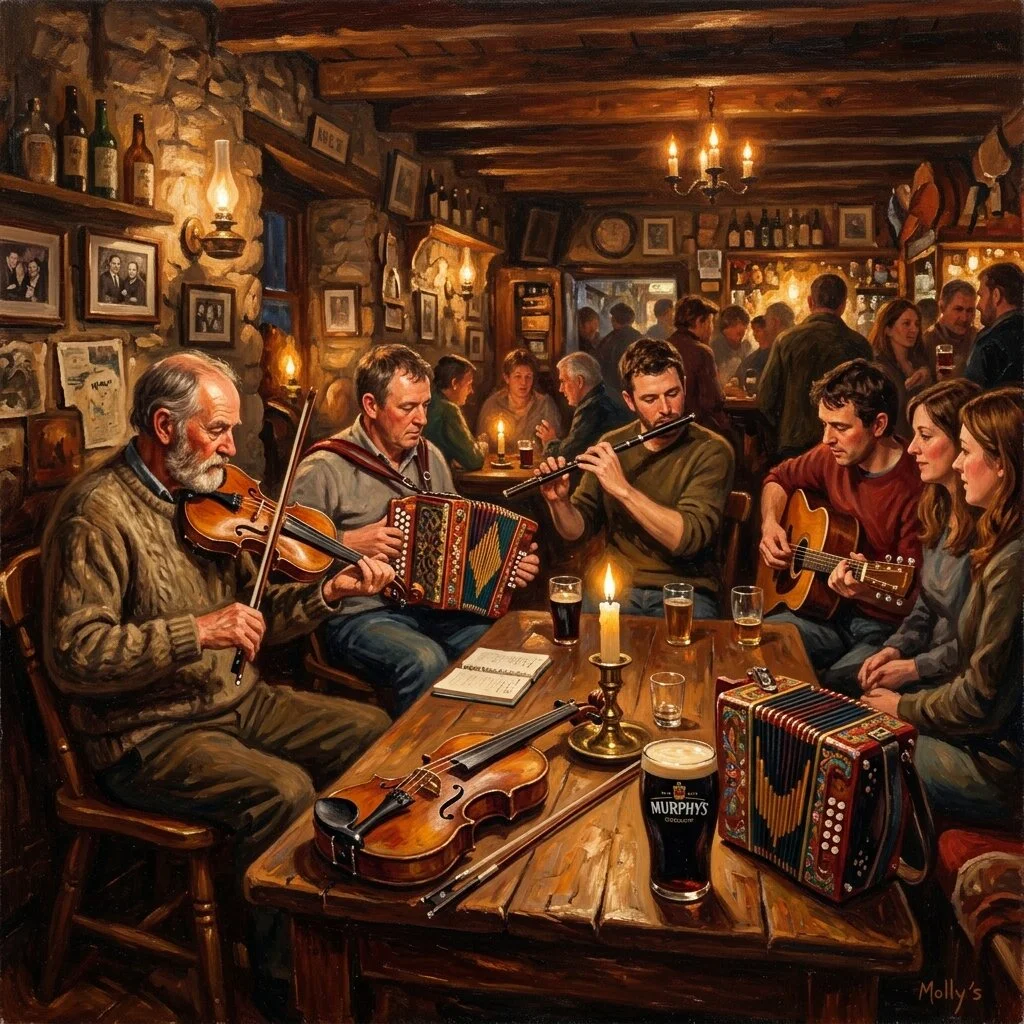
The most common tune played immediately after Cooley's Reel in sessions is The Wise Maid (Reel, D Major), appearing in 22.00% of sets. The second most popular choice is Drowsy Maggie (13.98%), followed by The Maid Behind The Bar (10.14%). Traced from 1,223 session sets, these pairings represent the ultimate session combinations for reels.
Why this page is useful: This data-driven guide analyzes commercial albums and user sets from the Trad Tune Explorer database to trace how Cooley's Reel connects to other tunes in the living tradition.
1. Introduction & Sourced Statistics
If you walk into a traditional session and someone kicks off Cooley's Reel, every musician in the room is already thinking about the next tune. Playing tunes in continuous sets is the lifeblood of traditional Irish music, creating momentum and energy. But what tune fits best after the king of session reels? Using the Trad Tune Explorer database, we analyzed over 1,200 sets to find the statistics, musical patterns, and artist examples that define the perfect follow-on tune.
Below are the top 5 immediate follow-ons for Cooley's Reel, ranked by transition occurrences in live session sets:
| Rank & Tune Name | Key / Mode | Sets Occurrences | Transition Percentage |
|---|---|---|---|
| 1. Wise Maid, The (ID: 118) | D Major | 287 sets | 18.46% |
| 2. Drowsy Maggie (ID: 27) | D Dorian | 171 sets | 11.00% |
| 3. Maid Behind The Bar, The (ID: 64) | D Major | 125 sets | 8.04% |
| 4. Cup Of Tea, The (ID: 20) | E Dorian | 104 sets | 6.69% |
| 5. Silver Spear, The (ID: 182) | D Major | 56 sets | 3.60% |
2. Visualizing the Three-Level Set Continuation Tree
Set building isn't just about the next tune—it's about the entire arc. Below is a three-level set continuation tree showing what tunes follow immediately, and what tunes usually follow *those* in three-part combinations:
Three-Level Set Continuation Tree: Cooley's Reel (Root)
-
Root: Cooley's Reel (REEL, E Dorian)
-
→ 1. Wise Maid, The (ID: 118, D Major)
— 18.46%
- * Bird In The Bush, The (ID 629, G Major) — 5.71%
- * Cup Of Tea, The (ID 20, E Dorian) — 5.49%
- * Maid Behind The Bar, The (ID 64, D Major) — 5.05%
- * Banshee, The (ID 8, G Major) — 2.42%
-
→ 2. Drowsy Maggie (ID: 27, D Dorian) —
11.00%
- * Maid Behind The Bar, The (ID 64, D Major) — 5.08%
- * Mountain Road, The (ID 68, D Major) — 4.03%
- * Kesh, The (ID 55, G Major) — 3.93%
- * Toss The Feathers (ID 113, D Dorian) — 3.26%
-
→ 3. Maid Behind The Bar, The (ID: 64,
D Major) — 8.04%
- * Banshee, The (ID 8, G Major) — 5.32%
- * Sally Gardens, The (ID 98, G Major) — 5.32%
- * Wind That Shakes The Barley, The (ID 116, D Major) — 4.87%
- * Silver Spear, The (ID 182, D Major) — 3.99%
-
→ 4. Cup Of Tea, The (ID: 20, E Dorian)
— 6.69%
- * Wise Maid, The (ID 118, D Major) — 17.89%
- * Banshee, The (ID 8, G Major) — 5.46%
- * Drowsy Maggie (ID 27, D Dorian) — 3.39%
- * Earl's Chair, The (ID 221, D Major) — 3.01%
-
→ 5. Silver Spear, The (ID: 182, D
Major) — 3.60%
- * Earl's Chair, The (ID 221, D Major) — 10.22%
- * Maid Behind The Bar, The (ID 64, D Major) — 6.05%
- * Sally Gardens, The (ID 98, G Major) — 5.65%
- * Humours Of Tulla, The (ID 141, D Major) — 4.66%
-
→ 1. Wise Maid, The (ID: 118, D Major)
— 18.46%
Want to explore these paths interactively? View the live D3 graph on the Set Follow-On Tree page for Cooley's Reel.
3. Musical Analysis of Key Transitions
Why the Top Transitions Work Musically
Traditional musicians choose tune pairings not by chance, but by subconscious musical compatibility. Here is a breakdown of why Cooley's Reel transitions work so well:
This is a classic "modal modulation" from a minor-sounding key (E Dorian, 1 sharp: F#) to a bright major key (D Major, 2 sharps: F#, C#). Because E Dorian is a minor mode related to D Major (it is the second mode of D Major), this transition creates a beautiful, uplifting release. The drive of Cooley's minor-key B-part resolves perfectly as the musicians strike the opening D and E notes of The Wise Maid.
This transition keeps the key signature identical, staying within E Dorian. Instead of modulating keys, the contrast comes from the rhythmic structure: Cooley's is built around syncopated A-part jumps, while Drowsy Maggie features a drone-like, constant string-crossing pattern. This maintains a steady, driving minor atmosphere while introducing a new textures.
Similar to The Wise Maid transition, this modulates from E Dorian to D Major. The Maid Behind the Bar starts immediately on an F# (FAAB AFED...), which is the major third of the scale. This starting note instantly lifts the dark Dorian mood of Cooley's into a celebratory major key.
4. Commercial Recording Examples (Landmark Albums)
Artist Examples: Who Recorded These Sets?
Many of these session combinations were popularized by legendary recordings that defined how we group tunes today:
The Bothy Band — Live In Concert (1978)
Track 5 Set: Michael Gorman's → The Frieze Britches → The Road To Lisdoonvarna → Cooley's Reel → The Wise Maid
The Bothy Band's live album popularized the Cooley's to Wise Maid transition on uilleann pipes, fiddle, and flute, demonstrating how to modulate tempo and volume to create a dramatic major-key release.
Frankie Gavin & Paul Brock — Ómós Do Joe Cooley (1986)
Track 1 Set: Cooley's Reel → The Wise Maid
Fiddle master Frankie Gavin and accordionist Paul Brock open their Joe Cooley tribute album with this exact set, playing it with a bouncy East Galway lift that set the standard for accordion players.
5. Frequently Asked Questions (FAQ)
Why is The Wise Maid so popular after Cooley's?
Musically, Cooley's is in E Dorian (minor feel) and The Wise Maid is in D Major (bright feel). Modulating up a tone from E Dorian to D Major provides a highly satisfying major-key release that lifts the energy of the room.
What other reels can I play after Cooley's?
Drowsy Maggie, The Maid Behind the Bar, The Cup of Tea, and The Silver Spear are all highly common and musically compatible reels.
6. Conclusion
Understanding tune transitions is key to developing your session craft. Start practicing these popular pairings to build cohesive, high-energy sets.
Build your own tune sets using Trad Tune Explorer.