Quick Facts: Studio vs. Session Discrepancy
Table of Contents
Introduction: The Studio vs. Session Paradox
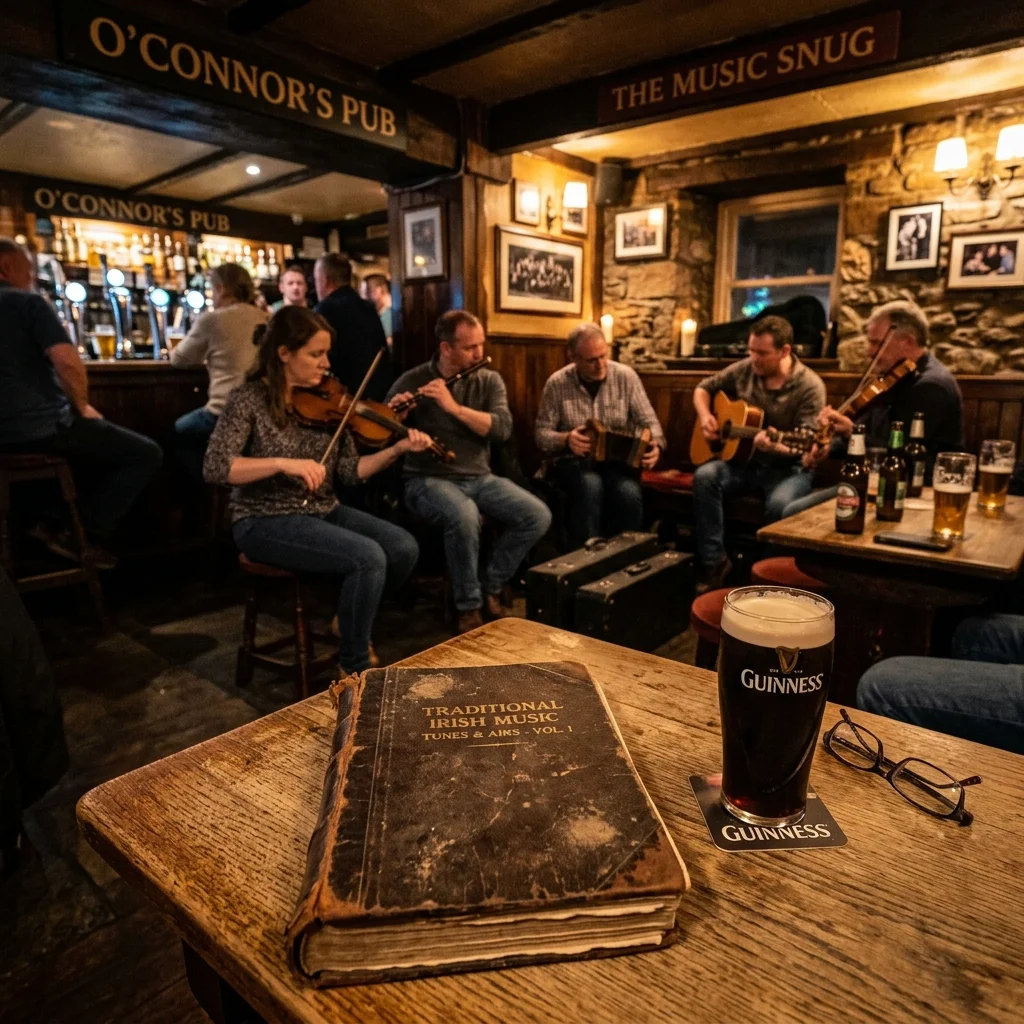
It is a scenario familiar to many traditional musicians: you buy a landmark album by a legendary fiddle player or concertina maestro, fall in love with a spectacular track, and spend weeks memorizing every triplet and roll. But when you enthusiastically strike up the tune at your local pub session, you are met with blank stares, awkward hesitations, or a quick derailment.
Why do some tunes dominate commercial recordings and printed tunebooks, yet remain almost entirely absent from real-world session circles?
The answer lies in the **Studio vs. Session Paradox**. In a recording studio, a solo performer or band seeks novelty, high contrast, technical showmanship, and unique arrangements. Key changes to awkward sharps or flats are welcomed to suit vocalists or stand out, and multi-part complex structures are used to highlight virtuosity.
In a casual pub session, however, the goals are completely different. A session thrives on **collective flow**, ergonomic fingering, shared repertoire, and rhythmic stability. If a tune is too long, uses keys that clash with standard D tin whistles or pipes, or lacks natural transition pathways, it gets left behind. Using data from the **Trad Tune Explorer**, we have mapped these discrepancies to reveal which famous tunes are the ultimate "studio stars" and why they rarely cross over into the pub.
Most Recorded... But Rarely Heard
Here are the 14 most prominent examples of tunes that occupy a massive footprint in commercial albums but remain surprising rarities in recorded session sets.
1. The High Level
G Major (Hornpipe)Why it is surprising: Composed by Newcastle fiddle master James Hill, *The High Level* is celebrated in recordings by legends like Bobby Casey and Sean McGuire as a pinnacle of hornpipe playing.
Session obstacle: The tune modulates from G major in the first part to B-flat major in the second. While B-flat is beautiful on the fiddle or an accordion, it requires difficult half-holing on the standard D whistle, and is practically impossible on standard uilleann pipes. Unless you have a room full of fiddle players, this tune is a session-killer.
2. The Star of Munster
A Dorian (Reel)Why it is surprising: Boasting over 220 commercial recordings, *The Star of Munster* is one of the most famous reels in Irish music. Almost every student learns it early in their training.
Session obstacle: Despite its fame, the tune has a very low set appearance count (75) compared to session giants like *Cooley's* (over 1,500). Its B part is notoriously repetitive and features high, screaming G notes on the fiddle that require careful control. In a crowded, noisy pub, the repetitive nature and high register can easily sound screechy and tire out the players.
3. The Blackbird
D Major (Hornpipe)Why it is surprising: *The Blackbird* is a foundational melody, heavily recorded across the 20th century as a symbol of cultural pride.
Session obstacle: *The Blackbird* is actually a traditional **set dance**—meaning it is played in hornpipe time but has an irregular structure (8-bar A part, but a long 15-bar B part). Because it deviates from the standard 32-bar form, it cannot be easily paired with other hornpipes. It is played as a solo piece for dancers or showpieces, making it an awkward choice for group sets.
4. The Frieze Breeches
D Major (Jig)Why it is surprising: A classic jig recorded by master uilleann pipers and button accordionists to demonstrate complex ornamentation.
Session obstacle: The tune is a massive **6-part jig**. In a pub session, playing multi-part tunes is highly risky unless every musician knows all six parts in the exact same sequence. Because different regions and players omit or swap parts, sessions almost always stick to simpler 2-part or 3-part jigs to maintain cohesion.
5. Tatter Jack Walsh
D Mixolydian (Jig)Why it is surprising: A beautiful, driving jig in D mixolydian, highly popular in recording catalogs.
Session obstacle: While played occasionally, its ratio of recordings to session sets is heavily skewed. The tune features awkward fingering leaps and a circular, modal structure that makes finding a satisfying transition into a subsequent jig difficult. It is often treated as a standalone recital piece.
6. The Frost Is All Over
D Major (Jig)Why it is surprising: A globally recognized jig, historically published in almost every 19th-century collection and recorded by major folk bands.
Session obstacle: This tune is heavily associated with the traditional song of the same name. Because it is simple and has vocal roots, instrumentalists often find it too plain or slow to generate the drive expected in modern session sets. It is bypassed in favor of punchier jigs like *The Morrison's* or *The Kesh*.
7. My Lagan Love
C Major (Polka / Air)Why it is surprising: A hauntingly beautiful melody recorded on dozens of albums by singers and harpists.
Session obstacle: Although occasionally transcribed as a polka on index sites due to its rhythmic structure, *My Lagan Love* is fundamentally a **slow air** and song. Slow airs are highly expressive, solo pieces that rely on free, unmetered rhythm (rubato). They do not translate to the steady, driving beat of a pub session and are rarely played in a group setting.
8. The Derry
D Major (Hornpipe)Why it is surprising: A famous hornpipe recorded by virtuosos to demonstrate speed and complex bowing or bellows work.
Session obstacle: *The Derry* is an extremely intricate **5-part hornpipe** packed with rapid triplets, arpeggios, and register shifts. While it is a beloved test piece for step dancers and solo violinists, its high technical barrier makes it too risky for casual, multi-instrumental sessions.
9. As I Roved Out
G Major (Polka)Why it is surprising: A legendary melody immortalized by bands like Planxty and The Dubliners.
Session obstacle: This tune is a classic ballad (song). Although rhythmically a polka, it is almost exclusively performed by singers with backing chords. Instrumental session players rarely adopt it because it lacks the typical ornamentations and drive of dance-oriented polkas.
10. The Bucks of Oranmore
D Major (Reel)Why it is surprising: *The Bucks of Oranmore* is arguably the most famous 5-part reel in the entire tradition, recorded on countless legendary piping and fiddle albums.
Session obstacle: It is known as a **"session-ender"** or showstopper. Because it is highly energetic, technically demanding, and has five distinct parts, starting it requires courage. It can quickly exhaust a group, and less experienced players will immediately drop out, meaning it is played far less frequently than its fame suggests.
11. The Mason's Apron
A Major (Reel)Why it is surprising: A blistering, bright A major reel with 242 commercial recordings, representing one of the highest recorded counts in the database.
Session obstacle: *The Mason's Apron* is historically used as a platform for endless, virtuoso variations (specifically in the styles of Sean McGuire). In a collaborative pub session, playing a tune that is associated with solo exhibitionism is often avoided to keep the focus on group music-making.
12. Scully Casey's
D Mixolydian (Slide)Why it is surprising: A classic Sliabh Luachra slide, recorded by legendary players to showcase regional West Kerry styling.
Session obstacle: Slides are played at a fast, driving 12/8 clip. *Scully Casey's* contains complex, chromatic-feeling lines that are difficult to coordinate at high speeds compared to simpler slides like *The Road to Lisdoonvarna* or *Denis Murphy's*.
13. The Lakes of Sligo
D Major (Polka)Why it is surprising: A famous polka widely documented in historical collections and recorded on classic traditional band albums.
Session obstacle: This tune is a march/polka heavily used by marching bands and set dancers. In a standard pub session, musicians prefer Sliabh Luachra polkas with a specific lift, bypassing this tune because of its square, brass-band feel.
14. Dark Girl Dressed in Blue
D Major (Polka)Why it is surprising: A popular, bouncy polka that is recorded across many old-time and Irish albums.
Session obstacle: Originally a music hall song, its popularity is driven by vocal arrangements. Instrumentalists rarely include it in session sets because the melodic structure feels repetitive without the lyrics.
What Makes a Good Session Tune?
By comparing the "recording stars" against session staples like Cooley's Reel, The Maid Behind The Bar, or The Silver Spear, we can see what the analytics suggest makes a perfect session tune:
- Transition Centrality (Degree Centrality): A good session tune has dozens of distinct, unique neighbors in recorded sets. Rather than being locked into a single set, it acts as "glue" that can bridge multiple keys. Explore Most Versatile Reels or Most Versatile Jigs to see these hubs.
- Ergonomic Fingering: Standards are usually in G major, D major, E minor, or A Dorian. They avoid difficult key shifts (like B-flat major) or complex chromatic movements, allowing musicians to maintain momentum.
- Moderate Complexity: Standard 2-part (32-bar) structures are preferred. Musicians can easily align on parts without having to coordinate complex sequences like the 5 parts of *The Derry* or the 6 parts of *The Frieze Breeches*.
- Repertoire Familiarity: The best session tunes are universally known. Standardizing repertoire creates a welcoming space where visiting musicians can immediately join. Discover these on the Session Staples page.
Recording Fame vs. Session Fame
The table below illustrates the stark contrast between commercial recording count and modern session appearances for the 14 tunes profiled in this article.
| Tune | Rhythm | Recordings | Session Appearances | Bookmarks | Key/Mode |
|---|---|---|---|---|---|
| The Mason's Apron | reel | 242 | 224 | 92 | Amajor |
| The Star of Munster | reel | 222 | 75 | 189 | Adorian |
| The Bucks of Oranmore | reel | 212 | 313 | 154 | Dmajor |
| Tatter Jack Walsh | jig | 146 | 268 | 136 | Dmixolydian |
| The Frost Is All Over | jig | 144 | 88 | 25 | Dmajor |
| The Blackbird | hornpipe | 143 | 29 | 20 | Dmajor |
| The Frieze Breeches | jig | 127 | 98 | 48 | Dmajor |
| The High Level | hornpipe | 98 | 13 | 9 | Gmajor |
| The Derry | hornpipe | 87 | 22 | 11 | Dmajor |
| As I Roved Out | polka | 62 | 6 | 6 | Gmajor |
| The Lakes of Sligo | polka | 57 | 17 | 4 | Dmajor |
| My Lagan Love | polka | 53 | 6 | 7 | Cmajor |
| Dark Girl Dressed in Blue | polka | 51 | 19 | 15 | Dmajor |
| Scully Casey's | slide | 47 | 16 | 1 | Dmixolydian |
Frequently Asked Questions
Why do recording popularity and session popularity differ?
A great recording tune demands novelty, technical showmanship, or a vocal center, whereas a great session tune requires shared repertoire, ergonomic fingering, and steady rhythm to support group flow.
Why is The High Level Hornpipe rarely played in sessions?
The High Level is written in the keys of G major and B-flat major. The key change to B-flat is notoriously awkward on traditional instruments like D tin whistles, concertinas, and uilleann pipes, making it a violin showpiece but a session-killer.
What is a "session-ender" tune?
A session-ender is a technically demanding, high-energy tune (like The Bucks of Oranmore) that musicians hesitate to start because it is exhausting to play and difficult for less experienced players to join.
Should I avoid learning these tunes?
Absolutely not! These are some of the most beautiful and historically significant tunes in the tradition. However, you should learn them with the understanding that they are best suited for solo performance, small rehearsed groups, or recording projects rather than casual pub sessions.
How can I find tunes that are popular in both worlds?
You can explore our Most Versatile Reels or Most Recorded Reels articles. Many tunes, like *The Maid Behind the Bar* or *The Kesh Jig*, are highly recorded and remain massive session staples because they strike the perfect balance between musical quality and session playability.
Conclusion & Tune Exploration
Understanding the difference between recording fame and session fame is a key milestone for any traditional musician. Sourcing database analytics helps us look past the hype of landmark recordings and see what tunes actually build community in real-world sessions.
If you want to discover more about tune networks, set transitions, and regional standards, explore our suite of data-driven tools.