Quick Facts: Studio vs. Session Discrepancy
Table of Contents
Introduction: The Studio vs. Session Paradox
You hear a tune on a fiddle album, work it out, and try it at a session. The room goes quiet or the tune falls apart. Why do some tunes dominate recordings yet have a comparatively modest presence in documented session sets?
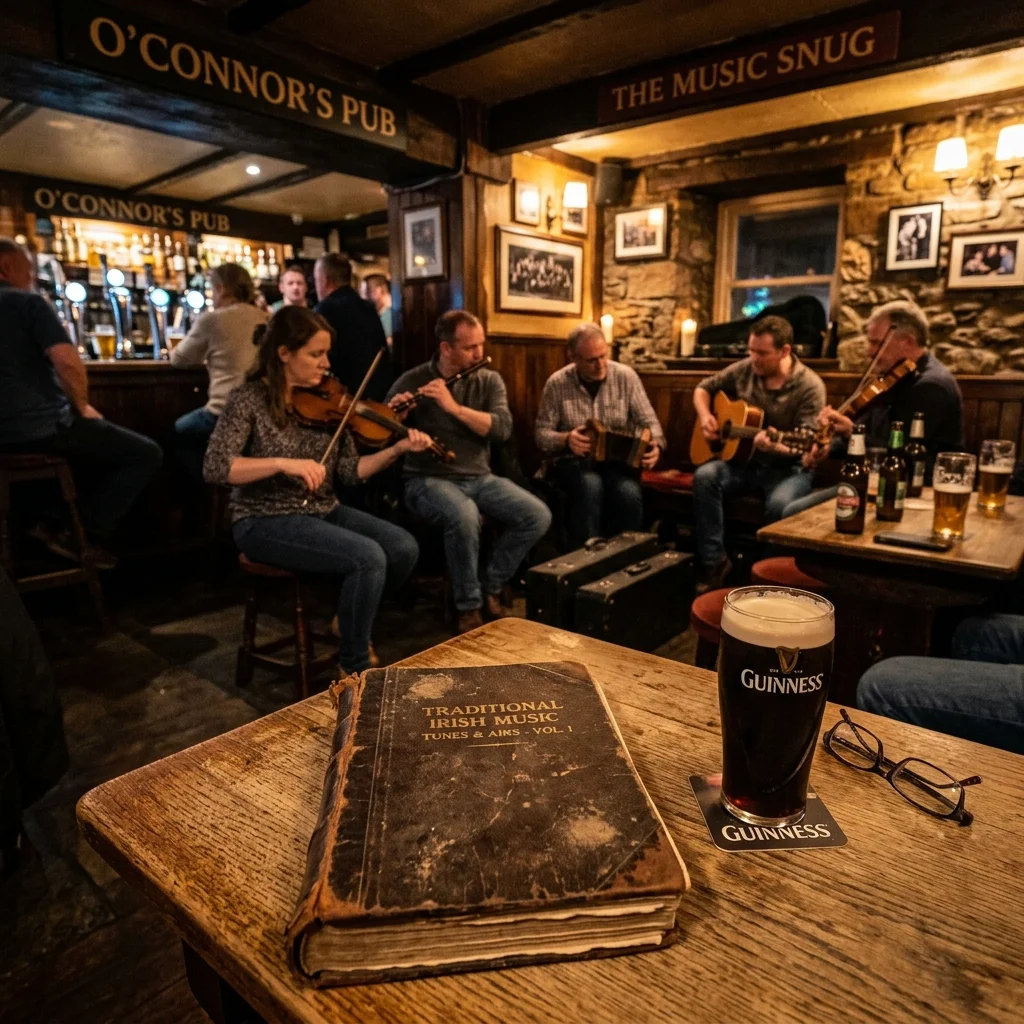
Studio tracks prioritize novelty and individual showmanship, often utilizing complex keys, slow air arrangements, or intricate ornamentation. Sessions, by contrast, rely on a shared vocabulary, comfortable fingerings, and a steady, danceable flow. Tunes with complex keys, irregular phrasing, or multiple parts may be less suitable for group session play.
The database analytics from **Trad Tune Explorer** highlight these gaps, demonstrating which commercial favorites appear in considerably fewer documented session-set appearances than their recording histories would suggest.
Most Recorded... But Rarely Heard
Here are 14 prominent examples of tunes with a large commercial footprint that are rarely heard in session sets.
1. Sliabh Na mBan
G Major (Hornpipe)Sliabh Na mBan has a prominent commercial footprint in traditional Irish music, appearing on 72 commercial recordings by 60 different artists. However, it has a comparatively modest presence in documented session sets, with only 8 appearances.
The data suggest that this discrepancy reflects the tune's primary role as a slow air. In standard group sessions, players typically opt for rhythmic dance tempos (like reels or jigs) over slow, unmetered melodies, which are historically performed as solo pieces.
2. As I Roved Out
G Major (Polka)Popularized by groups like Planxty and The Dubliners, As I Roved Out has accumulated 63 commercial recordings by 51 artists. In contrast, it appears in considerably fewer documented session-set appearances, with only 15 entries.
This may reflect the tune's origin as a song melody. Even though the instrumental phrasing conforms to a polka meter, musicians in casual sessions may prefer dedicated dance tunes that possess more rhythmic drive and ornamentation.
3. Roisin Dubh
G Major (Hornpipe)Roisin Dubh is a cornerstone of the traditional repertoire, with 56 commercial recordings by 41 artists. Yet, it has a comparatively modest presence in documented session sets, with only 16 appearances.
This discrepancy likely arises because the tune is typically performed as a slow air. Slow airs are historically solo, expressive pieces with free-flowing rhythm, which does not translate easily to the steady, collective tempo of a group session.
4. Easter Snow
D Major (Slip Jig)Easter Snow is highly regarded in commercial studio projects, counting 42 recordings by 33 artists. Despite this, it has a comparatively modest presence in documented session sets, with only 12 appearances.
The data suggest that the tune's flowing, air-like qualities may make it less suitable for group session play. Musicians may find it fits solo piping or fiddle performances better than structured, multi-instrument sets.
5. The Cuckoo
G Major (Hornpipe)With 94 recordings by 72 artists, The Cuckoo is a classic showpiece. In documented session sets, however, it appears only 28 times.
One possible explanation is the tune's technical demands, including frequent triplets and descriptive bird-call imitation passages. This level of ornamentation may make it much more prominent on commercial recordings, where solo players can showcase their skills, than in standard group sets.
6. Johnny Cope
B Minor (Polka)Johnny Cope has a long commercial history, with 49 recordings by 44 artists. Yet, it has only 16 appearances in documented session sets.
This may reflect the tune's complex, multi-part structure, often containing up to six distinct parts. Such complexity is often well-suited for studio arrangements or solo exhibitions, but can make coordinating a set in a busy pub session much more difficult.
7. The Banks
F Dorian (Hornpipe)The Banks is a prominent display hornpipe with 66 recordings by 59 artists. In session sets, however, it appears in considerably fewer documented appearances, with only 23 entries.
A possible explanation is the tune's key. Written in F Dorian (often modulating to F major), it requires advanced half-holing on the standard D tin whistle or uilleann pipes, which may deter players in open sessions.
8. My Lagan Love
A Mixolydian (Polka)My Lagan Love has a massive commercial footprint with 52 recordings by 45 artists. However, it shows up in only 19 documented session sets.
The data suggest that this discrepancy is due to the tune's character as a song or slow air. In group sessions, players typically opt for rhythmic dance styles like jigs or reels over slow, unmetered melodies.
9. The Cliff
D Major (Hornpipe)The Cliff has been recorded 64 times by 50 artists, showing its popularity in the studio. In documented session sets, it appears only 24 times.
One possible explanation is the tune's wide melodic range and complex leaps, which are well-suited for solo fiddle or button accordion recordings but present coordination challenges in a crowded group.
10. Colonel Fraser
G Major (Reel)Colonel Fraser is a legendary five-part reel, recorded 123 times by 92 artists. However, it has a comparatively modest presence in documented session sets, with only 49 entries.
This may reflect the reel's length and the technical precision required to execute its key transitions across five parts. It is highly valued as a test of solo piping and fiddle playing, making it much more prominent on commercial recordings.
11. The Garden Of Daisies
D Major (Hornpipe)The Garden Of Daisies is a traditional set dance with 57 recordings by 53 artists. In documented session sets, it appears only 23 times.
This may reflect the irregular, asymmetrical structure characteristic of set dances. Since set dances do not conform to the standard 32-bar structure of typical session tunes, they are more difficult to pair with other hornpipes.
12. President Garfield's
G Major (Hornpipe)President Garfield's has 49 recordings by 43 artists, demonstrating its studio popularity. However, it has only 20 documented session-set appearances.
One possible explanation is the tune's rapid string-crossing patterns and arpeggios. While accordionists and fiddle players enjoy this complexity on solo albums, the tune presents technical hurdles in a casual multi-instrument session.
13. The Blackbird
G Major (Hornpipe)The Blackbird is a classic melody, counting 142 commercial recordings by 118 artists. In documented session sets, it appears in considerably fewer appearances, with only 60 entries.
The data suggest that this reflects its role as a traditional set dance with an irregular 15-bar B-part. This structural asymmetry makes it difficult to blend into standard sets of 32-bar hornpipes.
14. The High Level
G Major (Hornpipe)James Hill's famous hornpipe is highly popular in studios, with 97 recordings by 76 artists. In documented session sets, it has a comparatively modest presence, appearing only 43 times.
This may reflect the key change in the second part to B-flat major. While B-flat works well on fiddle or accordion, it requires difficult half-holing on standard D tin whistles and is nearly impossible on standard pipes, which likely limits its use in group sessions.
What Makes a Good Session Tune?
If you compare these commercial hits with session workhorses like Cooley's Reel, The Maid Behind The Bar, or The Silver Spear, the characteristics of a successful session tune become clear:
- Set Versatility: A good session tune is highly adaptable, meaning it can be paired with many different tunes. It acts as a bridge between different keys rather than being locked into a single set. You can see these hubs in our analysis of Most Versatile Reels and Most Versatile Jigs.
- Ergonomic Fingering: Most session staples are in G, D, E minor, or A Dorian. They avoid difficult key shifts (like modulating to B-flat) or chromatic lines, allowing players to keep their momentum.
- Simple Phrasing: Standard two-part (32-bar) structures are preferred. It is much easier for a group to stay together when the structure is predictable, rather than trying to coordinate a five-part hornpipe like *The Derry* or a six-part jig like *The Frieze Breeches*.
- Broad Familiarity: The best session tunes are the ones most people have in common. A shared repertoire makes it easy for visiting musicians to sit in and play along. You can find these on the Session Staples page.
Recording Fame vs. Session Fame
The table below compares the commercial recording numbers with documented session appearances and recording artists for each of the 14 tunes discussed.
| Tune | Rhythm | Recordings | Session Appearances | Recording Artists | Key/Mode |
|---|---|---|---|---|---|
| Sliabh Na mBan | hornpipe | 72 | 8 | 60 | Gmajor |
| As I Roved Out | polka | 63 | 15 | 51 | Gmajor |
| Easter Snow | slip jig | 42 | 12 | 33 | Dmajor |
| Roisin Dubh | hornpipe | 56 | 16 | 41 | Gmajor |
| Cuckoo, The | hornpipe | 94 | 28 | 72 | Gmajor |
| Johnny Cope | polka | 49 | 16 | 44 | Bminor |
| Banks, The | hornpipe | 66 | 23 | 59 | Fdorian |
| My Lagan Love | polka | 52 | 19 | 45 | Amixolydian |
| Cliff, The | hornpipe | 64 | 24 | 50 | Dmajor |
| Colonel Fraser | reel | 123 | 49 | 92 | Gmajor |
| Garden Of Daisies, The | hornpipe | 57 | 23 | 53 | Dmajor |
| President Garfield's | hornpipe | 49 | 20 | 43 | Gmajor |
| Blackbird, The | hornpipe | 142 | 60 | 118 | Gmajor |
| High Level, The | hornpipe | 97 | 43 | 76 | Gmajor |
Frequently Asked Questions
Why do recording popularity and session popularity differ?
A recording project values novelty, complex arrangements, or vocal backing, while a session relies on common tunes, comfortable fingerings, and a steady tempo that lets everyone participate.
Why does Sliabh Na mBan appear so rarely in session sets?
Sliabh Na mBan has a comparatively modest presence in documented session sets, as it is typically played as a slow air. Because slow airs are historically performed as solo, unmetered pieces, they are less suited for group session playing where dance rhythms are preferred.
Why does The High Level Hornpipe have fewer session appearances than its recording history suggests?
The data suggest that James Hill's hornpipe is much more prominent on commercial recordings than in documented session sets. A possible explanation is the key change to B-flat major, which is awkward on standard D whistles and pipes, making it a popular choice for solo fiddle and accordion albums rather than group sets.
Should I avoid learning these tunes?
No. They are classic pieces. Some just work better for solo practice, small bands, or home recording than in a crowded session.
How can I find tunes that are popular in both worlds?
You can explore our articles on the Most Versatile Reels or Most Recorded Reels. Many melodies, such as *The Maid Behind the Bar* or *The Kesh Jig*, are both heavily recorded and widely played in sessions because they strike a balance between musical interest and playability.
Conclusion & Tune Exploration
Understanding the difference between a recording favorite and a session workhorse is part of finding your feet in the tradition. Looking at the actual data helps us see past the tracklists of famous albums and understand which tunes actually keep a session moving.
If you want to dig deeper into how these tunes connect, you can explore the transition networks and set pairings using the tools below.